Have you ever wondered why some people thrive behind the console while others chase the spotlight?
I’ve seen talented musicians pivot into roles that pay well and last—A&R at Atlantic, engineering at Sunset Sound, licensing for Netflix—because the music industry needs more than performers.
FREE TOOL FOR THIS TOPIC
Music Producer Career Roadmap
Built specifically for readers of Music Producer Career Paths: 12 Roles. Answer four quick questions to receive a focused result immediately—no email required.
Music Producer Career Roadmap
Get a focused 12-month learning and portfolio plan.
Continue building your career
Use another free CareersForge resource to turn this result into your next application, resume or interview step.
Music producer careers connect creativity and commerce: choosing material, shaping arrangements, managing budgets, and guiding mixes so songs reach listeners and earn revenue.



If you’re thinking about becoming a music producer, remember this is one of many music production job opportunities. You can build a career in studio production, scoring for media, live sound, artist management, publishing, or touring.
Breaking in is competitive, but honing your craft, networking, and learning business basics open doors. I’ll share paths I’ve seen work and concrete steps to move from hobbyist to paid professional.
Table of Contents
Table of Contents
Overview of music producer career paths and industry context
The music industry has changed a lot. It used to be all about vinyl studios, but now it’s about cloud collaboration and home setups. Roles like production, engineering, and management are key. They help artists record, promote, and tour, making sure they earn.
Why non-performance music careers matter
Jobs like A&R teams and record engineers are crucial. They help artists grow. Booking agents and tour managers get acts on stage. Music supervisors and publishers place songs in media. Without these roles, music rarely reaches people or makes money.
How versatility increases employment prospects
Being good at both tech and business opens more doors. I’ve seen producers who teach, run session work, and consult on sync deals earn more. Learning about DAWs, signal flow, and royalties helps in getting jobs in studios, labels, and live shows.
Typical income ranges and what influences pay
Income varies based on the job and experience. Studio assistants and live techs start around $25,000. But, experienced producers and managers can make six figures with major labels or TV.
Technology and starting your own business can also boost income. Sync licensing, publishing splits, and remote mixing offer steady income. Mixing these with session work or teaching is key to a successful career in music.
| Role Category | Typical Entry Range | Mid Career | High-End / Examples |
|---|---|---|---|
| Studio production & producing | $25,000–$45,000 | $50,000–$120,000 | Major label projects, sync deals: $100,000–$1,000,000+ |
| Audio engineering & mixing | $25,000–$40,000 | $45,000–$100,000 | Top studio or touring engineer: $80,000–$300,000+ |
| Live production & touring | $28,000–$50,000 | $60,000–$150,000 | Tour manager/FOH for major acts: $100,000–$500,000+ |
| Publishing, licensing, supervision | $30,000–$50,000 | $60,000–$150,000 | Successful supervisors/publishers: $120,000–$400,000+ |
| Artist relations, A&R, management | $25,000–$40,000 | $50,000–$120,000 | High-profile management commissions: six-figure incomes |
Having different income streams makes you more secure. I suggest learning one technical skill, one business skill, and networking a lot. This way, you open up more career paths and ensure steady growth in the music industry.
Music producer and record production roles
I’ve seen artists come to the studio with a song and leave with a new career path. A producer does many things: they guide the creative process, manage the project, and act as a mediator. This makes being a music producer both fulfilling and challenging.
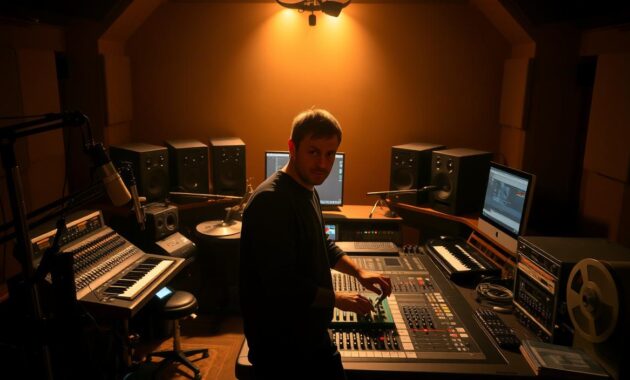
Producers shape the recording session. They pick the best takes, guide the arrangement, set sound goals, and decide when a track is complete. They balance artistic choices with budget and time constraints. I learned early that soft skills are just as important as technical skills.
Role summary and responsibilities
A producer builds relationships with artists and labels, selects music, and creates a space where artists can shine. They work with engineers, adjust arrangements, manage budgets, and influence the final mix. Some producers scout for talent or work with labels, while others run their own production houses.
Skills to learn
- Arranging: turn a basic song into a polished record by shaping structure and instrumentation.
- Engineering basics: understand mic placement, tracking workflows, and DAW session management.
- Budgeting: plan sessions, allocate studio time, and forecast costs to protect profitability.
- Artist relations: manage expectations, give productive feedback, and build trust.
Money and job options
Income comes from freelance fees, production points, royalties, and label salaries. Music production jobs range from freelance work to label jobs and running an indie studio. Earnings vary from about $25,000 for new producers to over $1,000,000 for top producers, based on credits and business model.
| Path | Typical Roles | Primary Income Streams | Estimated Range |
|---|---|---|---|
| Freelance Producer | Project producer, beat maker, remote producer | Session fees, royalties, production points | $25,000 – $200,000 |
| Label-employed Producer | In-house producer, A&R collaborator, staff producer | Salary, project bonuses, label royalties | $40,000 – $300,000 |
| Indie Production House | Studio owner, executive producer, co-producer | Studio rental, production packages, publishing shares | $50,000 – $1,000,000+ |
Music producer career development is rarely straightforward. Formal training helps, but internships, on-the-job learning, and entrepreneurial spirit often lead to the best opportunities. If you’re thinking about becoming a music producer, study the credits of albums you love and read interviews with producers like Rick Rubin or Sylvia Massy to learn real techniques.
There are more music production job opportunities in remote sessions, sync licensing, and specific genres. Build a portfolio, learn to manage people, and protect your business. These steps can help you grow from entry-level to a sustained career in music production.
Audio engineer, mixing, and mastering careers
I’ve seen how a small change in mic choice or workflow can change a whole record. Audio engineering careers cover studio work, live events, and mastering. Each area requires different skills but all value attention to detail and quality.

Studio engineering vs. live sound engineering
Studio engineers work on recording albums, singles, and streaming content. They adjust preamps, place microphones, and guide sessions in controlled environments like Ocean Way or Abbey Road.
Live sound engineers mix shows in clubs, theaters, and stadiums. I’ve mixed for tours and learned to handle acoustic surprises quickly. They need to make fast decisions and know how to use consoles from Allen & Heath to Yamaha.
Technical skills: microphones, compressors, DAWs, signal flow, file management
Knowing your technical skills is key. Learn about mic types, compressor settings, EQ, and gain structure. Practice with Pro Tools, Logic Pro, and Ableton Live until you’re comfortable.
Signal flow and patching are crucial. Understanding track routing, clocking, and backup plans keeps sessions running smoothly. Good file management and organized stems make clients happy and reduce stress.
Need skills for these jobs?
Get certified with our Music Producer Roadmap (100% Free) »Employment prospects and salary ranges ($25,000–$150,000+)
There are many music production jobs like studio engineer, mastering engineer, live sound tech, and studio manager. Starting salaries can be around $25,000, but with experience and clients, you can earn over $100,000.
Music producer jobs get better with training, internships, and networking. Freelancing can be unpredictable, but salaried jobs offer stability. Investing in your skills and building relationships opens up more opportunities.
Composer, film/TV/game scoring, and arranging work
I’ve worked on various projects, showing how diverse composing careers can be. Composers create music for films, TV shows, ads, albums, and games. Each area has its own pace, style, and professional connections.
Different composing markets:
TV composers need quick work and evolving themes. Feature composers focus on long-term development and work closely with directors. Ads require catchy, short pieces with fast approval. Game scoring involves creating music that adapts to the game.
What to learn:
Understanding music theory and orchestration is key. Learn to use tools like Sibelius or Dorico for writing music. Familiarize yourself with DAWs like Logic Pro or Pro Tools for mockups.
Building a large sample library is important. Learn to use Kontakt, EastWest, or Spitfire libraries for realistic sounds. Interactive audio tools like Wwise or FMOD are crucial for game music.
Typical pay structures and example rates:
Composers often work on a project basis. Pay varies based on budget, medium, and experience. TV episodes might pay from $1,500 to $7,500. Features can range from indie budgets to high studio fees. Games offer creative or package fees based on the project’s scope.
Here’s a comparison of typical rates for different projects. This shows how composing careers fit into broader music producer paths and the types of offers you might get.
| Project Type | Typical Range (USD) | Common Payment Model |
|---|---|---|
| 30-min TV episode | $1,500–$7,500+ | Per episode fee; possible residuals |
| 60-min TV episode | $2,000–$15,000+ | Per episode; buyout or backend share |
| TV movie | $2,000–$55,000+ | Flat fee; negotiated rights |
| Indie feature | $2,500–$500,000+ | Project fee; sometimes profit participation |
| Studio feature | $35,000–$2,000,000+ | High-profile composer contracts; backend varies |
| Game score (~30 min) | $30,000–$75,000+ (creative) | Creative or package fee; license terms matter |
| Casual mobile game | $300–$600 per finished minute | Per-minute creative fee; smaller buyouts |
| Student or short film | $0–$10,000+ | Spec or low budget; possible deferred payment |
| Arranging work | $20,000–$43,000+ | Per project or fee-for-service |
Composers can move from sample-based demos to live studio sessions. This mirrors many music producer careers—start small, prove your worth, and grow. Always treat each piece as both a craft and a pitch.
Session musician and studio performer opportunities
I’ve seen musicians turn short gigs into long careers. They play on recordings, live shows, and in house bands. They work in studios, session houses, theaters, and festivals.

Studios often need specific skills. Pop sessions require tight timing, while film sessions need sight-reading. I’ve seen musicians move from TV to touring, and from playing to producing.
What session players do and where they work
They record for artists, play in live bands, and fill TV or theater spots. Work can be one-off or long-term. Famous musicians often start by backing big acts and then go solo.
Key technical and professional skills
Being great at your instrument is key. Sight-reading is crucial for hiring. Improvisation is important when there’s little to follow. Being flexible in style helps you work in different genres.
Networking and career development
Building relationships with producers and engineers is vital. Keep your recordings clean and have a short demo reel. Take lessons, join unions, and attend sessions to learn the ropes.
Earnings, union guidance, and typical rates
Pay varies a lot. Union rates set a minimum for studio work. Rates range from $100 for indie gigs to $2,500 for major sessions. Top players can earn over $100,000 by mixing studio work, touring, and collaborations.
| Work Type | Common Setting | Skills Required | Typical Pay |
|---|---|---|---|
| Studio session | Commercial recording studio, session house | Sight-reading, quick tone matching, click-track skills | $150–$2,500 per day (AFofM minimums apply) |
| Live backing | Concerts, TV shows, club dates | Stamina, charts or memorize parts, in-ear monitor use | $100–$1,000+ per gig; weekly touring income varies |
| House band/residency | TV studios, hotels, theme venues | Consistency, wide repertoire, reliability | Daily or weekly rates; steady work boosts annual income |
| Orchestral/film session | Scoring stages, orchestral pits | Notation reading, ensemble blend, sight-reading speed | Union scale per call; higher for featured solos |
Session work is great for exploring music production. I advise tracking bookings and invoicing quickly. This helps build a stable career in the music industry.
Artist management, A&R, and talent development careers
I’ve seen careers soar when a manager, label rep, or developer offers a clear plan and support. Artist managers open doors, handle negotiations, and shape long-term strategy. A&R teams scout talent, pick songs, and guide repertoire. Talent development ties those roles together by building the artist’s brand, skills, and market fit.
Artist manager responsibilities
Managers create opportunities and connect artists with promoters, publishers, and agents. They plan releases, manage budgets, and negotiate deals. Most take a commission, commonly between 10% and 50% of artist earnings. Pay varies widely: developing acts might generate manager incomes from about $30,000 to $200,000 a year. Major clients can push manager pay into the millions. Leadership, negotiation, organization, and a strong grasp of the music business are essential.
A&R roles inside labels
A&R work ranges from clerical tasks to strategic signings. Entry positions include A&R administrator, handling paperwork and metadata. Field reps focus on scouting and first contacts. A&R managers lead negotiations and repertoire decisions. Directors oversee the department and larger signings. Administrative experience and internships help you get a foot in the door.
How to build these careers
I recommend internships at labels and management firms to learn processes and make contacts. Study contract basics, royalties, and digital marketing. Practical experience in promotion, playlist pitching, and artist relations matters more than a diploma in many cases. Networking at shows, conferences, and on platforms like LinkedIn and Twitter yields real leads.
Below is a compact comparison to help you choose a starting point and set expectations across common roles.
| Role | Primary Focus | Typical Entry Path | Early Income Range |
|---|---|---|---|
| Artist Manager | Career strategy, deals, partnerships | Assistant roles, small-firm internships, self-management | $30,000–$200,000 |
| A&R Representative | Scouting, fieldwork, early development | Label internships, freelance scouting, local scene work | $35,000–$120,000 |
| A&R Administrator | Metadata, licensing paperwork, admin support | Office assistant, label admin internships | $30,000–$60,000 |
| A&R Manager / Director | Negotiation, signing, department leadership | Years in A&R roles, proven signings, network growth | $80,000–$300,000+ |
| Talent Development Specialist | Artist branding, training, repertoire coaching | Management support roles, production or marketing experience | $40,000–$150,000 |
For anyone focused on music producer career development, moving into management or A&R deepens your industry view. Producing gives you relationships and a curriculum vitae that impresses managers and labels. I’ve found that blending production skills with business know-how creates the most durable career paths.
Tour management, live production, and booking roles
I’ve spent years on tour and behind the scenes. I’ve seen how logistics, timing, and relationships shape careers in live music. These roles blend art and operation, offering clear paths from entry-level to high-earning positions.
Tour manager and road crew responsibilities and pay
Tour managers handle everything from transportation to finances for bands on the road. They solve problems quickly and manage budgets. Road crew and techs build stages and run soundchecks. Pay varies, with experienced tour managers earning up to $10,000 a week.
Booking agent and promoter duties
Booking agents find venues and negotiate deals. They work with managers and promoters to match artists with the right stages. Agents earn 10–20% of gross per show. Promoters handle contracts, marketing, and ticketing risk, earning six-figure incomes at higher levels.
Live production skills and festival/theater pathways
Live production jobs include stage managers and lighting techs. The job requires technical knowledge and soft skills. Experience in festivals, theaters, and clubs can lead to bigger tours and more job opportunities.
How to move up
- Start on local gigs to learn setup, load-in, and safety protocols.
- Seek mentorship from experienced tour managers and production leads.
- Document logistics and budgets to show you can handle bigger responsibilities.
These paths offer durable work options. For stable income and growth, combine touring experience with networking and financial tracking. This approach opens doors to various music production jobs.
Music business support careers: publishing, licensing, royalties, and legal/financial roles
I’ve seen careers in music become more stable with the right support team. These careers are behind the scenes, making sure songs make money, protecting rights, and keeping artists financially sound. They need attention to detail, persistence, and a knack for contracts, just as much as a love for music.
Music publishers handle copyrights, pitch songs for use in films, TV, ads, and music, and collect fees. Music supervisors pick and license songs for media, making sure they fit the project and are affordable. Song pluggers connect songs with artists and labels, aiming to get them recorded or used in projects.
Royalty coordinators check statements, make sure payments are correct, and sort out splits so everyone gets paid right. Entertainment accountants manage finances, taxes, and cash flow for artists; many aim to become CPAs. Business managers handle budgets, investments, and long-term financial plans for artists and managers.
Here’s what I recommend studying if you want to join this world:
- Copyright law and music licensing basics.
- Accounting and taxes for artists.
- Music business degrees, paralegal certificates, or CPA prep for credentialed roles.
Expect steady, salaried jobs at labels, publishers, or streaming platforms, or contract work with independent artists and production houses. Starting roles like royalty coordinator or sync coordinator can lead to higher-paying jobs like publisher, music supervisor, or business manager.
For those considering options, music publishing and licensing careers offer stable income, unlike many creative jobs. They also help music producers by combining production skills with knowledge of rights and revenue. I’ve seen producers increase their value by understanding publishing and licensing as much as they do production and mix decisions.
Curious about the money? Check out our detailed report on Music Producer Salaries & Earnings in the US (2026 Data).
Explore Berklee’s overview of the music producer role and common ways producers build experience. Berklee’s overview of the music producer role.
Conclusion
I’ve seen how the music industry values those who treat their work as a craft and a business. There are many career paths for music producers, like studio work, engineering, and composing. Roles also include live performances, management, publishing, and support.
Being versatile is key. It means having technical skills, networking well, and finding different ways to make money. This approach can turn short-term jobs into long-term opportunities.
Getting started is important. Look for internships, do administrative work, or offer services like mixing. Teaching can also help build skills and connections. While a music degree is helpful, real-world experience and being entrepreneurial can move your career forward.
Building a portfolio that shows your skills and adaptability is crucial. Think of your career as a series of experiments. Learn about audio tools, business, and copyright laws.
Use research, interviews, and hands-on experience to guide your path. This approach will help you grow in the music industry and have a fulfilling career.
FAQ
What non-performance career paths exist for someone who wants to work in music but not be a touring artist?
Why do non-performance music careers matter in the industry?
How does versatility affect my employment prospects in music production careers?
What income ranges can I expect across music producer career paths?
What non-performance career paths exist for someone who wants to work in music but not be a touring artist?
Why do non-performance music careers matter in the industry?
How does versatility affect my employment prospects in music production careers?
What income ranges can I expect across music producer career paths?
FAQ
What non-performance career paths exist for someone who wants to work in music but not be a touring artist?
There are many roles beyond performing. You can work in record production, audio engineering, or composing for film and TV. Other options include session musicians, artist management, and A&R. You can also work in tour management, booking, and promotion, music publishing, and more.
These jobs let you stay in music and build networks. You can combine income streams like teaching, session work, and production. This way, you can make a stable living.
Why do non-performance music careers matter in the industry?
Non-performance roles are crucial for making music possible. Producers and engineers shape sound and help artists grow. Managers, A&R, promoters, and publishers create opportunities and revenue.
Without this ecosystem, artists can’t record, distribute, or monetize their work. These careers offer more predictable income and a longer career span for many.
How does versatility affect my employment prospects in music production careers?
Versatility greatly increases your employability. Combining technical skills with business knowledge and soft skills opens more doors. Many professionals mix roles like teaching, producing, and session playing.
This diversifies income and grows connections for bigger projects. It’s a way to build a strong career in music.
What income ranges can I expect across music producer career paths?
Pay varies widely by role, client scale, reputation, and location. Producers can earn roughly ,000–
FAQ
What non-performance career paths exist for someone who wants to work in music but not be a touring artist?
There are many roles beyond performing. You can work in record production, audio engineering, or composing for film and TV. Other options include session musicians, artist management, and A&R. You can also work in tour management, booking, and promotion, music publishing, and more.
These jobs let you stay in music and build networks. You can combine income streams like teaching, session work, and production. This way, you can make a stable living.
Why do non-performance music careers matter in the industry?
Non-performance roles are crucial for making music possible. Producers and engineers shape sound and help artists grow. Managers, A&R, promoters, and publishers create opportunities and revenue.
Without this ecosystem, artists can’t record, distribute, or monetize their work. These careers offer more predictable income and a longer career span for many.
How does versatility affect my employment prospects in music production careers?
Versatility greatly increases your employability. Combining technical skills with business knowledge and soft skills opens more doors. Many professionals mix roles like teaching, producing, and session playing.
This diversifies income and grows connections for bigger projects. It’s a way to build a strong career in music.
What income ranges can I expect across music producer career paths?
Pay varies widely by role, client scale, reputation, and location. Producers can earn roughly $25,000–$1,000,000+. Engineers make $25,000–$150,000+.
Session fees range from $100–$2,500+ per day. Composers earn $1,500–$2,000,000+ for different projects. Treat these as context—individual outcomes depend on experience, market, and hustle.
What does a music producer actually do day to day?
A producer bridges creative and commercial needs. They select material, shape arrangements, and coach artists. They choose engineers and session players, set sonic goals, and manage budgets and schedules.
Producers often act as project managers and artistic directors. They realize a record or a session’s vision.
Which skills should I learn to become a successful producer?
Focus on arranging, basic engineering and mixing, and DAW proficiency. Learn budgeting and scheduling, and develop strong people skills. Study credits on records you admire and read interviews with producers.
Internships and real sessions teach practical decision-making and studio etiquette. These skills matter most.
What job models exist for producers and how do they make money?
Producers work freelance, as label staff, or run indie production houses. They earn upfront fees, production points, mixing fees, and placement royalties. Many combine producing with mixing, session work, teaching, or running a studio.
Earnings range from modest early-career fees to seven-figure revenue for top producers.
How do studio engineering and live sound differ?
Studio engineers focus on recording, editing, mixing, and mastering in controlled spaces. Live sound engineers manage mixes in variable venues, requiring on-the-fly problem solving. Both need strong technical knowledge but apply it differently.
What technical skills are essential for audio engineering careers?
Core skills include microphone selection and placement, signal flow, and DAW operation. You also need editing and mixing techniques, file management, and troubleshooting. For live roles, learn console workflow and PA systems.
Formal training helps, but internships and practical session experience are invaluable.
What do composers for film, TV, and games need to learn?
Composers must master music theory, orchestration, and arranging. They need to know notation software, sample libraries, and DAW scoring tools. Understanding temp tracks, spotting sessions, and how music supervisors and publishers place music is crucial.
Networking with directors, game developers, and music supervisors is key for placements.
How are composers paid for different types of projects?
Payment models vary by medium and scale. Typical ranges include modest fees for student films, $1,500–$15,000+ for TV episodes, and $2,500–$500,000+ for indie features. Studio features can pay $35,000–$2,000,000+.
Games often pay $30,000–$75,000+ for 30 minutes of music. Composers also earn performance and publishing royalties when applicable.
What does session work look like and where does it pay well?
Session musicians perform on recordings or live gigs for other artists. High-demand session work requires sight-reading, stylistic adaptability, and professionalism. Pay can range from standard AFofM rates to $100–$2,500+ per day for top players.
Long-term top session musicians can build six-figure annual incomes through consistent bookings and high-profile projects.
What skills make a session musician marketable?
Master your instrument, read charts, improvise, and switch styles quickly. Be punctual, prepared, and easy to work with. Build relationships with producers, engineers, and studios.
Join AFofM where relevant to access standard rates and union jobs that pay better and offer protections.
What do artist managers and A&R pros actually do?
Artist managers guide careers—finding opportunities, negotiating deals, coordinating teams, and often taking 10–50% commission. A&R professionals scout talent, develop repertoire, and shepherd artists through label processes. Entry-level A&R roles can be administrative, while senior roles focus on strategy and signing acts.
Both rely on deep industry networks and business savvy.
How can I start a career in management or A&R?
Start with internships at labels, management firms, or publishing houses. Gain experience in marketing, contract basics, and artist relations. Work in promotion, publicity, or label admin to build credibility.
Networking, hands-on experience with artist campaigns, and a good track record of identifying and developing talent matter more than formal credentials alone.
What do tour managers and booking agents earn, and what do those jobs require?
Tour managers organize logistics—travel, accommodations, rider fulfillment, and tour finances. Theater/arena-level touring can pay $2,500–$10,000 per week. Booking agents secure gigs and negotiate fees, typically earning 10–20% commission per show.
Both require logistics skills, contract knowledge, calm under pressure, and strong industry contacts.
How do I get into live production or festival touring?
Entry often comes via road crew or venue tech roles, then moving to stage management, FOH mixing, or event production. Internships with promoters, volunteering at festivals, and apprenticeship with production companies help. Strong technical competence, vendor relationships, and a reputation for reliability create advancement opportunities.
What roles exist in publishing, licensing, and royalty administration?
Music publishers manage song copyrights and seek placements. Music supervisors select and license songs for media. Song pluggers pitch works to artists and media. Royalty coordinators and administrators track income and clearances.
Entertainment accountants and business managers handle money, taxes, and investments for artists. These roles often deliver steadier income than freelance creative work.
What should I study or train in for legal and financial music careers?
Study copyright law, licensing, music business, accounting, and contract negotiation. Degrees or certifications in music business, law (J.D.), or accounting (CPA) add credibility. Practical experience at publishing houses, rights organizations, or accounting firms serving entertainment clients accelerates career growth.
How important are internships and real-world experience for music industry career development?
Critical. Internships and entry-level administrative roles give access to real projects, credit lines, and industry relationships. On-the-job learning often trumps classroom knowledge in production or A&R. I’ve seen careers accelerate when people combined internships with entrepreneurial projects—running sessions, scoring indie films, or assisting tours—so they built practical portfolios.
Can a music degree lead to stable careers, or is entrepreneurship required?
A music degree opens doors—technical training, theory, and industry context—but real stability often comes from entrepreneurial skill, tech fluency, and multiple income streams. Many professionals mix salaried roles (label admin, publishing, accounting) with freelance creative work. Learning business fundamentals and modern tools (aggregation, sync pitching, DAWs) improves outcomes.
What practical first steps do you recommend for someone pursuing music producer careers?
Hone craft: practice arranging, mixing, and DAW workflow. Get internships in studios or labels. Build a portfolio of produced tracks and credits. Network deliberately—assist engineers, attend sessions, and support local artists.
Diversify income: teach, do session work, or offer mixing services. Stay curious about new tech and licensing opportunities. I’ve found that steady, small wins and relationships compound into larger career breaks.
,000,000+. Engineers make ,000–0,000+.
Session fees range from 0–,500+ per day. Composers earn
FAQ
What non-performance career paths exist for someone who wants to work in music but not be a touring artist?
There are many roles beyond performing. You can work in record production, audio engineering, or composing for film and TV. Other options include session musicians, artist management, and A&R. You can also work in tour management, booking, and promotion, music publishing, and more.
These jobs let you stay in music and build networks. You can combine income streams like teaching, session work, and production. This way, you can make a stable living.
Why do non-performance music careers matter in the industry?
Non-performance roles are crucial for making music possible. Producers and engineers shape sound and help artists grow. Managers, A&R, promoters, and publishers create opportunities and revenue.
Without this ecosystem, artists can’t record, distribute, or monetize their work. These careers offer more predictable income and a longer career span for many.
How does versatility affect my employment prospects in music production careers?
Versatility greatly increases your employability. Combining technical skills with business knowledge and soft skills opens more doors. Many professionals mix roles like teaching, producing, and session playing.
This diversifies income and grows connections for bigger projects. It’s a way to build a strong career in music.
What income ranges can I expect across music producer career paths?
Pay varies widely by role, client scale, reputation, and location. Producers can earn roughly $25,000–$1,000,000+. Engineers make $25,000–$150,000+.
Session fees range from $100–$2,500+ per day. Composers earn $1,500–$2,000,000+ for different projects. Treat these as context—individual outcomes depend on experience, market, and hustle.
What does a music producer actually do day to day?
A producer bridges creative and commercial needs. They select material, shape arrangements, and coach artists. They choose engineers and session players, set sonic goals, and manage budgets and schedules.
Producers often act as project managers and artistic directors. They realize a record or a session’s vision.
Which skills should I learn to become a successful producer?
Focus on arranging, basic engineering and mixing, and DAW proficiency. Learn budgeting and scheduling, and develop strong people skills. Study credits on records you admire and read interviews with producers.
Internships and real sessions teach practical decision-making and studio etiquette. These skills matter most.
What job models exist for producers and how do they make money?
Producers work freelance, as label staff, or run indie production houses. They earn upfront fees, production points, mixing fees, and placement royalties. Many combine producing with mixing, session work, teaching, or running a studio.
Earnings range from modest early-career fees to seven-figure revenue for top producers.
How do studio engineering and live sound differ?
Studio engineers focus on recording, editing, mixing, and mastering in controlled spaces. Live sound engineers manage mixes in variable venues, requiring on-the-fly problem solving. Both need strong technical knowledge but apply it differently.
What technical skills are essential for audio engineering careers?
Core skills include microphone selection and placement, signal flow, and DAW operation. You also need editing and mixing techniques, file management, and troubleshooting. For live roles, learn console workflow and PA systems.
Formal training helps, but internships and practical session experience are invaluable.
What do composers for film, TV, and games need to learn?
Composers must master music theory, orchestration, and arranging. They need to know notation software, sample libraries, and DAW scoring tools. Understanding temp tracks, spotting sessions, and how music supervisors and publishers place music is crucial.
Networking with directors, game developers, and music supervisors is key for placements.
How are composers paid for different types of projects?
Payment models vary by medium and scale. Typical ranges include modest fees for student films, $1,500–$15,000+ for TV episodes, and $2,500–$500,000+ for indie features. Studio features can pay $35,000–$2,000,000+.
Games often pay $30,000–$75,000+ for 30 minutes of music. Composers also earn performance and publishing royalties when applicable.
What does session work look like and where does it pay well?
Session musicians perform on recordings or live gigs for other artists. High-demand session work requires sight-reading, stylistic adaptability, and professionalism. Pay can range from standard AFofM rates to $100–$2,500+ per day for top players.
Long-term top session musicians can build six-figure annual incomes through consistent bookings and high-profile projects.
What skills make a session musician marketable?
Master your instrument, read charts, improvise, and switch styles quickly. Be punctual, prepared, and easy to work with. Build relationships with producers, engineers, and studios.
Join AFofM where relevant to access standard rates and union jobs that pay better and offer protections.
What do artist managers and A&R pros actually do?
Artist managers guide careers—finding opportunities, negotiating deals, coordinating teams, and often taking 10–50% commission. A&R professionals scout talent, develop repertoire, and shepherd artists through label processes. Entry-level A&R roles can be administrative, while senior roles focus on strategy and signing acts.
Both rely on deep industry networks and business savvy.
How can I start a career in management or A&R?
Start with internships at labels, management firms, or publishing houses. Gain experience in marketing, contract basics, and artist relations. Work in promotion, publicity, or label admin to build credibility.
Networking, hands-on experience with artist campaigns, and a good track record of identifying and developing talent matter more than formal credentials alone.
What do tour managers and booking agents earn, and what do those jobs require?
Tour managers organize logistics—travel, accommodations, rider fulfillment, and tour finances. Theater/arena-level touring can pay $2,500–$10,000 per week. Booking agents secure gigs and negotiate fees, typically earning 10–20% commission per show.
Both require logistics skills, contract knowledge, calm under pressure, and strong industry contacts.
How do I get into live production or festival touring?
Entry often comes via road crew or venue tech roles, then moving to stage management, FOH mixing, or event production. Internships with promoters, volunteering at festivals, and apprenticeship with production companies help. Strong technical competence, vendor relationships, and a reputation for reliability create advancement opportunities.
What roles exist in publishing, licensing, and royalty administration?
Music publishers manage song copyrights and seek placements. Music supervisors select and license songs for media. Song pluggers pitch works to artists and media. Royalty coordinators and administrators track income and clearances.
Entertainment accountants and business managers handle money, taxes, and investments for artists. These roles often deliver steadier income than freelance creative work.
What should I study or train in for legal and financial music careers?
Study copyright law, licensing, music business, accounting, and contract negotiation. Degrees or certifications in music business, law (J.D.), or accounting (CPA) add credibility. Practical experience at publishing houses, rights organizations, or accounting firms serving entertainment clients accelerates career growth.
How important are internships and real-world experience for music industry career development?
Critical. Internships and entry-level administrative roles give access to real projects, credit lines, and industry relationships. On-the-job learning often trumps classroom knowledge in production or A&R. I’ve seen careers accelerate when people combined internships with entrepreneurial projects—running sessions, scoring indie films, or assisting tours—so they built practical portfolios.
Can a music degree lead to stable careers, or is entrepreneurship required?
A music degree opens doors—technical training, theory, and industry context—but real stability often comes from entrepreneurial skill, tech fluency, and multiple income streams. Many professionals mix salaried roles (label admin, publishing, accounting) with freelance creative work. Learning business fundamentals and modern tools (aggregation, sync pitching, DAWs) improves outcomes.
What practical first steps do you recommend for someone pursuing music producer careers?
Hone craft: practice arranging, mixing, and DAW workflow. Get internships in studios or labels. Build a portfolio of produced tracks and credits. Network deliberately—assist engineers, attend sessions, and support local artists.
Diversify income: teach, do session work, or offer mixing services. Stay curious about new tech and licensing opportunities. I’ve found that steady, small wins and relationships compound into larger career breaks.
,500–,000,000+ for different projects. Treat these as context—individual outcomes depend on experience, market, and hustle.
What does a music producer actually do day to day?
A producer bridges creative and commercial needs. They select material, shape arrangements, and coach artists. They choose engineers and session players, set sonic goals, and manage budgets and schedules.
Producers often act as project managers and artistic directors. They realize a record or a session’s vision.
Which skills should I learn to become a successful producer?
Focus on arranging, basic engineering and mixing, and DAW proficiency. Learn budgeting and scheduling, and develop strong people skills. Study credits on records you admire and read interviews with producers.
Internships and real sessions teach practical decision-making and studio etiquette. These skills matter most.
What job models exist for producers and how do they make money?
Producers work freelance, as label staff, or run indie production houses. They earn upfront fees, production points, mixing fees, and placement royalties. Many combine producing with mixing, session work, teaching, or running a studio.
Earnings range from modest early-career fees to seven-figure revenue for top producers.
How do studio engineering and live sound differ?
Studio engineers focus on recording, editing, mixing, and mastering in controlled spaces. Live sound engineers manage mixes in variable venues, requiring on-the-fly problem solving. Both need strong technical knowledge but apply it differently.
What technical skills are essential for audio engineering careers?
Core skills include microphone selection and placement, signal flow, and DAW operation. You also need editing and mixing techniques, file management, and troubleshooting. For live roles, learn console workflow and PA systems.
Formal training helps, but internships and practical session experience are invaluable.
What do composers for film, TV, and games need to learn?
Composers must master music theory, orchestration, and arranging. They need to know notation software, sample libraries, and DAW scoring tools. Understanding temp tracks, spotting sessions, and how music supervisors and publishers place music is crucial.
Networking with directors, game developers, and music supervisors is key for placements.
How are composers paid for different types of projects?
Payment models vary by medium and scale. Typical ranges include modest fees for student films,
FAQ
What non-performance career paths exist for someone who wants to work in music but not be a touring artist?
There are many roles beyond performing. You can work in record production, audio engineering, or composing for film and TV. Other options include session musicians, artist management, and A&R. You can also work in tour management, booking, and promotion, music publishing, and more.
These jobs let you stay in music and build networks. You can combine income streams like teaching, session work, and production. This way, you can make a stable living.
Why do non-performance music careers matter in the industry?
Non-performance roles are crucial for making music possible. Producers and engineers shape sound and help artists grow. Managers, A&R, promoters, and publishers create opportunities and revenue.
Without this ecosystem, artists can’t record, distribute, or monetize their work. These careers offer more predictable income and a longer career span for many.
How does versatility affect my employment prospects in music production careers?
Versatility greatly increases your employability. Combining technical skills with business knowledge and soft skills opens more doors. Many professionals mix roles like teaching, producing, and session playing.
This diversifies income and grows connections for bigger projects. It’s a way to build a strong career in music.
What income ranges can I expect across music producer career paths?
Pay varies widely by role, client scale, reputation, and location. Producers can earn roughly $25,000–$1,000,000+. Engineers make $25,000–$150,000+.
Session fees range from $100–$2,500+ per day. Composers earn $1,500–$2,000,000+ for different projects. Treat these as context—individual outcomes depend on experience, market, and hustle.
What does a music producer actually do day to day?
A producer bridges creative and commercial needs. They select material, shape arrangements, and coach artists. They choose engineers and session players, set sonic goals, and manage budgets and schedules.
Producers often act as project managers and artistic directors. They realize a record or a session’s vision.
Which skills should I learn to become a successful producer?
Focus on arranging, basic engineering and mixing, and DAW proficiency. Learn budgeting and scheduling, and develop strong people skills. Study credits on records you admire and read interviews with producers.
Internships and real sessions teach practical decision-making and studio etiquette. These skills matter most.
What job models exist for producers and how do they make money?
Producers work freelance, as label staff, or run indie production houses. They earn upfront fees, production points, mixing fees, and placement royalties. Many combine producing with mixing, session work, teaching, or running a studio.
Earnings range from modest early-career fees to seven-figure revenue for top producers.
How do studio engineering and live sound differ?
Studio engineers focus on recording, editing, mixing, and mastering in controlled spaces. Live sound engineers manage mixes in variable venues, requiring on-the-fly problem solving. Both need strong technical knowledge but apply it differently.
What technical skills are essential for audio engineering careers?
Core skills include microphone selection and placement, signal flow, and DAW operation. You also need editing and mixing techniques, file management, and troubleshooting. For live roles, learn console workflow and PA systems.
Formal training helps, but internships and practical session experience are invaluable.
What do composers for film, TV, and games need to learn?
Composers must master music theory, orchestration, and arranging. They need to know notation software, sample libraries, and DAW scoring tools. Understanding temp tracks, spotting sessions, and how music supervisors and publishers place music is crucial.
Networking with directors, game developers, and music supervisors is key for placements.
How are composers paid for different types of projects?
Payment models vary by medium and scale. Typical ranges include modest fees for student films, $1,500–$15,000+ for TV episodes, and $2,500–$500,000+ for indie features. Studio features can pay $35,000–$2,000,000+.
Games often pay $30,000–$75,000+ for 30 minutes of music. Composers also earn performance and publishing royalties when applicable.
What does session work look like and where does it pay well?
Session musicians perform on recordings or live gigs for other artists. High-demand session work requires sight-reading, stylistic adaptability, and professionalism. Pay can range from standard AFofM rates to $100–$2,500+ per day for top players.
Long-term top session musicians can build six-figure annual incomes through consistent bookings and high-profile projects.
What skills make a session musician marketable?
Master your instrument, read charts, improvise, and switch styles quickly. Be punctual, prepared, and easy to work with. Build relationships with producers, engineers, and studios.
Join AFofM where relevant to access standard rates and union jobs that pay better and offer protections.
What do artist managers and A&R pros actually do?
Artist managers guide careers—finding opportunities, negotiating deals, coordinating teams, and often taking 10–50% commission. A&R professionals scout talent, develop repertoire, and shepherd artists through label processes. Entry-level A&R roles can be administrative, while senior roles focus on strategy and signing acts.
Both rely on deep industry networks and business savvy.
How can I start a career in management or A&R?
Start with internships at labels, management firms, or publishing houses. Gain experience in marketing, contract basics, and artist relations. Work in promotion, publicity, or label admin to build credibility.
Networking, hands-on experience with artist campaigns, and a good track record of identifying and developing talent matter more than formal credentials alone.
What do tour managers and booking agents earn, and what do those jobs require?
Tour managers organize logistics—travel, accommodations, rider fulfillment, and tour finances. Theater/arena-level touring can pay $2,500–$10,000 per week. Booking agents secure gigs and negotiate fees, typically earning 10–20% commission per show.
Both require logistics skills, contract knowledge, calm under pressure, and strong industry contacts.
How do I get into live production or festival touring?
Entry often comes via road crew or venue tech roles, then moving to stage management, FOH mixing, or event production. Internships with promoters, volunteering at festivals, and apprenticeship with production companies help. Strong technical competence, vendor relationships, and a reputation for reliability create advancement opportunities.
What roles exist in publishing, licensing, and royalty administration?
Music publishers manage song copyrights and seek placements. Music supervisors select and license songs for media. Song pluggers pitch works to artists and media. Royalty coordinators and administrators track income and clearances.
Entertainment accountants and business managers handle money, taxes, and investments for artists. These roles often deliver steadier income than freelance creative work.
What should I study or train in for legal and financial music careers?
Study copyright law, licensing, music business, accounting, and contract negotiation. Degrees or certifications in music business, law (J.D.), or accounting (CPA) add credibility. Practical experience at publishing houses, rights organizations, or accounting firms serving entertainment clients accelerates career growth.
How important are internships and real-world experience for music industry career development?
Critical. Internships and entry-level administrative roles give access to real projects, credit lines, and industry relationships. On-the-job learning often trumps classroom knowledge in production or A&R. I’ve seen careers accelerate when people combined internships with entrepreneurial projects—running sessions, scoring indie films, or assisting tours—so they built practical portfolios.
Can a music degree lead to stable careers, or is entrepreneurship required?
A music degree opens doors—technical training, theory, and industry context—but real stability often comes from entrepreneurial skill, tech fluency, and multiple income streams. Many professionals mix salaried roles (label admin, publishing, accounting) with freelance creative work. Learning business fundamentals and modern tools (aggregation, sync pitching, DAWs) improves outcomes.
What practical first steps do you recommend for someone pursuing music producer careers?
Hone craft: practice arranging, mixing, and DAW workflow. Get internships in studios or labels. Build a portfolio of produced tracks and credits. Network deliberately—assist engineers, attend sessions, and support local artists.
Diversify income: teach, do session work, or offer mixing services. Stay curious about new tech and licensing opportunities. I’ve found that steady, small wins and relationships compound into larger career breaks.
,500–,000+ for TV episodes, and ,500–0,000+ for indie features. Studio features can pay ,000–,000,000+.
Games often pay ,000–,000+ for 30 minutes of music. Composers also earn performance and publishing royalties when applicable.
What does session work look like and where does it pay well?
Session musicians perform on recordings or live gigs for other artists. High-demand session work requires sight-reading, stylistic adaptability, and professionalism. Pay can range from standard AFofM rates to 0–,500+ per day for top players.
Long-term top session musicians can build six-figure annual incomes through consistent bookings and high-profile projects.
What skills make a session musician marketable?
Master your instrument, read charts, improvise, and switch styles quickly. Be punctual, prepared, and easy to work with. Build relationships with producers, engineers, and studios.
Join AFofM where relevant to access standard rates and union jobs that pay better and offer protections.
What do artist managers and A&R pros actually do?
Artist managers guide careers—finding opportunities, negotiating deals, coordinating teams, and often taking 10–50% commission. A&R professionals scout talent, develop repertoire, and shepherd artists through label processes. Entry-level A&R roles can be administrative, while senior roles focus on strategy and signing acts.
Both rely on deep industry networks and business savvy.
How can I start a career in management or A&R?
Start with internships at labels, management firms, or publishing houses. Gain experience in marketing, contract basics, and artist relations. Work in promotion, publicity, or label admin to build credibility.
Networking, hands-on experience with artist campaigns, and a good track record of identifying and developing talent matter more than formal credentials alone.
What do tour managers and booking agents earn, and what do those jobs require?
Tour managers organize logistics—travel, accommodations, rider fulfillment, and tour finances. Theater/arena-level touring can pay ,500–,000 per week. Booking agents secure gigs and negotiate fees, typically earning 10–20% commission per show.
Both require logistics skills, contract knowledge, calm under pressure, and strong industry contacts.
How do I get into live production or festival touring?
Entry often comes via road crew or venue tech roles, then moving to stage management, FOH mixing, or event production. Internships with promoters, volunteering at festivals, and apprenticeship with production companies help. Strong technical competence, vendor relationships, and a reputation for reliability create advancement opportunities.
What roles exist in publishing, licensing, and royalty administration?
Music publishers manage song copyrights and seek placements. Music supervisors select and license songs for media. Song pluggers pitch works to artists and media. Royalty coordinators and administrators track income and clearances.
Entertainment accountants and business managers handle money, taxes, and investments for artists. These roles often deliver steadier income than freelance creative work.
What should I study or train in for legal and financial music careers?
Study copyright law, licensing, music business, accounting, and contract negotiation. Degrees or certifications in music business, law (J.D.), or accounting (CPA) add credibility. Practical experience at publishing houses, rights organizations, or accounting firms serving entertainment clients accelerates career growth.
How important are internships and real-world experience for music industry career development?
Critical. Internships and entry-level administrative roles give access to real projects, credit lines, and industry relationships. On-the-job learning often trumps classroom knowledge in production or A&R. I’ve seen careers accelerate when people combined internships with entrepreneurial projects—running sessions, scoring indie films, or assisting tours—so they built practical portfolios.
Can a music degree lead to stable careers, or is entrepreneurship required?
A music degree opens doors—technical training, theory, and industry context—but real stability often comes from entrepreneurial skill, tech fluency, and multiple income streams. Many professionals mix salaried roles (label admin, publishing, accounting) with freelance creative work. Learning business fundamentals and modern tools (aggregation, sync pitching, DAWs) improves outcomes.
What practical first steps do you recommend for someone pursuing music producer careers?
Hone craft: practice arranging, mixing, and DAW workflow. Get internships in studios or labels. Build a portfolio of produced tracks and credits. Network deliberately—assist engineers, attend sessions, and support local artists.
Diversify income: teach, do session work, or offer mixing services. Stay curious about new tech and licensing opportunities. I’ve found that steady, small wins and relationships compound into larger career breaks.
FAQ
What non-performance career paths exist for someone who wants to work in music but not be a touring artist?
There are many roles beyond performing. You can work in record production, audio engineering, or composing for film and TV. Other options include session musicians, artist management, and A&R. You can also work in tour management, booking, and promotion, music publishing, and more.
These jobs let you stay in music and build networks. You can combine income streams like teaching, session work, and production. This way, you can make a stable living.
Why do non-performance music careers matter in the industry?
Non-performance roles are crucial for making music possible. Producers and engineers shape sound and help artists grow. Managers, A&R, promoters, and publishers create opportunities and revenue.
Without this ecosystem, artists can’t record, distribute, or monetize their work. These careers offer more predictable income and a longer career span for many.
How does versatility affect my employment prospects in music production careers?
Versatility greatly increases your employability. Combining technical skills with business knowledge and soft skills opens more doors. Many professionals mix roles like teaching, producing, and session playing.
This diversifies income and grows connections for bigger projects. It’s a way to build a strong career in music.
What income ranges can I expect across music producer career paths?
Pay varies widely by role, client scale, reputation, and location. Producers can earn roughly ,000–
FAQ
What non-performance career paths exist for someone who wants to work in music but not be a touring artist?
There are many roles beyond performing. You can work in record production, audio engineering, or composing for film and TV. Other options include session musicians, artist management, and A&R. You can also work in tour management, booking, and promotion, music publishing, and more.
These jobs let you stay in music and build networks. You can combine income streams like teaching, session work, and production. This way, you can make a stable living.
Why do non-performance music careers matter in the industry?
Non-performance roles are crucial for making music possible. Producers and engineers shape sound and help artists grow. Managers, A&R, promoters, and publishers create opportunities and revenue.
Without this ecosystem, artists can’t record, distribute, or monetize their work. These careers offer more predictable income and a longer career span for many.
How does versatility affect my employment prospects in music production careers?
Versatility greatly increases your employability. Combining technical skills with business knowledge and soft skills opens more doors. Many professionals mix roles like teaching, producing, and session playing.
This diversifies income and grows connections for bigger projects. It’s a way to build a strong career in music.
What income ranges can I expect across music producer career paths?
Pay varies widely by role, client scale, reputation, and location. Producers can earn roughly $25,000–$1,000,000+. Engineers make $25,000–$150,000+.
Session fees range from $100–$2,500+ per day. Composers earn $1,500–$2,000,000+ for different projects. Treat these as context—individual outcomes depend on experience, market, and hustle.
What does a music producer actually do day to day?
A producer bridges creative and commercial needs. They select material, shape arrangements, and coach artists. They choose engineers and session players, set sonic goals, and manage budgets and schedules.
Producers often act as project managers and artistic directors. They realize a record or a session’s vision.
Which skills should I learn to become a successful producer?
Focus on arranging, basic engineering and mixing, and DAW proficiency. Learn budgeting and scheduling, and develop strong people skills. Study credits on records you admire and read interviews with producers.
Internships and real sessions teach practical decision-making and studio etiquette. These skills matter most.
What job models exist for producers and how do they make money?
Producers work freelance, as label staff, or run indie production houses. They earn upfront fees, production points, mixing fees, and placement royalties. Many combine producing with mixing, session work, teaching, or running a studio.
Earnings range from modest early-career fees to seven-figure revenue for top producers.
How do studio engineering and live sound differ?
Studio engineers focus on recording, editing, mixing, and mastering in controlled spaces. Live sound engineers manage mixes in variable venues, requiring on-the-fly problem solving. Both need strong technical knowledge but apply it differently.
What technical skills are essential for audio engineering careers?
Core skills include microphone selection and placement, signal flow, and DAW operation. You also need editing and mixing techniques, file management, and troubleshooting. For live roles, learn console workflow and PA systems.
Formal training helps, but internships and practical session experience are invaluable.
What do composers for film, TV, and games need to learn?
Composers must master music theory, orchestration, and arranging. They need to know notation software, sample libraries, and DAW scoring tools. Understanding temp tracks, spotting sessions, and how music supervisors and publishers place music is crucial.
Networking with directors, game developers, and music supervisors is key for placements.
How are composers paid for different types of projects?
Payment models vary by medium and scale. Typical ranges include modest fees for student films, $1,500–$15,000+ for TV episodes, and $2,500–$500,000+ for indie features. Studio features can pay $35,000–$2,000,000+.
Games often pay $30,000–$75,000+ for 30 minutes of music. Composers also earn performance and publishing royalties when applicable.
What does session work look like and where does it pay well?
Session musicians perform on recordings or live gigs for other artists. High-demand session work requires sight-reading, stylistic adaptability, and professionalism. Pay can range from standard AFofM rates to $100–$2,500+ per day for top players.
Long-term top session musicians can build six-figure annual incomes through consistent bookings and high-profile projects.
What skills make a session musician marketable?
Master your instrument, read charts, improvise, and switch styles quickly. Be punctual, prepared, and easy to work with. Build relationships with producers, engineers, and studios.
Join AFofM where relevant to access standard rates and union jobs that pay better and offer protections.
What do artist managers and A&R pros actually do?
Artist managers guide careers—finding opportunities, negotiating deals, coordinating teams, and often taking 10–50% commission. A&R professionals scout talent, develop repertoire, and shepherd artists through label processes. Entry-level A&R roles can be administrative, while senior roles focus on strategy and signing acts.
Both rely on deep industry networks and business savvy.
How can I start a career in management or A&R?
Start with internships at labels, management firms, or publishing houses. Gain experience in marketing, contract basics, and artist relations. Work in promotion, publicity, or label admin to build credibility.
Networking, hands-on experience with artist campaigns, and a good track record of identifying and developing talent matter more than formal credentials alone.
What do tour managers and booking agents earn, and what do those jobs require?
Tour managers organize logistics—travel, accommodations, rider fulfillment, and tour finances. Theater/arena-level touring can pay $2,500–$10,000 per week. Booking agents secure gigs and negotiate fees, typically earning 10–20% commission per show.
Both require logistics skills, contract knowledge, calm under pressure, and strong industry contacts.
How do I get into live production or festival touring?
Entry often comes via road crew or venue tech roles, then moving to stage management, FOH mixing, or event production. Internships with promoters, volunteering at festivals, and apprenticeship with production companies help. Strong technical competence, vendor relationships, and a reputation for reliability create advancement opportunities.
What roles exist in publishing, licensing, and royalty administration?
Music publishers manage song copyrights and seek placements. Music supervisors select and license songs for media. Song pluggers pitch works to artists and media. Royalty coordinators and administrators track income and clearances.
Entertainment accountants and business managers handle money, taxes, and investments for artists. These roles often deliver steadier income than freelance creative work.
What should I study or train in for legal and financial music careers?
Study copyright law, licensing, music business, accounting, and contract negotiation. Degrees or certifications in music business, law (J.D.), or accounting (CPA) add credibility. Practical experience at publishing houses, rights organizations, or accounting firms serving entertainment clients accelerates career growth.
How important are internships and real-world experience for music industry career development?
Critical. Internships and entry-level administrative roles give access to real projects, credit lines, and industry relationships. On-the-job learning often trumps classroom knowledge in production or A&R. I’ve seen careers accelerate when people combined internships with entrepreneurial projects—running sessions, scoring indie films, or assisting tours—so they built practical portfolios.
Can a music degree lead to stable careers, or is entrepreneurship required?
A music degree opens doors—technical training, theory, and industry context—but real stability often comes from entrepreneurial skill, tech fluency, and multiple income streams. Many professionals mix salaried roles (label admin, publishing, accounting) with freelance creative work. Learning business fundamentals and modern tools (aggregation, sync pitching, DAWs) improves outcomes.
What practical first steps do you recommend for someone pursuing music producer careers?
Hone craft: practice arranging, mixing, and DAW workflow. Get internships in studios or labels. Build a portfolio of produced tracks and credits. Network deliberately—assist engineers, attend sessions, and support local artists.
Diversify income: teach, do session work, or offer mixing services. Stay curious about new tech and licensing opportunities. I’ve found that steady, small wins and relationships compound into larger career breaks.
,000,000+. Engineers make ,000–0,000+.
Session fees range from 0–,500+ per day. Composers earn
FAQ
What non-performance career paths exist for someone who wants to work in music but not be a touring artist?
There are many roles beyond performing. You can work in record production, audio engineering, or composing for film and TV. Other options include session musicians, artist management, and A&R. You can also work in tour management, booking, and promotion, music publishing, and more.
These jobs let you stay in music and build networks. You can combine income streams like teaching, session work, and production. This way, you can make a stable living.
Why do non-performance music careers matter in the industry?
Non-performance roles are crucial for making music possible. Producers and engineers shape sound and help artists grow. Managers, A&R, promoters, and publishers create opportunities and revenue.
Without this ecosystem, artists can’t record, distribute, or monetize their work. These careers offer more predictable income and a longer career span for many.
How does versatility affect my employment prospects in music production careers?
Versatility greatly increases your employability. Combining technical skills with business knowledge and soft skills opens more doors. Many professionals mix roles like teaching, producing, and session playing.
This diversifies income and grows connections for bigger projects. It’s a way to build a strong career in music.
What income ranges can I expect across music producer career paths?
Pay varies widely by role, client scale, reputation, and location. Producers can earn roughly $25,000–$1,000,000+. Engineers make $25,000–$150,000+.
Session fees range from $100–$2,500+ per day. Composers earn $1,500–$2,000,000+ for different projects. Treat these as context—individual outcomes depend on experience, market, and hustle.
What does a music producer actually do day to day?
A producer bridges creative and commercial needs. They select material, shape arrangements, and coach artists. They choose engineers and session players, set sonic goals, and manage budgets and schedules.
Producers often act as project managers and artistic directors. They realize a record or a session’s vision.
Which skills should I learn to become a successful producer?
Focus on arranging, basic engineering and mixing, and DAW proficiency. Learn budgeting and scheduling, and develop strong people skills. Study credits on records you admire and read interviews with producers.
Internships and real sessions teach practical decision-making and studio etiquette. These skills matter most.
What job models exist for producers and how do they make money?
Producers work freelance, as label staff, or run indie production houses. They earn upfront fees, production points, mixing fees, and placement royalties. Many combine producing with mixing, session work, teaching, or running a studio.
Earnings range from modest early-career fees to seven-figure revenue for top producers.
How do studio engineering and live sound differ?
Studio engineers focus on recording, editing, mixing, and mastering in controlled spaces. Live sound engineers manage mixes in variable venues, requiring on-the-fly problem solving. Both need strong technical knowledge but apply it differently.
What technical skills are essential for audio engineering careers?
Core skills include microphone selection and placement, signal flow, and DAW operation. You also need editing and mixing techniques, file management, and troubleshooting. For live roles, learn console workflow and PA systems.
Formal training helps, but internships and practical session experience are invaluable.
What do composers for film, TV, and games need to learn?
Composers must master music theory, orchestration, and arranging. They need to know notation software, sample libraries, and DAW scoring tools. Understanding temp tracks, spotting sessions, and how music supervisors and publishers place music is crucial.
Networking with directors, game developers, and music supervisors is key for placements.
How are composers paid for different types of projects?
Payment models vary by medium and scale. Typical ranges include modest fees for student films, $1,500–$15,000+ for TV episodes, and $2,500–$500,000+ for indie features. Studio features can pay $35,000–$2,000,000+.
Games often pay $30,000–$75,000+ for 30 minutes of music. Composers also earn performance and publishing royalties when applicable.
What does session work look like and where does it pay well?
Session musicians perform on recordings or live gigs for other artists. High-demand session work requires sight-reading, stylistic adaptability, and professionalism. Pay can range from standard AFofM rates to $100–$2,500+ per day for top players.
Long-term top session musicians can build six-figure annual incomes through consistent bookings and high-profile projects.
What skills make a session musician marketable?
Master your instrument, read charts, improvise, and switch styles quickly. Be punctual, prepared, and easy to work with. Build relationships with producers, engineers, and studios.
Join AFofM where relevant to access standard rates and union jobs that pay better and offer protections.
What do artist managers and A&R pros actually do?
Artist managers guide careers—finding opportunities, negotiating deals, coordinating teams, and often taking 10–50% commission. A&R professionals scout talent, develop repertoire, and shepherd artists through label processes. Entry-level A&R roles can be administrative, while senior roles focus on strategy and signing acts.
Both rely on deep industry networks and business savvy.
How can I start a career in management or A&R?
Start with internships at labels, management firms, or publishing houses. Gain experience in marketing, contract basics, and artist relations. Work in promotion, publicity, or label admin to build credibility.
Networking, hands-on experience with artist campaigns, and a good track record of identifying and developing talent matter more than formal credentials alone.
What do tour managers and booking agents earn, and what do those jobs require?
Tour managers organize logistics—travel, accommodations, rider fulfillment, and tour finances. Theater/arena-level touring can pay $2,500–$10,000 per week. Booking agents secure gigs and negotiate fees, typically earning 10–20% commission per show.
Both require logistics skills, contract knowledge, calm under pressure, and strong industry contacts.
How do I get into live production or festival touring?
Entry often comes via road crew or venue tech roles, then moving to stage management, FOH mixing, or event production. Internships with promoters, volunteering at festivals, and apprenticeship with production companies help. Strong technical competence, vendor relationships, and a reputation for reliability create advancement opportunities.
What roles exist in publishing, licensing, and royalty administration?
Music publishers manage song copyrights and seek placements. Music supervisors select and license songs for media. Song pluggers pitch works to artists and media. Royalty coordinators and administrators track income and clearances.
Entertainment accountants and business managers handle money, taxes, and investments for artists. These roles often deliver steadier income than freelance creative work.
What should I study or train in for legal and financial music careers?
Study copyright law, licensing, music business, accounting, and contract negotiation. Degrees or certifications in music business, law (J.D.), or accounting (CPA) add credibility. Practical experience at publishing houses, rights organizations, or accounting firms serving entertainment clients accelerates career growth.
How important are internships and real-world experience for music industry career development?
Critical. Internships and entry-level administrative roles give access to real projects, credit lines, and industry relationships. On-the-job learning often trumps classroom knowledge in production or A&R. I’ve seen careers accelerate when people combined internships with entrepreneurial projects—running sessions, scoring indie films, or assisting tours—so they built practical portfolios.
Can a music degree lead to stable careers, or is entrepreneurship required?
A music degree opens doors—technical training, theory, and industry context—but real stability often comes from entrepreneurial skill, tech fluency, and multiple income streams. Many professionals mix salaried roles (label admin, publishing, accounting) with freelance creative work. Learning business fundamentals and modern tools (aggregation, sync pitching, DAWs) improves outcomes.
What practical first steps do you recommend for someone pursuing music producer careers?
Hone craft: practice arranging, mixing, and DAW workflow. Get internships in studios or labels. Build a portfolio of produced tracks and credits. Network deliberately—assist engineers, attend sessions, and support local artists.
Diversify income: teach, do session work, or offer mixing services. Stay curious about new tech and licensing opportunities. I’ve found that steady, small wins and relationships compound into larger career breaks.
,500–,000,000+ for different projects. Treat these as context—individual outcomes depend on experience, market, and hustle.
What does a music producer actually do day to day?
A producer bridges creative and commercial needs. They select material, shape arrangements, and coach artists. They choose engineers and session players, set sonic goals, and manage budgets and schedules.
Producers often act as project managers and artistic directors. They realize a record or a session’s vision.
Which skills should I learn to become a successful producer?
Focus on arranging, basic engineering and mixing, and DAW proficiency. Learn budgeting and scheduling, and develop strong people skills. Study credits on records you admire and read interviews with producers.
Internships and real sessions teach practical decision-making and studio etiquette. These skills matter most.
What job models exist for producers and how do they make money?
Producers work freelance, as label staff, or run indie production houses. They earn upfront fees, production points, mixing fees, and placement royalties. Many combine producing with mixing, session work, teaching, or running a studio.
Earnings range from modest early-career fees to seven-figure revenue for top producers.
How do studio engineering and live sound differ?
Studio engineers focus on recording, editing, mixing, and mastering in controlled spaces. Live sound engineers manage mixes in variable venues, requiring on-the-fly problem solving. Both need strong technical knowledge but apply it differently.
What technical skills are essential for audio engineering careers?
Core skills include microphone selection and placement, signal flow, and DAW operation. You also need editing and mixing techniques, file management, and troubleshooting. For live roles, learn console workflow and PA systems.
Formal training helps, but internships and practical session experience are invaluable.
What do composers for film, TV, and games need to learn?
Composers must master music theory, orchestration, and arranging. They need to know notation software, sample libraries, and DAW scoring tools. Understanding temp tracks, spotting sessions, and how music supervisors and publishers place music is crucial.
Networking with directors, game developers, and music supervisors is key for placements.
How are composers paid for different types of projects?
Payment models vary by medium and scale. Typical ranges include modest fees for student films,
FAQ
What non-performance career paths exist for someone who wants to work in music but not be a touring artist?
There are many roles beyond performing. You can work in record production, audio engineering, or composing for film and TV. Other options include session musicians, artist management, and A&R. You can also work in tour management, booking, and promotion, music publishing, and more.
These jobs let you stay in music and build networks. You can combine income streams like teaching, session work, and production. This way, you can make a stable living.
Why do non-performance music careers matter in the industry?
Non-performance roles are crucial for making music possible. Producers and engineers shape sound and help artists grow. Managers, A&R, promoters, and publishers create opportunities and revenue.
Without this ecosystem, artists can’t record, distribute, or monetize their work. These careers offer more predictable income and a longer career span for many.
How does versatility affect my employment prospects in music production careers?
Versatility greatly increases your employability. Combining technical skills with business knowledge and soft skills opens more doors. Many professionals mix roles like teaching, producing, and session playing.
This diversifies income and grows connections for bigger projects. It’s a way to build a strong career in music.
What income ranges can I expect across music producer career paths?
Pay varies widely by role, client scale, reputation, and location. Producers can earn roughly $25,000–$1,000,000+. Engineers make $25,000–$150,000+.
Session fees range from $100–$2,500+ per day. Composers earn $1,500–$2,000,000+ for different projects. Treat these as context—individual outcomes depend on experience, market, and hustle.
What does a music producer actually do day to day?
A producer bridges creative and commercial needs. They select material, shape arrangements, and coach artists. They choose engineers and session players, set sonic goals, and manage budgets and schedules.
Producers often act as project managers and artistic directors. They realize a record or a session’s vision.
Which skills should I learn to become a successful producer?
Focus on arranging, basic engineering and mixing, and DAW proficiency. Learn budgeting and scheduling, and develop strong people skills. Study credits on records you admire and read interviews with producers.
Internships and real sessions teach practical decision-making and studio etiquette. These skills matter most.
What job models exist for producers and how do they make money?
Producers work freelance, as label staff, or run indie production houses. They earn upfront fees, production points, mixing fees, and placement royalties. Many combine producing with mixing, session work, teaching, or running a studio.
Earnings range from modest early-career fees to seven-figure revenue for top producers.
How do studio engineering and live sound differ?
Studio engineers focus on recording, editing, mixing, and mastering in controlled spaces. Live sound engineers manage mixes in variable venues, requiring on-the-fly problem solving. Both need strong technical knowledge but apply it differently.
What technical skills are essential for audio engineering careers?
Core skills include microphone selection and placement, signal flow, and DAW operation. You also need editing and mixing techniques, file management, and troubleshooting. For live roles, learn console workflow and PA systems.
Formal training helps, but internships and practical session experience are invaluable.
What do composers for film, TV, and games need to learn?
Composers must master music theory, orchestration, and arranging. They need to know notation software, sample libraries, and DAW scoring tools. Understanding temp tracks, spotting sessions, and how music supervisors and publishers place music is crucial.
Networking with directors, game developers, and music supervisors is key for placements.
How are composers paid for different types of projects?
Payment models vary by medium and scale. Typical ranges include modest fees for student films, $1,500–$15,000+ for TV episodes, and $2,500–$500,000+ for indie features. Studio features can pay $35,000–$2,000,000+.
Games often pay $30,000–$75,000+ for 30 minutes of music. Composers also earn performance and publishing royalties when applicable.
What does session work look like and where does it pay well?
Session musicians perform on recordings or live gigs for other artists. High-demand session work requires sight-reading, stylistic adaptability, and professionalism. Pay can range from standard AFofM rates to $100–$2,500+ per day for top players.
Long-term top session musicians can build six-figure annual incomes through consistent bookings and high-profile projects.
What skills make a session musician marketable?
Master your instrument, read charts, improvise, and switch styles quickly. Be punctual, prepared, and easy to work with. Build relationships with producers, engineers, and studios.
Join AFofM where relevant to access standard rates and union jobs that pay better and offer protections.
What do artist managers and A&R pros actually do?
Artist managers guide careers—finding opportunities, negotiating deals, coordinating teams, and often taking 10–50% commission. A&R professionals scout talent, develop repertoire, and shepherd artists through label processes. Entry-level A&R roles can be administrative, while senior roles focus on strategy and signing acts.
Both rely on deep industry networks and business savvy.
How can I start a career in management or A&R?
Start with internships at labels, management firms, or publishing houses. Gain experience in marketing, contract basics, and artist relations. Work in promotion, publicity, or label admin to build credibility.
Networking, hands-on experience with artist campaigns, and a good track record of identifying and developing talent matter more than formal credentials alone.
What do tour managers and booking agents earn, and what do those jobs require?
Tour managers organize logistics—travel, accommodations, rider fulfillment, and tour finances. Theater/arena-level touring can pay $2,500–$10,000 per week. Booking agents secure gigs and negotiate fees, typically earning 10–20% commission per show.
Both require logistics skills, contract knowledge, calm under pressure, and strong industry contacts.
How do I get into live production or festival touring?
Entry often comes via road crew or venue tech roles, then moving to stage management, FOH mixing, or event production. Internships with promoters, volunteering at festivals, and apprenticeship with production companies help. Strong technical competence, vendor relationships, and a reputation for reliability create advancement opportunities.
What roles exist in publishing, licensing, and royalty administration?
Music publishers manage song copyrights and seek placements. Music supervisors select and license songs for media. Song pluggers pitch works to artists and media. Royalty coordinators and administrators track income and clearances.
Entertainment accountants and business managers handle money, taxes, and investments for artists. These roles often deliver steadier income than freelance creative work.
What should I study or train in for legal and financial music careers?
Study copyright law, licensing, music business, accounting, and contract negotiation. Degrees or certifications in music business, law (J.D.), or accounting (CPA) add credibility. Practical experience at publishing houses, rights organizations, or accounting firms serving entertainment clients accelerates career growth.
How important are internships and real-world experience for music industry career development?
Critical. Internships and entry-level administrative roles give access to real projects, credit lines, and industry relationships. On-the-job learning often trumps classroom knowledge in production or A&R. I’ve seen careers accelerate when people combined internships with entrepreneurial projects—running sessions, scoring indie films, or assisting tours—so they built practical portfolios.
Can a music degree lead to stable careers, or is entrepreneurship required?
A music degree opens doors—technical training, theory, and industry context—but real stability often comes from entrepreneurial skill, tech fluency, and multiple income streams. Many professionals mix salaried roles (label admin, publishing, accounting) with freelance creative work. Learning business fundamentals and modern tools (aggregation, sync pitching, DAWs) improves outcomes.
What practical first steps do you recommend for someone pursuing music producer careers?
Hone craft: practice arranging, mixing, and DAW workflow. Get internships in studios or labels. Build a portfolio of produced tracks and credits. Network deliberately—assist engineers, attend sessions, and support local artists.
Diversify income: teach, do session work, or offer mixing services. Stay curious about new tech and licensing opportunities. I’ve found that steady, small wins and relationships compound into larger career breaks.
,500–,000+ for TV episodes, and ,500–0,000+ for indie features. Studio features can pay ,000–,000,000+.
Games often pay ,000–,000+ for 30 minutes of music. Composers also earn performance and publishing royalties when applicable.
What does session work look like and where does it pay well?
Session musicians perform on recordings or live gigs for other artists. High-demand session work requires sight-reading, stylistic adaptability, and professionalism. Pay can range from standard AFofM rates to 0–,500+ per day for top players.
Long-term top session musicians can build six-figure annual incomes through consistent bookings and high-profile projects.
What skills make a session musician marketable?
Master your instrument, read charts, improvise, and switch styles quickly. Be punctual, prepared, and easy to work with. Build relationships with producers, engineers, and studios.
Join AFofM where relevant to access standard rates and union jobs that pay better and offer protections.
What do artist managers and A&R pros actually do?
Artist managers guide careers—finding opportunities, negotiating deals, coordinating teams, and often taking 10–50% commission. A&R professionals scout talent, develop repertoire, and shepherd artists through label processes. Entry-level A&R roles can be administrative, while senior roles focus on strategy and signing acts.
Both rely on deep industry networks and business savvy.
How can I start a career in management or A&R?
Start with internships at labels, management firms, or publishing houses. Gain experience in marketing, contract basics, and artist relations. Work in promotion, publicity, or label admin to build credibility.
Networking, hands-on experience with artist campaigns, and a good track record of identifying and developing talent matter more than formal credentials alone.
What do tour managers and booking agents earn, and what do those jobs require?
Tour managers organize logistics—travel, accommodations, rider fulfillment, and tour finances. Theater/arena-level touring can pay ,500–,000 per week. Booking agents secure gigs and negotiate fees, typically earning 10–20% commission per show.
Both require logistics skills, contract knowledge, calm under pressure, and strong industry contacts.
How do I get into live production or festival touring?
Entry often comes via road crew or venue tech roles, then moving to stage management, FOH mixing, or event production. Internships with promoters, volunteering at festivals, and apprenticeship with production companies help. Strong technical competence, vendor relationships, and a reputation for reliability create advancement opportunities.
What roles exist in publishing, licensing, and royalty administration?
Music publishers manage song copyrights and seek placements. Music supervisors select and license songs for media. Song pluggers pitch works to artists and media. Royalty coordinators and administrators track income and clearances.
Entertainment accountants and business managers handle money, taxes, and investments for artists. These roles often deliver steadier income than freelance creative work.
What should I study or train in for legal and financial music careers?
Study copyright law, licensing, music business, accounting, and contract negotiation. Degrees or certifications in music business, law (J.D.), or accounting (CPA) add credibility. Practical experience at publishing houses, rights organizations, or accounting firms serving entertainment clients accelerates career growth.
How important are internships and real-world experience for music industry career development?
Critical. Internships and entry-level administrative roles give access to real projects, credit lines, and industry relationships. On-the-job learning often trumps classroom knowledge in production or A&R. I’ve seen careers accelerate when people combined internships with entrepreneurial projects—running sessions, scoring indie films, or assisting tours—so they built practical portfolios.
Can a music degree lead to stable careers, or is entrepreneurship required?
A music degree opens doors—technical training, theory, and industry context—but real stability often comes from entrepreneurial skill, tech fluency, and multiple income streams. Many professionals mix salaried roles (label admin, publishing, accounting) with freelance creative work. Learning business fundamentals and modern tools (aggregation, sync pitching, DAWs) improves outcomes.
What practical first steps do you recommend for someone pursuing music producer careers?
Hone craft: practice arranging, mixing, and DAW workflow. Get internships in studios or labels. Build a portfolio of produced tracks and credits. Network deliberately—assist engineers, attend sessions, and support local artists.
Diversify income: teach, do session work, or offer mixing services. Stay curious about new tech and licensing opportunities. I’ve found that steady, small wins and relationships compound into larger career breaks.
What does a music producer actually do day to day?
Which skills should I learn to become a successful producer?
What job models exist for producers and how do they make money?
How do studio engineering and live sound differ?
What technical skills are essential for audio engineering careers?
What do composers for film, TV, and games need to learn?
How are composers paid for different types of projects?
FAQ
What non-performance career paths exist for someone who wants to work in music but not be a touring artist?
There are many roles beyond performing. You can work in record production, audio engineering, or composing for film and TV. Other options include session musicians, artist management, and A&R. You can also work in tour management, booking, and promotion, music publishing, and more.
These jobs let you stay in music and build networks. You can combine income streams like teaching, session work, and production. This way, you can make a stable living.
Why do non-performance music careers matter in the industry?
Non-performance roles are crucial for making music possible. Producers and engineers shape sound and help artists grow. Managers, A&R, promoters, and publishers create opportunities and revenue.
Without this ecosystem, artists can’t record, distribute, or monetize their work. These careers offer more predictable income and a longer career span for many.
How does versatility affect my employment prospects in music production careers?
Versatility greatly increases your employability. Combining technical skills with business knowledge and soft skills opens more doors. Many professionals mix roles like teaching, producing, and session playing.
This diversifies income and grows connections for bigger projects. It’s a way to build a strong career in music.
What income ranges can I expect across music producer career paths?
Pay varies widely by role, client scale, reputation, and location. Producers can earn roughly ,000–
FAQ
What non-performance career paths exist for someone who wants to work in music but not be a touring artist?
There are many roles beyond performing. You can work in record production, audio engineering, or composing for film and TV. Other options include session musicians, artist management, and A&R. You can also work in tour management, booking, and promotion, music publishing, and more.
These jobs let you stay in music and build networks. You can combine income streams like teaching, session work, and production. This way, you can make a stable living.
Why do non-performance music careers matter in the industry?
Non-performance roles are crucial for making music possible. Producers and engineers shape sound and help artists grow. Managers, A&R, promoters, and publishers create opportunities and revenue.
Without this ecosystem, artists can’t record, distribute, or monetize their work. These careers offer more predictable income and a longer career span for many.
How does versatility affect my employment prospects in music production careers?
Versatility greatly increases your employability. Combining technical skills with business knowledge and soft skills opens more doors. Many professionals mix roles like teaching, producing, and session playing.
This diversifies income and grows connections for bigger projects. It’s a way to build a strong career in music.
What income ranges can I expect across music producer career paths?
Pay varies widely by role, client scale, reputation, and location. Producers can earn roughly $25,000–$1,000,000+. Engineers make $25,000–$150,000+.
Session fees range from $100–$2,500+ per day. Composers earn $1,500–$2,000,000+ for different projects. Treat these as context—individual outcomes depend on experience, market, and hustle.
What does a music producer actually do day to day?
A producer bridges creative and commercial needs. They select material, shape arrangements, and coach artists. They choose engineers and session players, set sonic goals, and manage budgets and schedules.
Producers often act as project managers and artistic directors. They realize a record or a session’s vision.
Which skills should I learn to become a successful producer?
Focus on arranging, basic engineering and mixing, and DAW proficiency. Learn budgeting and scheduling, and develop strong people skills. Study credits on records you admire and read interviews with producers.
Internships and real sessions teach practical decision-making and studio etiquette. These skills matter most.
What job models exist for producers and how do they make money?
Producers work freelance, as label staff, or run indie production houses. They earn upfront fees, production points, mixing fees, and placement royalties. Many combine producing with mixing, session work, teaching, or running a studio.
Earnings range from modest early-career fees to seven-figure revenue for top producers.
How do studio engineering and live sound differ?
Studio engineers focus on recording, editing, mixing, and mastering in controlled spaces. Live sound engineers manage mixes in variable venues, requiring on-the-fly problem solving. Both need strong technical knowledge but apply it differently.
What technical skills are essential for audio engineering careers?
Core skills include microphone selection and placement, signal flow, and DAW operation. You also need editing and mixing techniques, file management, and troubleshooting. For live roles, learn console workflow and PA systems.
Formal training helps, but internships and practical session experience are invaluable.
What do composers for film, TV, and games need to learn?
Composers must master music theory, orchestration, and arranging. They need to know notation software, sample libraries, and DAW scoring tools. Understanding temp tracks, spotting sessions, and how music supervisors and publishers place music is crucial.
Networking with directors, game developers, and music supervisors is key for placements.
How are composers paid for different types of projects?
Payment models vary by medium and scale. Typical ranges include modest fees for student films, $1,500–$15,000+ for TV episodes, and $2,500–$500,000+ for indie features. Studio features can pay $35,000–$2,000,000+.
Games often pay $30,000–$75,000+ for 30 minutes of music. Composers also earn performance and publishing royalties when applicable.
What does session work look like and where does it pay well?
Session musicians perform on recordings or live gigs for other artists. High-demand session work requires sight-reading, stylistic adaptability, and professionalism. Pay can range from standard AFofM rates to $100–$2,500+ per day for top players.
Long-term top session musicians can build six-figure annual incomes through consistent bookings and high-profile projects.
What skills make a session musician marketable?
Master your instrument, read charts, improvise, and switch styles quickly. Be punctual, prepared, and easy to work with. Build relationships with producers, engineers, and studios.
Join AFofM where relevant to access standard rates and union jobs that pay better and offer protections.
What do artist managers and A&R pros actually do?
Artist managers guide careers—finding opportunities, negotiating deals, coordinating teams, and often taking 10–50% commission. A&R professionals scout talent, develop repertoire, and shepherd artists through label processes. Entry-level A&R roles can be administrative, while senior roles focus on strategy and signing acts.
Both rely on deep industry networks and business savvy.
How can I start a career in management or A&R?
Start with internships at labels, management firms, or publishing houses. Gain experience in marketing, contract basics, and artist relations. Work in promotion, publicity, or label admin to build credibility.
Networking, hands-on experience with artist campaigns, and a good track record of identifying and developing talent matter more than formal credentials alone.
What do tour managers and booking agents earn, and what do those jobs require?
Tour managers organize logistics—travel, accommodations, rider fulfillment, and tour finances. Theater/arena-level touring can pay $2,500–$10,000 per week. Booking agents secure gigs and negotiate fees, typically earning 10–20% commission per show.
Both require logistics skills, contract knowledge, calm under pressure, and strong industry contacts.
How do I get into live production or festival touring?
Entry often comes via road crew or venue tech roles, then moving to stage management, FOH mixing, or event production. Internships with promoters, volunteering at festivals, and apprenticeship with production companies help. Strong technical competence, vendor relationships, and a reputation for reliability create advancement opportunities.
What roles exist in publishing, licensing, and royalty administration?
Music publishers manage song copyrights and seek placements. Music supervisors select and license songs for media. Song pluggers pitch works to artists and media. Royalty coordinators and administrators track income and clearances.
Entertainment accountants and business managers handle money, taxes, and investments for artists. These roles often deliver steadier income than freelance creative work.
What should I study or train in for legal and financial music careers?
Study copyright law, licensing, music business, accounting, and contract negotiation. Degrees or certifications in music business, law (J.D.), or accounting (CPA) add credibility. Practical experience at publishing houses, rights organizations, or accounting firms serving entertainment clients accelerates career growth.
How important are internships and real-world experience for music industry career development?
Critical. Internships and entry-level administrative roles give access to real projects, credit lines, and industry relationships. On-the-job learning often trumps classroom knowledge in production or A&R. I’ve seen careers accelerate when people combined internships with entrepreneurial projects—running sessions, scoring indie films, or assisting tours—so they built practical portfolios.
Can a music degree lead to stable careers, or is entrepreneurship required?
A music degree opens doors—technical training, theory, and industry context—but real stability often comes from entrepreneurial skill, tech fluency, and multiple income streams. Many professionals mix salaried roles (label admin, publishing, accounting) with freelance creative work. Learning business fundamentals and modern tools (aggregation, sync pitching, DAWs) improves outcomes.
What practical first steps do you recommend for someone pursuing music producer careers?
Hone craft: practice arranging, mixing, and DAW workflow. Get internships in studios or labels. Build a portfolio of produced tracks and credits. Network deliberately—assist engineers, attend sessions, and support local artists.
Diversify income: teach, do session work, or offer mixing services. Stay curious about new tech and licensing opportunities. I’ve found that steady, small wins and relationships compound into larger career breaks.
,000,000+. Engineers make ,000–0,000+.
Session fees range from 0–,500+ per day. Composers earn
FAQ
What non-performance career paths exist for someone who wants to work in music but not be a touring artist?
There are many roles beyond performing. You can work in record production, audio engineering, or composing for film and TV. Other options include session musicians, artist management, and A&R. You can also work in tour management, booking, and promotion, music publishing, and more.
These jobs let you stay in music and build networks. You can combine income streams like teaching, session work, and production. This way, you can make a stable living.
Why do non-performance music careers matter in the industry?
Non-performance roles are crucial for making music possible. Producers and engineers shape sound and help artists grow. Managers, A&R, promoters, and publishers create opportunities and revenue.
Without this ecosystem, artists can’t record, distribute, or monetize their work. These careers offer more predictable income and a longer career span for many.
How does versatility affect my employment prospects in music production careers?
Versatility greatly increases your employability. Combining technical skills with business knowledge and soft skills opens more doors. Many professionals mix roles like teaching, producing, and session playing.
This diversifies income and grows connections for bigger projects. It’s a way to build a strong career in music.
What income ranges can I expect across music producer career paths?
Pay varies widely by role, client scale, reputation, and location. Producers can earn roughly $25,000–$1,000,000+. Engineers make $25,000–$150,000+.
Session fees range from $100–$2,500+ per day. Composers earn $1,500–$2,000,000+ for different projects. Treat these as context—individual outcomes depend on experience, market, and hustle.
What does a music producer actually do day to day?
A producer bridges creative and commercial needs. They select material, shape arrangements, and coach artists. They choose engineers and session players, set sonic goals, and manage budgets and schedules.
Producers often act as project managers and artistic directors. They realize a record or a session’s vision.
Which skills should I learn to become a successful producer?
Focus on arranging, basic engineering and mixing, and DAW proficiency. Learn budgeting and scheduling, and develop strong people skills. Study credits on records you admire and read interviews with producers.
Internships and real sessions teach practical decision-making and studio etiquette. These skills matter most.
What job models exist for producers and how do they make money?
Producers work freelance, as label staff, or run indie production houses. They earn upfront fees, production points, mixing fees, and placement royalties. Many combine producing with mixing, session work, teaching, or running a studio.
Earnings range from modest early-career fees to seven-figure revenue for top producers.
How do studio engineering and live sound differ?
Studio engineers focus on recording, editing, mixing, and mastering in controlled spaces. Live sound engineers manage mixes in variable venues, requiring on-the-fly problem solving. Both need strong technical knowledge but apply it differently.
What technical skills are essential for audio engineering careers?
Core skills include microphone selection and placement, signal flow, and DAW operation. You also need editing and mixing techniques, file management, and troubleshooting. For live roles, learn console workflow and PA systems.
Formal training helps, but internships and practical session experience are invaluable.
What do composers for film, TV, and games need to learn?
Composers must master music theory, orchestration, and arranging. They need to know notation software, sample libraries, and DAW scoring tools. Understanding temp tracks, spotting sessions, and how music supervisors and publishers place music is crucial.
Networking with directors, game developers, and music supervisors is key for placements.
How are composers paid for different types of projects?
Payment models vary by medium and scale. Typical ranges include modest fees for student films, $1,500–$15,000+ for TV episodes, and $2,500–$500,000+ for indie features. Studio features can pay $35,000–$2,000,000+.
Games often pay $30,000–$75,000+ for 30 minutes of music. Composers also earn performance and publishing royalties when applicable.
What does session work look like and where does it pay well?
Session musicians perform on recordings or live gigs for other artists. High-demand session work requires sight-reading, stylistic adaptability, and professionalism. Pay can range from standard AFofM rates to $100–$2,500+ per day for top players.
Long-term top session musicians can build six-figure annual incomes through consistent bookings and high-profile projects.
What skills make a session musician marketable?
Master your instrument, read charts, improvise, and switch styles quickly. Be punctual, prepared, and easy to work with. Build relationships with producers, engineers, and studios.
Join AFofM where relevant to access standard rates and union jobs that pay better and offer protections.
What do artist managers and A&R pros actually do?
Artist managers guide careers—finding opportunities, negotiating deals, coordinating teams, and often taking 10–50% commission. A&R professionals scout talent, develop repertoire, and shepherd artists through label processes. Entry-level A&R roles can be administrative, while senior roles focus on strategy and signing acts.
Both rely on deep industry networks and business savvy.
How can I start a career in management or A&R?
Start with internships at labels, management firms, or publishing houses. Gain experience in marketing, contract basics, and artist relations. Work in promotion, publicity, or label admin to build credibility.
Networking, hands-on experience with artist campaigns, and a good track record of identifying and developing talent matter more than formal credentials alone.
What do tour managers and booking agents earn, and what do those jobs require?
Tour managers organize logistics—travel, accommodations, rider fulfillment, and tour finances. Theater/arena-level touring can pay $2,500–$10,000 per week. Booking agents secure gigs and negotiate fees, typically earning 10–20% commission per show.
Both require logistics skills, contract knowledge, calm under pressure, and strong industry contacts.
How do I get into live production or festival touring?
Entry often comes via road crew or venue tech roles, then moving to stage management, FOH mixing, or event production. Internships with promoters, volunteering at festivals, and apprenticeship with production companies help. Strong technical competence, vendor relationships, and a reputation for reliability create advancement opportunities.
What roles exist in publishing, licensing, and royalty administration?
Music publishers manage song copyrights and seek placements. Music supervisors select and license songs for media. Song pluggers pitch works to artists and media. Royalty coordinators and administrators track income and clearances.
Entertainment accountants and business managers handle money, taxes, and investments for artists. These roles often deliver steadier income than freelance creative work.
What should I study or train in for legal and financial music careers?
Study copyright law, licensing, music business, accounting, and contract negotiation. Degrees or certifications in music business, law (J.D.), or accounting (CPA) add credibility. Practical experience at publishing houses, rights organizations, or accounting firms serving entertainment clients accelerates career growth.
How important are internships and real-world experience for music industry career development?
Critical. Internships and entry-level administrative roles give access to real projects, credit lines, and industry relationships. On-the-job learning often trumps classroom knowledge in production or A&R. I’ve seen careers accelerate when people combined internships with entrepreneurial projects—running sessions, scoring indie films, or assisting tours—so they built practical portfolios.
Can a music degree lead to stable careers, or is entrepreneurship required?
A music degree opens doors—technical training, theory, and industry context—but real stability often comes from entrepreneurial skill, tech fluency, and multiple income streams. Many professionals mix salaried roles (label admin, publishing, accounting) with freelance creative work. Learning business fundamentals and modern tools (aggregation, sync pitching, DAWs) improves outcomes.
What practical first steps do you recommend for someone pursuing music producer careers?
Hone craft: practice arranging, mixing, and DAW workflow. Get internships in studios or labels. Build a portfolio of produced tracks and credits. Network deliberately—assist engineers, attend sessions, and support local artists.
Diversify income: teach, do session work, or offer mixing services. Stay curious about new tech and licensing opportunities. I’ve found that steady, small wins and relationships compound into larger career breaks.
,500–,000,000+ for different projects. Treat these as context—individual outcomes depend on experience, market, and hustle.
What does a music producer actually do day to day?
A producer bridges creative and commercial needs. They select material, shape arrangements, and coach artists. They choose engineers and session players, set sonic goals, and manage budgets and schedules.
Producers often act as project managers and artistic directors. They realize a record or a session’s vision.
Which skills should I learn to become a successful producer?
Focus on arranging, basic engineering and mixing, and DAW proficiency. Learn budgeting and scheduling, and develop strong people skills. Study credits on records you admire and read interviews with producers.
Internships and real sessions teach practical decision-making and studio etiquette. These skills matter most.
What job models exist for producers and how do they make money?
Producers work freelance, as label staff, or run indie production houses. They earn upfront fees, production points, mixing fees, and placement royalties. Many combine producing with mixing, session work, teaching, or running a studio.
Earnings range from modest early-career fees to seven-figure revenue for top producers.
How do studio engineering and live sound differ?
Studio engineers focus on recording, editing, mixing, and mastering in controlled spaces. Live sound engineers manage mixes in variable venues, requiring on-the-fly problem solving. Both need strong technical knowledge but apply it differently.
What technical skills are essential for audio engineering careers?
Core skills include microphone selection and placement, signal flow, and DAW operation. You also need editing and mixing techniques, file management, and troubleshooting. For live roles, learn console workflow and PA systems.
Formal training helps, but internships and practical session experience are invaluable.
What do composers for film, TV, and games need to learn?
Composers must master music theory, orchestration, and arranging. They need to know notation software, sample libraries, and DAW scoring tools. Understanding temp tracks, spotting sessions, and how music supervisors and publishers place music is crucial.
Networking with directors, game developers, and music supervisors is key for placements.
How are composers paid for different types of projects?
Payment models vary by medium and scale. Typical ranges include modest fees for student films,
FAQ
What non-performance career paths exist for someone who wants to work in music but not be a touring artist?
There are many roles beyond performing. You can work in record production, audio engineering, or composing for film and TV. Other options include session musicians, artist management, and A&R. You can also work in tour management, booking, and promotion, music publishing, and more.
These jobs let you stay in music and build networks. You can combine income streams like teaching, session work, and production. This way, you can make a stable living.
Why do non-performance music careers matter in the industry?
Non-performance roles are crucial for making music possible. Producers and engineers shape sound and help artists grow. Managers, A&R, promoters, and publishers create opportunities and revenue.
Without this ecosystem, artists can’t record, distribute, or monetize their work. These careers offer more predictable income and a longer career span for many.
How does versatility affect my employment prospects in music production careers?
Versatility greatly increases your employability. Combining technical skills with business knowledge and soft skills opens more doors. Many professionals mix roles like teaching, producing, and session playing.
This diversifies income and grows connections for bigger projects. It’s a way to build a strong career in music.
What income ranges can I expect across music producer career paths?
Pay varies widely by role, client scale, reputation, and location. Producers can earn roughly $25,000–$1,000,000+. Engineers make $25,000–$150,000+.
Session fees range from $100–$2,500+ per day. Composers earn $1,500–$2,000,000+ for different projects. Treat these as context—individual outcomes depend on experience, market, and hustle.
What does a music producer actually do day to day?
A producer bridges creative and commercial needs. They select material, shape arrangements, and coach artists. They choose engineers and session players, set sonic goals, and manage budgets and schedules.
Producers often act as project managers and artistic directors. They realize a record or a session’s vision.
Which skills should I learn to become a successful producer?
Focus on arranging, basic engineering and mixing, and DAW proficiency. Learn budgeting and scheduling, and develop strong people skills. Study credits on records you admire and read interviews with producers.
Internships and real sessions teach practical decision-making and studio etiquette. These skills matter most.
What job models exist for producers and how do they make money?
Producers work freelance, as label staff, or run indie production houses. They earn upfront fees, production points, mixing fees, and placement royalties. Many combine producing with mixing, session work, teaching, or running a studio.
Earnings range from modest early-career fees to seven-figure revenue for top producers.
How do studio engineering and live sound differ?
Studio engineers focus on recording, editing, mixing, and mastering in controlled spaces. Live sound engineers manage mixes in variable venues, requiring on-the-fly problem solving. Both need strong technical knowledge but apply it differently.
What technical skills are essential for audio engineering careers?
Core skills include microphone selection and placement, signal flow, and DAW operation. You also need editing and mixing techniques, file management, and troubleshooting. For live roles, learn console workflow and PA systems.
Formal training helps, but internships and practical session experience are invaluable.
What do composers for film, TV, and games need to learn?
Composers must master music theory, orchestration, and arranging. They need to know notation software, sample libraries, and DAW scoring tools. Understanding temp tracks, spotting sessions, and how music supervisors and publishers place music is crucial.
Networking with directors, game developers, and music supervisors is key for placements.
How are composers paid for different types of projects?
Payment models vary by medium and scale. Typical ranges include modest fees for student films, $1,500–$15,000+ for TV episodes, and $2,500–$500,000+ for indie features. Studio features can pay $35,000–$2,000,000+.
Games often pay $30,000–$75,000+ for 30 minutes of music. Composers also earn performance and publishing royalties when applicable.
What does session work look like and where does it pay well?
Session musicians perform on recordings or live gigs for other artists. High-demand session work requires sight-reading, stylistic adaptability, and professionalism. Pay can range from standard AFofM rates to $100–$2,500+ per day for top players.
Long-term top session musicians can build six-figure annual incomes through consistent bookings and high-profile projects.
What skills make a session musician marketable?
Master your instrument, read charts, improvise, and switch styles quickly. Be punctual, prepared, and easy to work with. Build relationships with producers, engineers, and studios.
Join AFofM where relevant to access standard rates and union jobs that pay better and offer protections.
What do artist managers and A&R pros actually do?
Artist managers guide careers—finding opportunities, negotiating deals, coordinating teams, and often taking 10–50% commission. A&R professionals scout talent, develop repertoire, and shepherd artists through label processes. Entry-level A&R roles can be administrative, while senior roles focus on strategy and signing acts.
Both rely on deep industry networks and business savvy.
How can I start a career in management or A&R?
Start with internships at labels, management firms, or publishing houses. Gain experience in marketing, contract basics, and artist relations. Work in promotion, publicity, or label admin to build credibility.
Networking, hands-on experience with artist campaigns, and a good track record of identifying and developing talent matter more than formal credentials alone.
What do tour managers and booking agents earn, and what do those jobs require?
Tour managers organize logistics—travel, accommodations, rider fulfillment, and tour finances. Theater/arena-level touring can pay $2,500–$10,000 per week. Booking agents secure gigs and negotiate fees, typically earning 10–20% commission per show.
Both require logistics skills, contract knowledge, calm under pressure, and strong industry contacts.
How do I get into live production or festival touring?
Entry often comes via road crew or venue tech roles, then moving to stage management, FOH mixing, or event production. Internships with promoters, volunteering at festivals, and apprenticeship with production companies help. Strong technical competence, vendor relationships, and a reputation for reliability create advancement opportunities.
What roles exist in publishing, licensing, and royalty administration?
Music publishers manage song copyrights and seek placements. Music supervisors select and license songs for media. Song pluggers pitch works to artists and media. Royalty coordinators and administrators track income and clearances.
Entertainment accountants and business managers handle money, taxes, and investments for artists. These roles often deliver steadier income than freelance creative work.
What should I study or train in for legal and financial music careers?
Study copyright law, licensing, music business, accounting, and contract negotiation. Degrees or certifications in music business, law (J.D.), or accounting (CPA) add credibility. Practical experience at publishing houses, rights organizations, or accounting firms serving entertainment clients accelerates career growth.
How important are internships and real-world experience for music industry career development?
Critical. Internships and entry-level administrative roles give access to real projects, credit lines, and industry relationships. On-the-job learning often trumps classroom knowledge in production or A&R. I’ve seen careers accelerate when people combined internships with entrepreneurial projects—running sessions, scoring indie films, or assisting tours—so they built practical portfolios.
Can a music degree lead to stable careers, or is entrepreneurship required?
A music degree opens doors—technical training, theory, and industry context—but real stability often comes from entrepreneurial skill, tech fluency, and multiple income streams. Many professionals mix salaried roles (label admin, publishing, accounting) with freelance creative work. Learning business fundamentals and modern tools (aggregation, sync pitching, DAWs) improves outcomes.
What practical first steps do you recommend for someone pursuing music producer careers?
Hone craft: practice arranging, mixing, and DAW workflow. Get internships in studios or labels. Build a portfolio of produced tracks and credits. Network deliberately—assist engineers, attend sessions, and support local artists.
Diversify income: teach, do session work, or offer mixing services. Stay curious about new tech and licensing opportunities. I’ve found that steady, small wins and relationships compound into larger career breaks.
,500–,000+ for TV episodes, and ,500–0,000+ for indie features. Studio features can pay ,000–,000,000+.
Games often pay ,000–,000+ for 30 minutes of music. Composers also earn performance and publishing royalties when applicable.
What does session work look like and where does it pay well?
Session musicians perform on recordings or live gigs for other artists. High-demand session work requires sight-reading, stylistic adaptability, and professionalism. Pay can range from standard AFofM rates to 0–,500+ per day for top players.
Long-term top session musicians can build six-figure annual incomes through consistent bookings and high-profile projects.
What skills make a session musician marketable?
Master your instrument, read charts, improvise, and switch styles quickly. Be punctual, prepared, and easy to work with. Build relationships with producers, engineers, and studios.
Join AFofM where relevant to access standard rates and union jobs that pay better and offer protections.
What do artist managers and A&R pros actually do?
Artist managers guide careers—finding opportunities, negotiating deals, coordinating teams, and often taking 10–50% commission. A&R professionals scout talent, develop repertoire, and shepherd artists through label processes. Entry-level A&R roles can be administrative, while senior roles focus on strategy and signing acts.
Both rely on deep industry networks and business savvy.
How can I start a career in management or A&R?
Start with internships at labels, management firms, or publishing houses. Gain experience in marketing, contract basics, and artist relations. Work in promotion, publicity, or label admin to build credibility.
Networking, hands-on experience with artist campaigns, and a good track record of identifying and developing talent matter more than formal credentials alone.
What do tour managers and booking agents earn, and what do those jobs require?
Tour managers organize logistics—travel, accommodations, rider fulfillment, and tour finances. Theater/arena-level touring can pay ,500–,000 per week. Booking agents secure gigs and negotiate fees, typically earning 10–20% commission per show.
Both require logistics skills, contract knowledge, calm under pressure, and strong industry contacts.
How do I get into live production or festival touring?
Entry often comes via road crew or venue tech roles, then moving to stage management, FOH mixing, or event production. Internships with promoters, volunteering at festivals, and apprenticeship with production companies help. Strong technical competence, vendor relationships, and a reputation for reliability create advancement opportunities.
What roles exist in publishing, licensing, and royalty administration?
Music publishers manage song copyrights and seek placements. Music supervisors select and license songs for media. Song pluggers pitch works to artists and media. Royalty coordinators and administrators track income and clearances.
Entertainment accountants and business managers handle money, taxes, and investments for artists. These roles often deliver steadier income than freelance creative work.
What should I study or train in for legal and financial music careers?
Study copyright law, licensing, music business, accounting, and contract negotiation. Degrees or certifications in music business, law (J.D.), or accounting (CPA) add credibility. Practical experience at publishing houses, rights organizations, or accounting firms serving entertainment clients accelerates career growth.
How important are internships and real-world experience for music industry career development?
Critical. Internships and entry-level administrative roles give access to real projects, credit lines, and industry relationships. On-the-job learning often trumps classroom knowledge in production or A&R. I’ve seen careers accelerate when people combined internships with entrepreneurial projects—running sessions, scoring indie films, or assisting tours—so they built practical portfolios.
Can a music degree lead to stable careers, or is entrepreneurship required?
A music degree opens doors—technical training, theory, and industry context—but real stability often comes from entrepreneurial skill, tech fluency, and multiple income streams. Many professionals mix salaried roles (label admin, publishing, accounting) with freelance creative work. Learning business fundamentals and modern tools (aggregation, sync pitching, DAWs) improves outcomes.
What practical first steps do you recommend for someone pursuing music producer careers?
Hone craft: practice arranging, mixing, and DAW workflow. Get internships in studios or labels. Build a portfolio of produced tracks and credits. Network deliberately—assist engineers, attend sessions, and support local artists.
Diversify income: teach, do session work, or offer mixing services. Stay curious about new tech and licensing opportunities. I’ve found that steady, small wins and relationships compound into larger career breaks.
What does session work look like and where does it pay well?
What skills make a session musician marketable?
What do artist managers and A&R pros actually do?
How can I start a career in management or A&R?
What do tour managers and booking agents earn, and what do those jobs require?
How do I get into live production or festival touring?
What roles exist in publishing, licensing, and royalty administration?
What should I study or train in for legal and financial music careers?
How important are internships and real-world experience for music industry career development?
Can a music degree lead to stable careers, or is entrepreneurship required?
What practical first steps do you recommend for someone pursuing music producer careers?
What non-performance career paths exist for someone who wants to work in music but not be a touring artist?
Why do non-performance music careers matter in the industry?
How does versatility affect my employment prospects in music production careers?
What income ranges can I expect across music producer career paths?
FAQ
What non-performance career paths exist for someone who wants to work in music but not be a touring artist?
There are many roles beyond performing. You can work in record production, audio engineering, or composing for film and TV. Other options include session musicians, artist management, and A&R. You can also work in tour management, booking, and promotion, music publishing, and more.
These jobs let you stay in music and build networks. You can combine income streams like teaching, session work, and production. This way, you can make a stable living.
Why do non-performance music careers matter in the industry?
Non-performance roles are crucial for making music possible. Producers and engineers shape sound and help artists grow. Managers, A&R, promoters, and publishers create opportunities and revenue.
Without this ecosystem, artists can’t record, distribute, or monetize their work. These careers offer more predictable income and a longer career span for many.
How does versatility affect my employment prospects in music production careers?
Versatility greatly increases your employability. Combining technical skills with business knowledge and soft skills opens more doors. Many professionals mix roles like teaching, producing, and session playing.
This diversifies income and grows connections for bigger projects. It’s a way to build a strong career in music.
What income ranges can I expect across music producer career paths?
Pay varies widely by role, client scale, reputation, and location. Producers can earn roughly ,000–
FAQ
What non-performance career paths exist for someone who wants to work in music but not be a touring artist?
There are many roles beyond performing. You can work in record production, audio engineering, or composing for film and TV. Other options include session musicians, artist management, and A&R. You can also work in tour management, booking, and promotion, music publishing, and more.
These jobs let you stay in music and build networks. You can combine income streams like teaching, session work, and production. This way, you can make a stable living.
Why do non-performance music careers matter in the industry?
Non-performance roles are crucial for making music possible. Producers and engineers shape sound and help artists grow. Managers, A&R, promoters, and publishers create opportunities and revenue.
Without this ecosystem, artists can’t record, distribute, or monetize their work. These careers offer more predictable income and a longer career span for many.
How does versatility affect my employment prospects in music production careers?
Versatility greatly increases your employability. Combining technical skills with business knowledge and soft skills opens more doors. Many professionals mix roles like teaching, producing, and session playing.
This diversifies income and grows connections for bigger projects. It’s a way to build a strong career in music.
What income ranges can I expect across music producer career paths?
Pay varies widely by role, client scale, reputation, and location. Producers can earn roughly $25,000–$1,000,000+. Engineers make $25,000–$150,000+.
Session fees range from $100–$2,500+ per day. Composers earn $1,500–$2,000,000+ for different projects. Treat these as context—individual outcomes depend on experience, market, and hustle.
What does a music producer actually do day to day?
A producer bridges creative and commercial needs. They select material, shape arrangements, and coach artists. They choose engineers and session players, set sonic goals, and manage budgets and schedules.
Producers often act as project managers and artistic directors. They realize a record or a session’s vision.
Which skills should I learn to become a successful producer?
Focus on arranging, basic engineering and mixing, and DAW proficiency. Learn budgeting and scheduling, and develop strong people skills. Study credits on records you admire and read interviews with producers.
Internships and real sessions teach practical decision-making and studio etiquette. These skills matter most.
What job models exist for producers and how do they make money?
Producers work freelance, as label staff, or run indie production houses. They earn upfront fees, production points, mixing fees, and placement royalties. Many combine producing with mixing, session work, teaching, or running a studio.
Earnings range from modest early-career fees to seven-figure revenue for top producers.
How do studio engineering and live sound differ?
Studio engineers focus on recording, editing, mixing, and mastering in controlled spaces. Live sound engineers manage mixes in variable venues, requiring on-the-fly problem solving. Both need strong technical knowledge but apply it differently.
What technical skills are essential for audio engineering careers?
Core skills include microphone selection and placement, signal flow, and DAW operation. You also need editing and mixing techniques, file management, and troubleshooting. For live roles, learn console workflow and PA systems.
Formal training helps, but internships and practical session experience are invaluable.
What do composers for film, TV, and games need to learn?
Composers must master music theory, orchestration, and arranging. They need to know notation software, sample libraries, and DAW scoring tools. Understanding temp tracks, spotting sessions, and how music supervisors and publishers place music is crucial.
Networking with directors, game developers, and music supervisors is key for placements.
How are composers paid for different types of projects?
Payment models vary by medium and scale. Typical ranges include modest fees for student films, $1,500–$15,000+ for TV episodes, and $2,500–$500,000+ for indie features. Studio features can pay $35,000–$2,000,000+.
Games often pay $30,000–$75,000+ for 30 minutes of music. Composers also earn performance and publishing royalties when applicable.
What does session work look like and where does it pay well?
Session musicians perform on recordings or live gigs for other artists. High-demand session work requires sight-reading, stylistic adaptability, and professionalism. Pay can range from standard AFofM rates to $100–$2,500+ per day for top players.
Long-term top session musicians can build six-figure annual incomes through consistent bookings and high-profile projects.
What skills make a session musician marketable?
Master your instrument, read charts, improvise, and switch styles quickly. Be punctual, prepared, and easy to work with. Build relationships with producers, engineers, and studios.
Join AFofM where relevant to access standard rates and union jobs that pay better and offer protections.
What do artist managers and A&R pros actually do?
Artist managers guide careers—finding opportunities, negotiating deals, coordinating teams, and often taking 10–50% commission. A&R professionals scout talent, develop repertoire, and shepherd artists through label processes. Entry-level A&R roles can be administrative, while senior roles focus on strategy and signing acts.
Both rely on deep industry networks and business savvy.
How can I start a career in management or A&R?
Start with internships at labels, management firms, or publishing houses. Gain experience in marketing, contract basics, and artist relations. Work in promotion, publicity, or label admin to build credibility.
Networking, hands-on experience with artist campaigns, and a good track record of identifying and developing talent matter more than formal credentials alone.
What do tour managers and booking agents earn, and what do those jobs require?
Tour managers organize logistics—travel, accommodations, rider fulfillment, and tour finances. Theater/arena-level touring can pay $2,500–$10,000 per week. Booking agents secure gigs and negotiate fees, typically earning 10–20% commission per show.
Both require logistics skills, contract knowledge, calm under pressure, and strong industry contacts.
How do I get into live production or festival touring?
Entry often comes via road crew or venue tech roles, then moving to stage management, FOH mixing, or event production. Internships with promoters, volunteering at festivals, and apprenticeship with production companies help. Strong technical competence, vendor relationships, and a reputation for reliability create advancement opportunities.
What roles exist in publishing, licensing, and royalty administration?
Music publishers manage song copyrights and seek placements. Music supervisors select and license songs for media. Song pluggers pitch works to artists and media. Royalty coordinators and administrators track income and clearances.
Entertainment accountants and business managers handle money, taxes, and investments for artists. These roles often deliver steadier income than freelance creative work.
What should I study or train in for legal and financial music careers?
Study copyright law, licensing, music business, accounting, and contract negotiation. Degrees or certifications in music business, law (J.D.), or accounting (CPA) add credibility. Practical experience at publishing houses, rights organizations, or accounting firms serving entertainment clients accelerates career growth.
How important are internships and real-world experience for music industry career development?
Critical. Internships and entry-level administrative roles give access to real projects, credit lines, and industry relationships. On-the-job learning often trumps classroom knowledge in production or A&R. I’ve seen careers accelerate when people combined internships with entrepreneurial projects—running sessions, scoring indie films, or assisting tours—so they built practical portfolios.
Can a music degree lead to stable careers, or is entrepreneurship required?
A music degree opens doors—technical training, theory, and industry context—but real stability often comes from entrepreneurial skill, tech fluency, and multiple income streams. Many professionals mix salaried roles (label admin, publishing, accounting) with freelance creative work. Learning business fundamentals and modern tools (aggregation, sync pitching, DAWs) improves outcomes.
What practical first steps do you recommend for someone pursuing music producer careers?
Hone craft: practice arranging, mixing, and DAW workflow. Get internships in studios or labels. Build a portfolio of produced tracks and credits. Network deliberately—assist engineers, attend sessions, and support local artists.
Diversify income: teach, do session work, or offer mixing services. Stay curious about new tech and licensing opportunities. I’ve found that steady, small wins and relationships compound into larger career breaks.
,000,000+. Engineers make ,000–0,000+.
Session fees range from 0–,500+ per day. Composers earn
FAQ
What non-performance career paths exist for someone who wants to work in music but not be a touring artist?
There are many roles beyond performing. You can work in record production, audio engineering, or composing for film and TV. Other options include session musicians, artist management, and A&R. You can also work in tour management, booking, and promotion, music publishing, and more.
These jobs let you stay in music and build networks. You can combine income streams like teaching, session work, and production. This way, you can make a stable living.
Why do non-performance music careers matter in the industry?
Non-performance roles are crucial for making music possible. Producers and engineers shape sound and help artists grow. Managers, A&R, promoters, and publishers create opportunities and revenue.
Without this ecosystem, artists can’t record, distribute, or monetize their work. These careers offer more predictable income and a longer career span for many.
How does versatility affect my employment prospects in music production careers?
Versatility greatly increases your employability. Combining technical skills with business knowledge and soft skills opens more doors. Many professionals mix roles like teaching, producing, and session playing.
This diversifies income and grows connections for bigger projects. It’s a way to build a strong career in music.
What income ranges can I expect across music producer career paths?
Pay varies widely by role, client scale, reputation, and location. Producers can earn roughly $25,000–$1,000,000+. Engineers make $25,000–$150,000+.
Session fees range from $100–$2,500+ per day. Composers earn $1,500–$2,000,000+ for different projects. Treat these as context—individual outcomes depend on experience, market, and hustle.
What does a music producer actually do day to day?
A producer bridges creative and commercial needs. They select material, shape arrangements, and coach artists. They choose engineers and session players, set sonic goals, and manage budgets and schedules.
Producers often act as project managers and artistic directors. They realize a record or a session’s vision.
Which skills should I learn to become a successful producer?
Focus on arranging, basic engineering and mixing, and DAW proficiency. Learn budgeting and scheduling, and develop strong people skills. Study credits on records you admire and read interviews with producers.
Internships and real sessions teach practical decision-making and studio etiquette. These skills matter most.
What job models exist for producers and how do they make money?
Producers work freelance, as label staff, or run indie production houses. They earn upfront fees, production points, mixing fees, and placement royalties. Many combine producing with mixing, session work, teaching, or running a studio.
Earnings range from modest early-career fees to seven-figure revenue for top producers.
How do studio engineering and live sound differ?
Studio engineers focus on recording, editing, mixing, and mastering in controlled spaces. Live sound engineers manage mixes in variable venues, requiring on-the-fly problem solving. Both need strong technical knowledge but apply it differently.
What technical skills are essential for audio engineering careers?
Core skills include microphone selection and placement, signal flow, and DAW operation. You also need editing and mixing techniques, file management, and troubleshooting. For live roles, learn console workflow and PA systems.
Formal training helps, but internships and practical session experience are invaluable.
What do composers for film, TV, and games need to learn?
Composers must master music theory, orchestration, and arranging. They need to know notation software, sample libraries, and DAW scoring tools. Understanding temp tracks, spotting sessions, and how music supervisors and publishers place music is crucial.
Networking with directors, game developers, and music supervisors is key for placements.
How are composers paid for different types of projects?
Payment models vary by medium and scale. Typical ranges include modest fees for student films, $1,500–$15,000+ for TV episodes, and $2,500–$500,000+ for indie features. Studio features can pay $35,000–$2,000,000+.
Games often pay $30,000–$75,000+ for 30 minutes of music. Composers also earn performance and publishing royalties when applicable.
What does session work look like and where does it pay well?
Session musicians perform on recordings or live gigs for other artists. High-demand session work requires sight-reading, stylistic adaptability, and professionalism. Pay can range from standard AFofM rates to $100–$2,500+ per day for top players.
Long-term top session musicians can build six-figure annual incomes through consistent bookings and high-profile projects.
What skills make a session musician marketable?
Master your instrument, read charts, improvise, and switch styles quickly. Be punctual, prepared, and easy to work with. Build relationships with producers, engineers, and studios.
Join AFofM where relevant to access standard rates and union jobs that pay better and offer protections.
What do artist managers and A&R pros actually do?
Artist managers guide careers—finding opportunities, negotiating deals, coordinating teams, and often taking 10–50% commission. A&R professionals scout talent, develop repertoire, and shepherd artists through label processes. Entry-level A&R roles can be administrative, while senior roles focus on strategy and signing acts.
Both rely on deep industry networks and business savvy.
How can I start a career in management or A&R?
Start with internships at labels, management firms, or publishing houses. Gain experience in marketing, contract basics, and artist relations. Work in promotion, publicity, or label admin to build credibility.
Networking, hands-on experience with artist campaigns, and a good track record of identifying and developing talent matter more than formal credentials alone.
What do tour managers and booking agents earn, and what do those jobs require?
Tour managers organize logistics—travel, accommodations, rider fulfillment, and tour finances. Theater/arena-level touring can pay $2,500–$10,000 per week. Booking agents secure gigs and negotiate fees, typically earning 10–20% commission per show.
Both require logistics skills, contract knowledge, calm under pressure, and strong industry contacts.
How do I get into live production or festival touring?
Entry often comes via road crew or venue tech roles, then moving to stage management, FOH mixing, or event production. Internships with promoters, volunteering at festivals, and apprenticeship with production companies help. Strong technical competence, vendor relationships, and a reputation for reliability create advancement opportunities.
What roles exist in publishing, licensing, and royalty administration?
Music publishers manage song copyrights and seek placements. Music supervisors select and license songs for media. Song pluggers pitch works to artists and media. Royalty coordinators and administrators track income and clearances.
Entertainment accountants and business managers handle money, taxes, and investments for artists. These roles often deliver steadier income than freelance creative work.
What should I study or train in for legal and financial music careers?
Study copyright law, licensing, music business, accounting, and contract negotiation. Degrees or certifications in music business, law (J.D.), or accounting (CPA) add credibility. Practical experience at publishing houses, rights organizations, or accounting firms serving entertainment clients accelerates career growth.
How important are internships and real-world experience for music industry career development?
Critical. Internships and entry-level administrative roles give access to real projects, credit lines, and industry relationships. On-the-job learning often trumps classroom knowledge in production or A&R. I’ve seen careers accelerate when people combined internships with entrepreneurial projects—running sessions, scoring indie films, or assisting tours—so they built practical portfolios.
Can a music degree lead to stable careers, or is entrepreneurship required?
A music degree opens doors—technical training, theory, and industry context—but real stability often comes from entrepreneurial skill, tech fluency, and multiple income streams. Many professionals mix salaried roles (label admin, publishing, accounting) with freelance creative work. Learning business fundamentals and modern tools (aggregation, sync pitching, DAWs) improves outcomes.
What practical first steps do you recommend for someone pursuing music producer careers?
Hone craft: practice arranging, mixing, and DAW workflow. Get internships in studios or labels. Build a portfolio of produced tracks and credits. Network deliberately—assist engineers, attend sessions, and support local artists.
Diversify income: teach, do session work, or offer mixing services. Stay curious about new tech and licensing opportunities. I’ve found that steady, small wins and relationships compound into larger career breaks.
,500–,000,000+ for different projects. Treat these as context—individual outcomes depend on experience, market, and hustle.
What does a music producer actually do day to day?
A producer bridges creative and commercial needs. They select material, shape arrangements, and coach artists. They choose engineers and session players, set sonic goals, and manage budgets and schedules.
Producers often act as project managers and artistic directors. They realize a record or a session’s vision.
Which skills should I learn to become a successful producer?
Focus on arranging, basic engineering and mixing, and DAW proficiency. Learn budgeting and scheduling, and develop strong people skills. Study credits on records you admire and read interviews with producers.
Internships and real sessions teach practical decision-making and studio etiquette. These skills matter most.
What job models exist for producers and how do they make money?
Producers work freelance, as label staff, or run indie production houses. They earn upfront fees, production points, mixing fees, and placement royalties. Many combine producing with mixing, session work, teaching, or running a studio.
Earnings range from modest early-career fees to seven-figure revenue for top producers.
How do studio engineering and live sound differ?
Studio engineers focus on recording, editing, mixing, and mastering in controlled spaces. Live sound engineers manage mixes in variable venues, requiring on-the-fly problem solving. Both need strong technical knowledge but apply it differently.
What technical skills are essential for audio engineering careers?
Core skills include microphone selection and placement, signal flow, and DAW operation. You also need editing and mixing techniques, file management, and troubleshooting. For live roles, learn console workflow and PA systems.
Formal training helps, but internships and practical session experience are invaluable.
What do composers for film, TV, and games need to learn?
Composers must master music theory, orchestration, and arranging. They need to know notation software, sample libraries, and DAW scoring tools. Understanding temp tracks, spotting sessions, and how music supervisors and publishers place music is crucial.
Networking with directors, game developers, and music supervisors is key for placements.
How are composers paid for different types of projects?
Payment models vary by medium and scale. Typical ranges include modest fees for student films,
FAQ
What non-performance career paths exist for someone who wants to work in music but not be a touring artist?
There are many roles beyond performing. You can work in record production, audio engineering, or composing for film and TV. Other options include session musicians, artist management, and A&R. You can also work in tour management, booking, and promotion, music publishing, and more.
These jobs let you stay in music and build networks. You can combine income streams like teaching, session work, and production. This way, you can make a stable living.
Why do non-performance music careers matter in the industry?
Non-performance roles are crucial for making music possible. Producers and engineers shape sound and help artists grow. Managers, A&R, promoters, and publishers create opportunities and revenue.
Without this ecosystem, artists can’t record, distribute, or monetize their work. These careers offer more predictable income and a longer career span for many.
How does versatility affect my employment prospects in music production careers?
Versatility greatly increases your employability. Combining technical skills with business knowledge and soft skills opens more doors. Many professionals mix roles like teaching, producing, and session playing.
This diversifies income and grows connections for bigger projects. It’s a way to build a strong career in music.
What income ranges can I expect across music producer career paths?
Pay varies widely by role, client scale, reputation, and location. Producers can earn roughly $25,000–$1,000,000+. Engineers make $25,000–$150,000+.
Session fees range from $100–$2,500+ per day. Composers earn $1,500–$2,000,000+ for different projects. Treat these as context—individual outcomes depend on experience, market, and hustle.
What does a music producer actually do day to day?
A producer bridges creative and commercial needs. They select material, shape arrangements, and coach artists. They choose engineers and session players, set sonic goals, and manage budgets and schedules.
Producers often act as project managers and artistic directors. They realize a record or a session’s vision.
Which skills should I learn to become a successful producer?
Focus on arranging, basic engineering and mixing, and DAW proficiency. Learn budgeting and scheduling, and develop strong people skills. Study credits on records you admire and read interviews with producers.
Internships and real sessions teach practical decision-making and studio etiquette. These skills matter most.
What job models exist for producers and how do they make money?
Producers work freelance, as label staff, or run indie production houses. They earn upfront fees, production points, mixing fees, and placement royalties. Many combine producing with mixing, session work, teaching, or running a studio.
Earnings range from modest early-career fees to seven-figure revenue for top producers.
How do studio engineering and live sound differ?
Studio engineers focus on recording, editing, mixing, and mastering in controlled spaces. Live sound engineers manage mixes in variable venues, requiring on-the-fly problem solving. Both need strong technical knowledge but apply it differently.
What technical skills are essential for audio engineering careers?
Core skills include microphone selection and placement, signal flow, and DAW operation. You also need editing and mixing techniques, file management, and troubleshooting. For live roles, learn console workflow and PA systems.
Formal training helps, but internships and practical session experience are invaluable.
What do composers for film, TV, and games need to learn?
Composers must master music theory, orchestration, and arranging. They need to know notation software, sample libraries, and DAW scoring tools. Understanding temp tracks, spotting sessions, and how music supervisors and publishers place music is crucial.
Networking with directors, game developers, and music supervisors is key for placements.
How are composers paid for different types of projects?
Payment models vary by medium and scale. Typical ranges include modest fees for student films, $1,500–$15,000+ for TV episodes, and $2,500–$500,000+ for indie features. Studio features can pay $35,000–$2,000,000+.
Games often pay $30,000–$75,000+ for 30 minutes of music. Composers also earn performance and publishing royalties when applicable.
What does session work look like and where does it pay well?
Session musicians perform on recordings or live gigs for other artists. High-demand session work requires sight-reading, stylistic adaptability, and professionalism. Pay can range from standard AFofM rates to $100–$2,500+ per day for top players.
Long-term top session musicians can build six-figure annual incomes through consistent bookings and high-profile projects.
What skills make a session musician marketable?
Master your instrument, read charts, improvise, and switch styles quickly. Be punctual, prepared, and easy to work with. Build relationships with producers, engineers, and studios.
Join AFofM where relevant to access standard rates and union jobs that pay better and offer protections.
What do artist managers and A&R pros actually do?
Artist managers guide careers—finding opportunities, negotiating deals, coordinating teams, and often taking 10–50% commission. A&R professionals scout talent, develop repertoire, and shepherd artists through label processes. Entry-level A&R roles can be administrative, while senior roles focus on strategy and signing acts.
Both rely on deep industry networks and business savvy.
How can I start a career in management or A&R?
Start with internships at labels, management firms, or publishing houses. Gain experience in marketing, contract basics, and artist relations. Work in promotion, publicity, or label admin to build credibility.
Networking, hands-on experience with artist campaigns, and a good track record of identifying and developing talent matter more than formal credentials alone.
What do tour managers and booking agents earn, and what do those jobs require?
Tour managers organize logistics—travel, accommodations, rider fulfillment, and tour finances. Theater/arena-level touring can pay $2,500–$10,000 per week. Booking agents secure gigs and negotiate fees, typically earning 10–20% commission per show.
Both require logistics skills, contract knowledge, calm under pressure, and strong industry contacts.
How do I get into live production or festival touring?
Entry often comes via road crew or venue tech roles, then moving to stage management, FOH mixing, or event production. Internships with promoters, volunteering at festivals, and apprenticeship with production companies help. Strong technical competence, vendor relationships, and a reputation for reliability create advancement opportunities.
What roles exist in publishing, licensing, and royalty administration?
Music publishers manage song copyrights and seek placements. Music supervisors select and license songs for media. Song pluggers pitch works to artists and media. Royalty coordinators and administrators track income and clearances.
Entertainment accountants and business managers handle money, taxes, and investments for artists. These roles often deliver steadier income than freelance creative work.
What should I study or train in for legal and financial music careers?
Study copyright law, licensing, music business, accounting, and contract negotiation. Degrees or certifications in music business, law (J.D.), or accounting (CPA) add credibility. Practical experience at publishing houses, rights organizations, or accounting firms serving entertainment clients accelerates career growth.
How important are internships and real-world experience for music industry career development?
Critical. Internships and entry-level administrative roles give access to real projects, credit lines, and industry relationships. On-the-job learning often trumps classroom knowledge in production or A&R. I’ve seen careers accelerate when people combined internships with entrepreneurial projects—running sessions, scoring indie films, or assisting tours—so they built practical portfolios.
Can a music degree lead to stable careers, or is entrepreneurship required?
A music degree opens doors—technical training, theory, and industry context—but real stability often comes from entrepreneurial skill, tech fluency, and multiple income streams. Many professionals mix salaried roles (label admin, publishing, accounting) with freelance creative work. Learning business fundamentals and modern tools (aggregation, sync pitching, DAWs) improves outcomes.
What practical first steps do you recommend for someone pursuing music producer careers?
Hone craft: practice arranging, mixing, and DAW workflow. Get internships in studios or labels. Build a portfolio of produced tracks and credits. Network deliberately—assist engineers, attend sessions, and support local artists.
Diversify income: teach, do session work, or offer mixing services. Stay curious about new tech and licensing opportunities. I’ve found that steady, small wins and relationships compound into larger career breaks.
,500–,000+ for TV episodes, and ,500–0,000+ for indie features. Studio features can pay ,000–,000,000+.
Games often pay ,000–,000+ for 30 minutes of music. Composers also earn performance and publishing royalties when applicable.
What does session work look like and where does it pay well?
Session musicians perform on recordings or live gigs for other artists. High-demand session work requires sight-reading, stylistic adaptability, and professionalism. Pay can range from standard AFofM rates to 0–,500+ per day for top players.
Long-term top session musicians can build six-figure annual incomes through consistent bookings and high-profile projects.
What skills make a session musician marketable?
Master your instrument, read charts, improvise, and switch styles quickly. Be punctual, prepared, and easy to work with. Build relationships with producers, engineers, and studios.
Join AFofM where relevant to access standard rates and union jobs that pay better and offer protections.
What do artist managers and A&R pros actually do?
Artist managers guide careers—finding opportunities, negotiating deals, coordinating teams, and often taking 10–50% commission. A&R professionals scout talent, develop repertoire, and shepherd artists through label processes. Entry-level A&R roles can be administrative, while senior roles focus on strategy and signing acts.
Both rely on deep industry networks and business savvy.
How can I start a career in management or A&R?
Start with internships at labels, management firms, or publishing houses. Gain experience in marketing, contract basics, and artist relations. Work in promotion, publicity, or label admin to build credibility.
Networking, hands-on experience with artist campaigns, and a good track record of identifying and developing talent matter more than formal credentials alone.
What do tour managers and booking agents earn, and what do those jobs require?
Tour managers organize logistics—travel, accommodations, rider fulfillment, and tour finances. Theater/arena-level touring can pay ,500–,000 per week. Booking agents secure gigs and negotiate fees, typically earning 10–20% commission per show.
Both require logistics skills, contract knowledge, calm under pressure, and strong industry contacts.
How do I get into live production or festival touring?
Entry often comes via road crew or venue tech roles, then moving to stage management, FOH mixing, or event production. Internships with promoters, volunteering at festivals, and apprenticeship with production companies help. Strong technical competence, vendor relationships, and a reputation for reliability create advancement opportunities.
What roles exist in publishing, licensing, and royalty administration?
Music publishers manage song copyrights and seek placements. Music supervisors select and license songs for media. Song pluggers pitch works to artists and media. Royalty coordinators and administrators track income and clearances.
Entertainment accountants and business managers handle money, taxes, and investments for artists. These roles often deliver steadier income than freelance creative work.
What should I study or train in for legal and financial music careers?
Study copyright law, licensing, music business, accounting, and contract negotiation. Degrees or certifications in music business, law (J.D.), or accounting (CPA) add credibility. Practical experience at publishing houses, rights organizations, or accounting firms serving entertainment clients accelerates career growth.
How important are internships and real-world experience for music industry career development?
Critical. Internships and entry-level administrative roles give access to real projects, credit lines, and industry relationships. On-the-job learning often trumps classroom knowledge in production or A&R. I’ve seen careers accelerate when people combined internships with entrepreneurial projects—running sessions, scoring indie films, or assisting tours—so they built practical portfolios.
Can a music degree lead to stable careers, or is entrepreneurship required?
A music degree opens doors—technical training, theory, and industry context—but real stability often comes from entrepreneurial skill, tech fluency, and multiple income streams. Many professionals mix salaried roles (label admin, publishing, accounting) with freelance creative work. Learning business fundamentals and modern tools (aggregation, sync pitching, DAWs) improves outcomes.
What practical first steps do you recommend for someone pursuing music producer careers?
Hone craft: practice arranging, mixing, and DAW workflow. Get internships in studios or labels. Build a portfolio of produced tracks and credits. Network deliberately—assist engineers, attend sessions, and support local artists.
Diversify income: teach, do session work, or offer mixing services. Stay curious about new tech and licensing opportunities. I’ve found that steady, small wins and relationships compound into larger career breaks.
FAQ
What non-performance career paths exist for someone who wants to work in music but not be a touring artist?
There are many roles beyond performing. You can work in record production, audio engineering, or composing for film and TV. Other options include session musicians, artist management, and A&R. You can also work in tour management, booking, and promotion, music publishing, and more.
These jobs let you stay in music and build networks. You can combine income streams like teaching, session work, and production. This way, you can make a stable living.
Why do non-performance music careers matter in the industry?
Non-performance roles are crucial for making music possible. Producers and engineers shape sound and help artists grow. Managers, A&R, promoters, and publishers create opportunities and revenue.
Without this ecosystem, artists can’t record, distribute, or monetize their work. These careers offer more predictable income and a longer career span for many.
How does versatility affect my employment prospects in music production careers?
Versatility greatly increases your employability. Combining technical skills with business knowledge and soft skills opens more doors. Many professionals mix roles like teaching, producing, and session playing.
This diversifies income and grows connections for bigger projects. It’s a way to build a strong career in music.
What income ranges can I expect across music producer career paths?
Pay varies widely by role, client scale, reputation, and location. Producers can earn roughly ,000–
FAQ
What non-performance career paths exist for someone who wants to work in music but not be a touring artist?
There are many roles beyond performing. You can work in record production, audio engineering, or composing for film and TV. Other options include session musicians, artist management, and A&R. You can also work in tour management, booking, and promotion, music publishing, and more.
These jobs let you stay in music and build networks. You can combine income streams like teaching, session work, and production. This way, you can make a stable living.
Why do non-performance music careers matter in the industry?
Non-performance roles are crucial for making music possible. Producers and engineers shape sound and help artists grow. Managers, A&R, promoters, and publishers create opportunities and revenue.
Without this ecosystem, artists can’t record, distribute, or monetize their work. These careers offer more predictable income and a longer career span for many.
How does versatility affect my employment prospects in music production careers?
Versatility greatly increases your employability. Combining technical skills with business knowledge and soft skills opens more doors. Many professionals mix roles like teaching, producing, and session playing.
This diversifies income and grows connections for bigger projects. It’s a way to build a strong career in music.
What income ranges can I expect across music producer career paths?
Pay varies widely by role, client scale, reputation, and location. Producers can earn roughly $25,000–$1,000,000+. Engineers make $25,000–$150,000+.
Session fees range from $100–$2,500+ per day. Composers earn $1,500–$2,000,000+ for different projects. Treat these as context—individual outcomes depend on experience, market, and hustle.
What does a music producer actually do day to day?
A producer bridges creative and commercial needs. They select material, shape arrangements, and coach artists. They choose engineers and session players, set sonic goals, and manage budgets and schedules.
Producers often act as project managers and artistic directors. They realize a record or a session’s vision.
Which skills should I learn to become a successful producer?
Focus on arranging, basic engineering and mixing, and DAW proficiency. Learn budgeting and scheduling, and develop strong people skills. Study credits on records you admire and read interviews with producers.
Internships and real sessions teach practical decision-making and studio etiquette. These skills matter most.
What job models exist for producers and how do they make money?
Producers work freelance, as label staff, or run indie production houses. They earn upfront fees, production points, mixing fees, and placement royalties. Many combine producing with mixing, session work, teaching, or running a studio.
Earnings range from modest early-career fees to seven-figure revenue for top producers.
How do studio engineering and live sound differ?
Studio engineers focus on recording, editing, mixing, and mastering in controlled spaces. Live sound engineers manage mixes in variable venues, requiring on-the-fly problem solving. Both need strong technical knowledge but apply it differently.
What technical skills are essential for audio engineering careers?
Core skills include microphone selection and placement, signal flow, and DAW operation. You also need editing and mixing techniques, file management, and troubleshooting. For live roles, learn console workflow and PA systems.
Formal training helps, but internships and practical session experience are invaluable.
What do composers for film, TV, and games need to learn?
Composers must master music theory, orchestration, and arranging. They need to know notation software, sample libraries, and DAW scoring tools. Understanding temp tracks, spotting sessions, and how music supervisors and publishers place music is crucial.
Networking with directors, game developers, and music supervisors is key for placements.
How are composers paid for different types of projects?
Payment models vary by medium and scale. Typical ranges include modest fees for student films, $1,500–$15,000+ for TV episodes, and $2,500–$500,000+ for indie features. Studio features can pay $35,000–$2,000,000+.
Games often pay $30,000–$75,000+ for 30 minutes of music. Composers also earn performance and publishing royalties when applicable.
What does session work look like and where does it pay well?
Session musicians perform on recordings or live gigs for other artists. High-demand session work requires sight-reading, stylistic adaptability, and professionalism. Pay can range from standard AFofM rates to $100–$2,500+ per day for top players.
Long-term top session musicians can build six-figure annual incomes through consistent bookings and high-profile projects.
What skills make a session musician marketable?
Master your instrument, read charts, improvise, and switch styles quickly. Be punctual, prepared, and easy to work with. Build relationships with producers, engineers, and studios.
Join AFofM where relevant to access standard rates and union jobs that pay better and offer protections.
What do artist managers and A&R pros actually do?
Artist managers guide careers—finding opportunities, negotiating deals, coordinating teams, and often taking 10–50% commission. A&R professionals scout talent, develop repertoire, and shepherd artists through label processes. Entry-level A&R roles can be administrative, while senior roles focus on strategy and signing acts.
Both rely on deep industry networks and business savvy.
How can I start a career in management or A&R?
Start with internships at labels, management firms, or publishing houses. Gain experience in marketing, contract basics, and artist relations. Work in promotion, publicity, or label admin to build credibility.
Networking, hands-on experience with artist campaigns, and a good track record of identifying and developing talent matter more than formal credentials alone.
What do tour managers and booking agents earn, and what do those jobs require?
Tour managers organize logistics—travel, accommodations, rider fulfillment, and tour finances. Theater/arena-level touring can pay $2,500–$10,000 per week. Booking agents secure gigs and negotiate fees, typically earning 10–20% commission per show.
Both require logistics skills, contract knowledge, calm under pressure, and strong industry contacts.
How do I get into live production or festival touring?
Entry often comes via road crew or venue tech roles, then moving to stage management, FOH mixing, or event production. Internships with promoters, volunteering at festivals, and apprenticeship with production companies help. Strong technical competence, vendor relationships, and a reputation for reliability create advancement opportunities.
What roles exist in publishing, licensing, and royalty administration?
Music publishers manage song copyrights and seek placements. Music supervisors select and license songs for media. Song pluggers pitch works to artists and media. Royalty coordinators and administrators track income and clearances.
Entertainment accountants and business managers handle money, taxes, and investments for artists. These roles often deliver steadier income than freelance creative work.
What should I study or train in for legal and financial music careers?
Study copyright law, licensing, music business, accounting, and contract negotiation. Degrees or certifications in music business, law (J.D.), or accounting (CPA) add credibility. Practical experience at publishing houses, rights organizations, or accounting firms serving entertainment clients accelerates career growth.
How important are internships and real-world experience for music industry career development?
Critical. Internships and entry-level administrative roles give access to real projects, credit lines, and industry relationships. On-the-job learning often trumps classroom knowledge in production or A&R. I’ve seen careers accelerate when people combined internships with entrepreneurial projects—running sessions, scoring indie films, or assisting tours—so they built practical portfolios.
Can a music degree lead to stable careers, or is entrepreneurship required?
A music degree opens doors—technical training, theory, and industry context—but real stability often comes from entrepreneurial skill, tech fluency, and multiple income streams. Many professionals mix salaried roles (label admin, publishing, accounting) with freelance creative work. Learning business fundamentals and modern tools (aggregation, sync pitching, DAWs) improves outcomes.
What practical first steps do you recommend for someone pursuing music producer careers?
Hone craft: practice arranging, mixing, and DAW workflow. Get internships in studios or labels. Build a portfolio of produced tracks and credits. Network deliberately—assist engineers, attend sessions, and support local artists.
Diversify income: teach, do session work, or offer mixing services. Stay curious about new tech and licensing opportunities. I’ve found that steady, small wins and relationships compound into larger career breaks.
,000,000+. Engineers make ,000–0,000+.
Session fees range from 0–,500+ per day. Composers earn
FAQ
What non-performance career paths exist for someone who wants to work in music but not be a touring artist?
There are many roles beyond performing. You can work in record production, audio engineering, or composing for film and TV. Other options include session musicians, artist management, and A&R. You can also work in tour management, booking, and promotion, music publishing, and more.
These jobs let you stay in music and build networks. You can combine income streams like teaching, session work, and production. This way, you can make a stable living.
Why do non-performance music careers matter in the industry?
Non-performance roles are crucial for making music possible. Producers and engineers shape sound and help artists grow. Managers, A&R, promoters, and publishers create opportunities and revenue.
Without this ecosystem, artists can’t record, distribute, or monetize their work. These careers offer more predictable income and a longer career span for many.
How does versatility affect my employment prospects in music production careers?
Versatility greatly increases your employability. Combining technical skills with business knowledge and soft skills opens more doors. Many professionals mix roles like teaching, producing, and session playing.
This diversifies income and grows connections for bigger projects. It’s a way to build a strong career in music.
What income ranges can I expect across music producer career paths?
Pay varies widely by role, client scale, reputation, and location. Producers can earn roughly $25,000–$1,000,000+. Engineers make $25,000–$150,000+.
Session fees range from $100–$2,500+ per day. Composers earn $1,500–$2,000,000+ for different projects. Treat these as context—individual outcomes depend on experience, market, and hustle.
What does a music producer actually do day to day?
A producer bridges creative and commercial needs. They select material, shape arrangements, and coach artists. They choose engineers and session players, set sonic goals, and manage budgets and schedules.
Producers often act as project managers and artistic directors. They realize a record or a session’s vision.
Which skills should I learn to become a successful producer?
Focus on arranging, basic engineering and mixing, and DAW proficiency. Learn budgeting and scheduling, and develop strong people skills. Study credits on records you admire and read interviews with producers.
Internships and real sessions teach practical decision-making and studio etiquette. These skills matter most.
What job models exist for producers and how do they make money?
Producers work freelance, as label staff, or run indie production houses. They earn upfront fees, production points, mixing fees, and placement royalties. Many combine producing with mixing, session work, teaching, or running a studio.
Earnings range from modest early-career fees to seven-figure revenue for top producers.
How do studio engineering and live sound differ?
Studio engineers focus on recording, editing, mixing, and mastering in controlled spaces. Live sound engineers manage mixes in variable venues, requiring on-the-fly problem solving. Both need strong technical knowledge but apply it differently.
What technical skills are essential for audio engineering careers?
Core skills include microphone selection and placement, signal flow, and DAW operation. You also need editing and mixing techniques, file management, and troubleshooting. For live roles, learn console workflow and PA systems.
Formal training helps, but internships and practical session experience are invaluable.
What do composers for film, TV, and games need to learn?
Composers must master music theory, orchestration, and arranging. They need to know notation software, sample libraries, and DAW scoring tools. Understanding temp tracks, spotting sessions, and how music supervisors and publishers place music is crucial.
Networking with directors, game developers, and music supervisors is key for placements.
How are composers paid for different types of projects?
Payment models vary by medium and scale. Typical ranges include modest fees for student films, $1,500–$15,000+ for TV episodes, and $2,500–$500,000+ for indie features. Studio features can pay $35,000–$2,000,000+.
Games often pay $30,000–$75,000+ for 30 minutes of music. Composers also earn performance and publishing royalties when applicable.
What does session work look like and where does it pay well?
Session musicians perform on recordings or live gigs for other artists. High-demand session work requires sight-reading, stylistic adaptability, and professionalism. Pay can range from standard AFofM rates to $100–$2,500+ per day for top players.
Long-term top session musicians can build six-figure annual incomes through consistent bookings and high-profile projects.
What skills make a session musician marketable?
Master your instrument, read charts, improvise, and switch styles quickly. Be punctual, prepared, and easy to work with. Build relationships with producers, engineers, and studios.
Join AFofM where relevant to access standard rates and union jobs that pay better and offer protections.
What do artist managers and A&R pros actually do?
Artist managers guide careers—finding opportunities, negotiating deals, coordinating teams, and often taking 10–50% commission. A&R professionals scout talent, develop repertoire, and shepherd artists through label processes. Entry-level A&R roles can be administrative, while senior roles focus on strategy and signing acts.
Both rely on deep industry networks and business savvy.
How can I start a career in management or A&R?
Start with internships at labels, management firms, or publishing houses. Gain experience in marketing, contract basics, and artist relations. Work in promotion, publicity, or label admin to build credibility.
Networking, hands-on experience with artist campaigns, and a good track record of identifying and developing talent matter more than formal credentials alone.
What do tour managers and booking agents earn, and what do those jobs require?
Tour managers organize logistics—travel, accommodations, rider fulfillment, and tour finances. Theater/arena-level touring can pay $2,500–$10,000 per week. Booking agents secure gigs and negotiate fees, typically earning 10–20% commission per show.
Both require logistics skills, contract knowledge, calm under pressure, and strong industry contacts.
How do I get into live production or festival touring?
Entry often comes via road crew or venue tech roles, then moving to stage management, FOH mixing, or event production. Internships with promoters, volunteering at festivals, and apprenticeship with production companies help. Strong technical competence, vendor relationships, and a reputation for reliability create advancement opportunities.
What roles exist in publishing, licensing, and royalty administration?
Music publishers manage song copyrights and seek placements. Music supervisors select and license songs for media. Song pluggers pitch works to artists and media. Royalty coordinators and administrators track income and clearances.
Entertainment accountants and business managers handle money, taxes, and investments for artists. These roles often deliver steadier income than freelance creative work.
What should I study or train in for legal and financial music careers?
Study copyright law, licensing, music business, accounting, and contract negotiation. Degrees or certifications in music business, law (J.D.), or accounting (CPA) add credibility. Practical experience at publishing houses, rights organizations, or accounting firms serving entertainment clients accelerates career growth.
How important are internships and real-world experience for music industry career development?
Critical. Internships and entry-level administrative roles give access to real projects, credit lines, and industry relationships. On-the-job learning often trumps classroom knowledge in production or A&R. I’ve seen careers accelerate when people combined internships with entrepreneurial projects—running sessions, scoring indie films, or assisting tours—so they built practical portfolios.
Can a music degree lead to stable careers, or is entrepreneurship required?
A music degree opens doors—technical training, theory, and industry context—but real stability often comes from entrepreneurial skill, tech fluency, and multiple income streams. Many professionals mix salaried roles (label admin, publishing, accounting) with freelance creative work. Learning business fundamentals and modern tools (aggregation, sync pitching, DAWs) improves outcomes.
What practical first steps do you recommend for someone pursuing music producer careers?
Hone craft: practice arranging, mixing, and DAW workflow. Get internships in studios or labels. Build a portfolio of produced tracks and credits. Network deliberately—assist engineers, attend sessions, and support local artists.
Diversify income: teach, do session work, or offer mixing services. Stay curious about new tech and licensing opportunities. I’ve found that steady, small wins and relationships compound into larger career breaks.
,500–,000,000+ for different projects. Treat these as context—individual outcomes depend on experience, market, and hustle.
What does a music producer actually do day to day?
A producer bridges creative and commercial needs. They select material, shape arrangements, and coach artists. They choose engineers and session players, set sonic goals, and manage budgets and schedules.
Producers often act as project managers and artistic directors. They realize a record or a session’s vision.
Which skills should I learn to become a successful producer?
Focus on arranging, basic engineering and mixing, and DAW proficiency. Learn budgeting and scheduling, and develop strong people skills. Study credits on records you admire and read interviews with producers.
Internships and real sessions teach practical decision-making and studio etiquette. These skills matter most.
What job models exist for producers and how do they make money?
Producers work freelance, as label staff, or run indie production houses. They earn upfront fees, production points, mixing fees, and placement royalties. Many combine producing with mixing, session work, teaching, or running a studio.
Earnings range from modest early-career fees to seven-figure revenue for top producers.
How do studio engineering and live sound differ?
Studio engineers focus on recording, editing, mixing, and mastering in controlled spaces. Live sound engineers manage mixes in variable venues, requiring on-the-fly problem solving. Both need strong technical knowledge but apply it differently.
What technical skills are essential for audio engineering careers?
Core skills include microphone selection and placement, signal flow, and DAW operation. You also need editing and mixing techniques, file management, and troubleshooting. For live roles, learn console workflow and PA systems.
Formal training helps, but internships and practical session experience are invaluable.
What do composers for film, TV, and games need to learn?
Composers must master music theory, orchestration, and arranging. They need to know notation software, sample libraries, and DAW scoring tools. Understanding temp tracks, spotting sessions, and how music supervisors and publishers place music is crucial.
Networking with directors, game developers, and music supervisors is key for placements.
How are composers paid for different types of projects?
Payment models vary by medium and scale. Typical ranges include modest fees for student films,
FAQ
What non-performance career paths exist for someone who wants to work in music but not be a touring artist?
There are many roles beyond performing. You can work in record production, audio engineering, or composing for film and TV. Other options include session musicians, artist management, and A&R. You can also work in tour management, booking, and promotion, music publishing, and more.
These jobs let you stay in music and build networks. You can combine income streams like teaching, session work, and production. This way, you can make a stable living.
Why do non-performance music careers matter in the industry?
Non-performance roles are crucial for making music possible. Producers and engineers shape sound and help artists grow. Managers, A&R, promoters, and publishers create opportunities and revenue.
Without this ecosystem, artists can’t record, distribute, or monetize their work. These careers offer more predictable income and a longer career span for many.
How does versatility affect my employment prospects in music production careers?
Versatility greatly increases your employability. Combining technical skills with business knowledge and soft skills opens more doors. Many professionals mix roles like teaching, producing, and session playing.
This diversifies income and grows connections for bigger projects. It’s a way to build a strong career in music.
What income ranges can I expect across music producer career paths?
Pay varies widely by role, client scale, reputation, and location. Producers can earn roughly $25,000–$1,000,000+. Engineers make $25,000–$150,000+.
Session fees range from $100–$2,500+ per day. Composers earn $1,500–$2,000,000+ for different projects. Treat these as context—individual outcomes depend on experience, market, and hustle.
What does a music producer actually do day to day?
A producer bridges creative and commercial needs. They select material, shape arrangements, and coach artists. They choose engineers and session players, set sonic goals, and manage budgets and schedules.
Producers often act as project managers and artistic directors. They realize a record or a session’s vision.
Which skills should I learn to become a successful producer?
Focus on arranging, basic engineering and mixing, and DAW proficiency. Learn budgeting and scheduling, and develop strong people skills. Study credits on records you admire and read interviews with producers.
Internships and real sessions teach practical decision-making and studio etiquette. These skills matter most.
What job models exist for producers and how do they make money?
Producers work freelance, as label staff, or run indie production houses. They earn upfront fees, production points, mixing fees, and placement royalties. Many combine producing with mixing, session work, teaching, or running a studio.
Earnings range from modest early-career fees to seven-figure revenue for top producers.
How do studio engineering and live sound differ?
Studio engineers focus on recording, editing, mixing, and mastering in controlled spaces. Live sound engineers manage mixes in variable venues, requiring on-the-fly problem solving. Both need strong technical knowledge but apply it differently.
What technical skills are essential for audio engineering careers?
Core skills include microphone selection and placement, signal flow, and DAW operation. You also need editing and mixing techniques, file management, and troubleshooting. For live roles, learn console workflow and PA systems.
Formal training helps, but internships and practical session experience are invaluable.
What do composers for film, TV, and games need to learn?
Composers must master music theory, orchestration, and arranging. They need to know notation software, sample libraries, and DAW scoring tools. Understanding temp tracks, spotting sessions, and how music supervisors and publishers place music is crucial.
Networking with directors, game developers, and music supervisors is key for placements.
How are composers paid for different types of projects?
Payment models vary by medium and scale. Typical ranges include modest fees for student films, $1,500–$15,000+ for TV episodes, and $2,500–$500,000+ for indie features. Studio features can pay $35,000–$2,000,000+.
Games often pay $30,000–$75,000+ for 30 minutes of music. Composers also earn performance and publishing royalties when applicable.
What does session work look like and where does it pay well?
Session musicians perform on recordings or live gigs for other artists. High-demand session work requires sight-reading, stylistic adaptability, and professionalism. Pay can range from standard AFofM rates to $100–$2,500+ per day for top players.
Long-term top session musicians can build six-figure annual incomes through consistent bookings and high-profile projects.
What skills make a session musician marketable?
Master your instrument, read charts, improvise, and switch styles quickly. Be punctual, prepared, and easy to work with. Build relationships with producers, engineers, and studios.
Join AFofM where relevant to access standard rates and union jobs that pay better and offer protections.
What do artist managers and A&R pros actually do?
Artist managers guide careers—finding opportunities, negotiating deals, coordinating teams, and often taking 10–50% commission. A&R professionals scout talent, develop repertoire, and shepherd artists through label processes. Entry-level A&R roles can be administrative, while senior roles focus on strategy and signing acts.
Both rely on deep industry networks and business savvy.
How can I start a career in management or A&R?
Start with internships at labels, management firms, or publishing houses. Gain experience in marketing, contract basics, and artist relations. Work in promotion, publicity, or label admin to build credibility.
Networking, hands-on experience with artist campaigns, and a good track record of identifying and developing talent matter more than formal credentials alone.
What do tour managers and booking agents earn, and what do those jobs require?
Tour managers organize logistics—travel, accommodations, rider fulfillment, and tour finances. Theater/arena-level touring can pay $2,500–$10,000 per week. Booking agents secure gigs and negotiate fees, typically earning 10–20% commission per show.
Both require logistics skills, contract knowledge, calm under pressure, and strong industry contacts.
How do I get into live production or festival touring?
Entry often comes via road crew or venue tech roles, then moving to stage management, FOH mixing, or event production. Internships with promoters, volunteering at festivals, and apprenticeship with production companies help. Strong technical competence, vendor relationships, and a reputation for reliability create advancement opportunities.
What roles exist in publishing, licensing, and royalty administration?
Music publishers manage song copyrights and seek placements. Music supervisors select and license songs for media. Song pluggers pitch works to artists and media. Royalty coordinators and administrators track income and clearances.
Entertainment accountants and business managers handle money, taxes, and investments for artists. These roles often deliver steadier income than freelance creative work.
What should I study or train in for legal and financial music careers?
Study copyright law, licensing, music business, accounting, and contract negotiation. Degrees or certifications in music business, law (J.D.), or accounting (CPA) add credibility. Practical experience at publishing houses, rights organizations, or accounting firms serving entertainment clients accelerates career growth.
How important are internships and real-world experience for music industry career development?
Critical. Internships and entry-level administrative roles give access to real projects, credit lines, and industry relationships. On-the-job learning often trumps classroom knowledge in production or A&R. I’ve seen careers accelerate when people combined internships with entrepreneurial projects—running sessions, scoring indie films, or assisting tours—so they built practical portfolios.
Can a music degree lead to stable careers, or is entrepreneurship required?
A music degree opens doors—technical training, theory, and industry context—but real stability often comes from entrepreneurial skill, tech fluency, and multiple income streams. Many professionals mix salaried roles (label admin, publishing, accounting) with freelance creative work. Learning business fundamentals and modern tools (aggregation, sync pitching, DAWs) improves outcomes.
What practical first steps do you recommend for someone pursuing music producer careers?
Hone craft: practice arranging, mixing, and DAW workflow. Get internships in studios or labels. Build a portfolio of produced tracks and credits. Network deliberately—assist engineers, attend sessions, and support local artists.
Diversify income: teach, do session work, or offer mixing services. Stay curious about new tech and licensing opportunities. I’ve found that steady, small wins and relationships compound into larger career breaks.
,500–,000+ for TV episodes, and ,500–0,000+ for indie features. Studio features can pay ,000–,000,000+.
Games often pay ,000–,000+ for 30 minutes of music. Composers also earn performance and publishing royalties when applicable.
What does session work look like and where does it pay well?
Session musicians perform on recordings or live gigs for other artists. High-demand session work requires sight-reading, stylistic adaptability, and professionalism. Pay can range from standard AFofM rates to 0–,500+ per day for top players.
Long-term top session musicians can build six-figure annual incomes through consistent bookings and high-profile projects.
What skills make a session musician marketable?
Master your instrument, read charts, improvise, and switch styles quickly. Be punctual, prepared, and easy to work with. Build relationships with producers, engineers, and studios.
Join AFofM where relevant to access standard rates and union jobs that pay better and offer protections.
What do artist managers and A&R pros actually do?
Artist managers guide careers—finding opportunities, negotiating deals, coordinating teams, and often taking 10–50% commission. A&R professionals scout talent, develop repertoire, and shepherd artists through label processes. Entry-level A&R roles can be administrative, while senior roles focus on strategy and signing acts.
Both rely on deep industry networks and business savvy.
How can I start a career in management or A&R?
Start with internships at labels, management firms, or publishing houses. Gain experience in marketing, contract basics, and artist relations. Work in promotion, publicity, or label admin to build credibility.
Networking, hands-on experience with artist campaigns, and a good track record of identifying and developing talent matter more than formal credentials alone.
What do tour managers and booking agents earn, and what do those jobs require?
Tour managers organize logistics—travel, accommodations, rider fulfillment, and tour finances. Theater/arena-level touring can pay ,500–,000 per week. Booking agents secure gigs and negotiate fees, typically earning 10–20% commission per show.
Both require logistics skills, contract knowledge, calm under pressure, and strong industry contacts.
How do I get into live production or festival touring?
Entry often comes via road crew or venue tech roles, then moving to stage management, FOH mixing, or event production. Internships with promoters, volunteering at festivals, and apprenticeship with production companies help. Strong technical competence, vendor relationships, and a reputation for reliability create advancement opportunities.
What roles exist in publishing, licensing, and royalty administration?
Music publishers manage song copyrights and seek placements. Music supervisors select and license songs for media. Song pluggers pitch works to artists and media. Royalty coordinators and administrators track income and clearances.
Entertainment accountants and business managers handle money, taxes, and investments for artists. These roles often deliver steadier income than freelance creative work.
What should I study or train in for legal and financial music careers?
Study copyright law, licensing, music business, accounting, and contract negotiation. Degrees or certifications in music business, law (J.D.), or accounting (CPA) add credibility. Practical experience at publishing houses, rights organizations, or accounting firms serving entertainment clients accelerates career growth.
How important are internships and real-world experience for music industry career development?
Critical. Internships and entry-level administrative roles give access to real projects, credit lines, and industry relationships. On-the-job learning often trumps classroom knowledge in production or A&R. I’ve seen careers accelerate when people combined internships with entrepreneurial projects—running sessions, scoring indie films, or assisting tours—so they built practical portfolios.
Can a music degree lead to stable careers, or is entrepreneurship required?
A music degree opens doors—technical training, theory, and industry context—but real stability often comes from entrepreneurial skill, tech fluency, and multiple income streams. Many professionals mix salaried roles (label admin, publishing, accounting) with freelance creative work. Learning business fundamentals and modern tools (aggregation, sync pitching, DAWs) improves outcomes.
What practical first steps do you recommend for someone pursuing music producer careers?
Hone craft: practice arranging, mixing, and DAW workflow. Get internships in studios or labels. Build a portfolio of produced tracks and credits. Network deliberately—assist engineers, attend sessions, and support local artists.
Diversify income: teach, do session work, or offer mixing services. Stay curious about new tech and licensing opportunities. I’ve found that steady, small wins and relationships compound into larger career breaks.
What does a music producer actually do day to day?
Which skills should I learn to become a successful producer?
What job models exist for producers and how do they make money?
How do studio engineering and live sound differ?
What technical skills are essential for audio engineering careers?
What do composers for film, TV, and games need to learn?
How are composers paid for different types of projects?
FAQ
What non-performance career paths exist for someone who wants to work in music but not be a touring artist?
There are many roles beyond performing. You can work in record production, audio engineering, or composing for film and TV. Other options include session musicians, artist management, and A&R. You can also work in tour management, booking, and promotion, music publishing, and more.
These jobs let you stay in music and build networks. You can combine income streams like teaching, session work, and production. This way, you can make a stable living.
Why do non-performance music careers matter in the industry?
Non-performance roles are crucial for making music possible. Producers and engineers shape sound and help artists grow. Managers, A&R, promoters, and publishers create opportunities and revenue.
Without this ecosystem, artists can’t record, distribute, or monetize their work. These careers offer more predictable income and a longer career span for many.
How does versatility affect my employment prospects in music production careers?
Versatility greatly increases your employability. Combining technical skills with business knowledge and soft skills opens more doors. Many professionals mix roles like teaching, producing, and session playing.
This diversifies income and grows connections for bigger projects. It’s a way to build a strong career in music.
What income ranges can I expect across music producer career paths?
Pay varies widely by role, client scale, reputation, and location. Producers can earn roughly ,000–
FAQ
What non-performance career paths exist for someone who wants to work in music but not be a touring artist?
There are many roles beyond performing. You can work in record production, audio engineering, or composing for film and TV. Other options include session musicians, artist management, and A&R. You can also work in tour management, booking, and promotion, music publishing, and more.
These jobs let you stay in music and build networks. You can combine income streams like teaching, session work, and production. This way, you can make a stable living.
Why do non-performance music careers matter in the industry?
Non-performance roles are crucial for making music possible. Producers and engineers shape sound and help artists grow. Managers, A&R, promoters, and publishers create opportunities and revenue.
Without this ecosystem, artists can’t record, distribute, or monetize their work. These careers offer more predictable income and a longer career span for many.
How does versatility affect my employment prospects in music production careers?
Versatility greatly increases your employability. Combining technical skills with business knowledge and soft skills opens more doors. Many professionals mix roles like teaching, producing, and session playing.
This diversifies income and grows connections for bigger projects. It’s a way to build a strong career in music.
What income ranges can I expect across music producer career paths?
Pay varies widely by role, client scale, reputation, and location. Producers can earn roughly $25,000–$1,000,000+. Engineers make $25,000–$150,000+.
Session fees range from $100–$2,500+ per day. Composers earn $1,500–$2,000,000+ for different projects. Treat these as context—individual outcomes depend on experience, market, and hustle.
What does a music producer actually do day to day?
A producer bridges creative and commercial needs. They select material, shape arrangements, and coach artists. They choose engineers and session players, set sonic goals, and manage budgets and schedules.
Producers often act as project managers and artistic directors. They realize a record or a session’s vision.
Which skills should I learn to become a successful producer?
Focus on arranging, basic engineering and mixing, and DAW proficiency. Learn budgeting and scheduling, and develop strong people skills. Study credits on records you admire and read interviews with producers.
Internships and real sessions teach practical decision-making and studio etiquette. These skills matter most.
What job models exist for producers and how do they make money?
Producers work freelance, as label staff, or run indie production houses. They earn upfront fees, production points, mixing fees, and placement royalties. Many combine producing with mixing, session work, teaching, or running a studio.
Earnings range from modest early-career fees to seven-figure revenue for top producers.
How do studio engineering and live sound differ?
Studio engineers focus on recording, editing, mixing, and mastering in controlled spaces. Live sound engineers manage mixes in variable venues, requiring on-the-fly problem solving. Both need strong technical knowledge but apply it differently.
What technical skills are essential for audio engineering careers?
Core skills include microphone selection and placement, signal flow, and DAW operation. You also need editing and mixing techniques, file management, and troubleshooting. For live roles, learn console workflow and PA systems.
Formal training helps, but internships and practical session experience are invaluable.
What do composers for film, TV, and games need to learn?
Composers must master music theory, orchestration, and arranging. They need to know notation software, sample libraries, and DAW scoring tools. Understanding temp tracks, spotting sessions, and how music supervisors and publishers place music is crucial.
Networking with directors, game developers, and music supervisors is key for placements.
How are composers paid for different types of projects?
Payment models vary by medium and scale. Typical ranges include modest fees for student films, $1,500–$15,000+ for TV episodes, and $2,500–$500,000+ for indie features. Studio features can pay $35,000–$2,000,000+.
Games often pay $30,000–$75,000+ for 30 minutes of music. Composers also earn performance and publishing royalties when applicable.
What does session work look like and where does it pay well?
Session musicians perform on recordings or live gigs for other artists. High-demand session work requires sight-reading, stylistic adaptability, and professionalism. Pay can range from standard AFofM rates to $100–$2,500+ per day for top players.
Long-term top session musicians can build six-figure annual incomes through consistent bookings and high-profile projects.
What skills make a session musician marketable?
Master your instrument, read charts, improvise, and switch styles quickly. Be punctual, prepared, and easy to work with. Build relationships with producers, engineers, and studios.
Join AFofM where relevant to access standard rates and union jobs that pay better and offer protections.
What do artist managers and A&R pros actually do?
Artist managers guide careers—finding opportunities, negotiating deals, coordinating teams, and often taking 10–50% commission. A&R professionals scout talent, develop repertoire, and shepherd artists through label processes. Entry-level A&R roles can be administrative, while senior roles focus on strategy and signing acts.
Both rely on deep industry networks and business savvy.
How can I start a career in management or A&R?
Start with internships at labels, management firms, or publishing houses. Gain experience in marketing, contract basics, and artist relations. Work in promotion, publicity, or label admin to build credibility.
Networking, hands-on experience with artist campaigns, and a good track record of identifying and developing talent matter more than formal credentials alone.
What do tour managers and booking agents earn, and what do those jobs require?
Tour managers organize logistics—travel, accommodations, rider fulfillment, and tour finances. Theater/arena-level touring can pay $2,500–$10,000 per week. Booking agents secure gigs and negotiate fees, typically earning 10–20% commission per show.
Both require logistics skills, contract knowledge, calm under pressure, and strong industry contacts.
How do I get into live production or festival touring?
Entry often comes via road crew or venue tech roles, then moving to stage management, FOH mixing, or event production. Internships with promoters, volunteering at festivals, and apprenticeship with production companies help. Strong technical competence, vendor relationships, and a reputation for reliability create advancement opportunities.
What roles exist in publishing, licensing, and royalty administration?
Music publishers manage song copyrights and seek placements. Music supervisors select and license songs for media. Song pluggers pitch works to artists and media. Royalty coordinators and administrators track income and clearances.
Entertainment accountants and business managers handle money, taxes, and investments for artists. These roles often deliver steadier income than freelance creative work.
What should I study or train in for legal and financial music careers?
Study copyright law, licensing, music business, accounting, and contract negotiation. Degrees or certifications in music business, law (J.D.), or accounting (CPA) add credibility. Practical experience at publishing houses, rights organizations, or accounting firms serving entertainment clients accelerates career growth.
How important are internships and real-world experience for music industry career development?
Critical. Internships and entry-level administrative roles give access to real projects, credit lines, and industry relationships. On-the-job learning often trumps classroom knowledge in production or A&R. I’ve seen careers accelerate when people combined internships with entrepreneurial projects—running sessions, scoring indie films, or assisting tours—so they built practical portfolios.
Can a music degree lead to stable careers, or is entrepreneurship required?
A music degree opens doors—technical training, theory, and industry context—but real stability often comes from entrepreneurial skill, tech fluency, and multiple income streams. Many professionals mix salaried roles (label admin, publishing, accounting) with freelance creative work. Learning business fundamentals and modern tools (aggregation, sync pitching, DAWs) improves outcomes.
What practical first steps do you recommend for someone pursuing music producer careers?
Hone craft: practice arranging, mixing, and DAW workflow. Get internships in studios or labels. Build a portfolio of produced tracks and credits. Network deliberately—assist engineers, attend sessions, and support local artists.
Diversify income: teach, do session work, or offer mixing services. Stay curious about new tech and licensing opportunities. I’ve found that steady, small wins and relationships compound into larger career breaks.
,000,000+. Engineers make ,000–0,000+.
Session fees range from 0–,500+ per day. Composers earn
FAQ
What non-performance career paths exist for someone who wants to work in music but not be a touring artist?
There are many roles beyond performing. You can work in record production, audio engineering, or composing for film and TV. Other options include session musicians, artist management, and A&R. You can also work in tour management, booking, and promotion, music publishing, and more.
These jobs let you stay in music and build networks. You can combine income streams like teaching, session work, and production. This way, you can make a stable living.
Why do non-performance music careers matter in the industry?
Non-performance roles are crucial for making music possible. Producers and engineers shape sound and help artists grow. Managers, A&R, promoters, and publishers create opportunities and revenue.
Without this ecosystem, artists can’t record, distribute, or monetize their work. These careers offer more predictable income and a longer career span for many.
How does versatility affect my employment prospects in music production careers?
Versatility greatly increases your employability. Combining technical skills with business knowledge and soft skills opens more doors. Many professionals mix roles like teaching, producing, and session playing.
This diversifies income and grows connections for bigger projects. It’s a way to build a strong career in music.
What income ranges can I expect across music producer career paths?
Pay varies widely by role, client scale, reputation, and location. Producers can earn roughly $25,000–$1,000,000+. Engineers make $25,000–$150,000+.
Session fees range from $100–$2,500+ per day. Composers earn $1,500–$2,000,000+ for different projects. Treat these as context—individual outcomes depend on experience, market, and hustle.
What does a music producer actually do day to day?
A producer bridges creative and commercial needs. They select material, shape arrangements, and coach artists. They choose engineers and session players, set sonic goals, and manage budgets and schedules.
Producers often act as project managers and artistic directors. They realize a record or a session’s vision.
Which skills should I learn to become a successful producer?
Focus on arranging, basic engineering and mixing, and DAW proficiency. Learn budgeting and scheduling, and develop strong people skills. Study credits on records you admire and read interviews with producers.
Internships and real sessions teach practical decision-making and studio etiquette. These skills matter most.
What job models exist for producers and how do they make money?
Producers work freelance, as label staff, or run indie production houses. They earn upfront fees, production points, mixing fees, and placement royalties. Many combine producing with mixing, session work, teaching, or running a studio.
Earnings range from modest early-career fees to seven-figure revenue for top producers.
How do studio engineering and live sound differ?
Studio engineers focus on recording, editing, mixing, and mastering in controlled spaces. Live sound engineers manage mixes in variable venues, requiring on-the-fly problem solving. Both need strong technical knowledge but apply it differently.
What technical skills are essential for audio engineering careers?
Core skills include microphone selection and placement, signal flow, and DAW operation. You also need editing and mixing techniques, file management, and troubleshooting. For live roles, learn console workflow and PA systems.
Formal training helps, but internships and practical session experience are invaluable.
What do composers for film, TV, and games need to learn?
Composers must master music theory, orchestration, and arranging. They need to know notation software, sample libraries, and DAW scoring tools. Understanding temp tracks, spotting sessions, and how music supervisors and publishers place music is crucial.
Networking with directors, game developers, and music supervisors is key for placements.
How are composers paid for different types of projects?
Payment models vary by medium and scale. Typical ranges include modest fees for student films, $1,500–$15,000+ for TV episodes, and $2,500–$500,000+ for indie features. Studio features can pay $35,000–$2,000,000+.
Games often pay $30,000–$75,000+ for 30 minutes of music. Composers also earn performance and publishing royalties when applicable.
What does session work look like and where does it pay well?
Session musicians perform on recordings or live gigs for other artists. High-demand session work requires sight-reading, stylistic adaptability, and professionalism. Pay can range from standard AFofM rates to $100–$2,500+ per day for top players.
Long-term top session musicians can build six-figure annual incomes through consistent bookings and high-profile projects.
What skills make a session musician marketable?
Master your instrument, read charts, improvise, and switch styles quickly. Be punctual, prepared, and easy to work with. Build relationships with producers, engineers, and studios.
Join AFofM where relevant to access standard rates and union jobs that pay better and offer protections.
What do artist managers and A&R pros actually do?
Artist managers guide careers—finding opportunities, negotiating deals, coordinating teams, and often taking 10–50% commission. A&R professionals scout talent, develop repertoire, and shepherd artists through label processes. Entry-level A&R roles can be administrative, while senior roles focus on strategy and signing acts.
Both rely on deep industry networks and business savvy.
How can I start a career in management or A&R?
Start with internships at labels, management firms, or publishing houses. Gain experience in marketing, contract basics, and artist relations. Work in promotion, publicity, or label admin to build credibility.
Networking, hands-on experience with artist campaigns, and a good track record of identifying and developing talent matter more than formal credentials alone.
What do tour managers and booking agents earn, and what do those jobs require?
Tour managers organize logistics—travel, accommodations, rider fulfillment, and tour finances. Theater/arena-level touring can pay $2,500–$10,000 per week. Booking agents secure gigs and negotiate fees, typically earning 10–20% commission per show.
Both require logistics skills, contract knowledge, calm under pressure, and strong industry contacts.
How do I get into live production or festival touring?
Entry often comes via road crew or venue tech roles, then moving to stage management, FOH mixing, or event production. Internships with promoters, volunteering at festivals, and apprenticeship with production companies help. Strong technical competence, vendor relationships, and a reputation for reliability create advancement opportunities.
What roles exist in publishing, licensing, and royalty administration?
Music publishers manage song copyrights and seek placements. Music supervisors select and license songs for media. Song pluggers pitch works to artists and media. Royalty coordinators and administrators track income and clearances.
Entertainment accountants and business managers handle money, taxes, and investments for artists. These roles often deliver steadier income than freelance creative work.
What should I study or train in for legal and financial music careers?
Study copyright law, licensing, music business, accounting, and contract negotiation. Degrees or certifications in music business, law (J.D.), or accounting (CPA) add credibility. Practical experience at publishing houses, rights organizations, or accounting firms serving entertainment clients accelerates career growth.
How important are internships and real-world experience for music industry career development?
Critical. Internships and entry-level administrative roles give access to real projects, credit lines, and industry relationships. On-the-job learning often trumps classroom knowledge in production or A&R. I’ve seen careers accelerate when people combined internships with entrepreneurial projects—running sessions, scoring indie films, or assisting tours—so they built practical portfolios.
Can a music degree lead to stable careers, or is entrepreneurship required?
A music degree opens doors—technical training, theory, and industry context—but real stability often comes from entrepreneurial skill, tech fluency, and multiple income streams. Many professionals mix salaried roles (label admin, publishing, accounting) with freelance creative work. Learning business fundamentals and modern tools (aggregation, sync pitching, DAWs) improves outcomes.
What practical first steps do you recommend for someone pursuing music producer careers?
Hone craft: practice arranging, mixing, and DAW workflow. Get internships in studios or labels. Build a portfolio of produced tracks and credits. Network deliberately—assist engineers, attend sessions, and support local artists.
Diversify income: teach, do session work, or offer mixing services. Stay curious about new tech and licensing opportunities. I’ve found that steady, small wins and relationships compound into larger career breaks.
,500–,000,000+ for different projects. Treat these as context—individual outcomes depend on experience, market, and hustle.
What does a music producer actually do day to day?
A producer bridges creative and commercial needs. They select material, shape arrangements, and coach artists. They choose engineers and session players, set sonic goals, and manage budgets and schedules.
Producers often act as project managers and artistic directors. They realize a record or a session’s vision.
Which skills should I learn to become a successful producer?
Focus on arranging, basic engineering and mixing, and DAW proficiency. Learn budgeting and scheduling, and develop strong people skills. Study credits on records you admire and read interviews with producers.
Internships and real sessions teach practical decision-making and studio etiquette. These skills matter most.
What job models exist for producers and how do they make money?
Producers work freelance, as label staff, or run indie production houses. They earn upfront fees, production points, mixing fees, and placement royalties. Many combine producing with mixing, session work, teaching, or running a studio.
Earnings range from modest early-career fees to seven-figure revenue for top producers.
How do studio engineering and live sound differ?
Studio engineers focus on recording, editing, mixing, and mastering in controlled spaces. Live sound engineers manage mixes in variable venues, requiring on-the-fly problem solving. Both need strong technical knowledge but apply it differently.
What technical skills are essential for audio engineering careers?
Core skills include microphone selection and placement, signal flow, and DAW operation. You also need editing and mixing techniques, file management, and troubleshooting. For live roles, learn console workflow and PA systems.
Formal training helps, but internships and practical session experience are invaluable.
What do composers for film, TV, and games need to learn?
Composers must master music theory, orchestration, and arranging. They need to know notation software, sample libraries, and DAW scoring tools. Understanding temp tracks, spotting sessions, and how music supervisors and publishers place music is crucial.
Networking with directors, game developers, and music supervisors is key for placements.
How are composers paid for different types of projects?
Payment models vary by medium and scale. Typical ranges include modest fees for student films,
FAQ
What non-performance career paths exist for someone who wants to work in music but not be a touring artist?
There are many roles beyond performing. You can work in record production, audio engineering, or composing for film and TV. Other options include session musicians, artist management, and A&R. You can also work in tour management, booking, and promotion, music publishing, and more.
These jobs let you stay in music and build networks. You can combine income streams like teaching, session work, and production. This way, you can make a stable living.
Why do non-performance music careers matter in the industry?
Non-performance roles are crucial for making music possible. Producers and engineers shape sound and help artists grow. Managers, A&R, promoters, and publishers create opportunities and revenue.
Without this ecosystem, artists can’t record, distribute, or monetize their work. These careers offer more predictable income and a longer career span for many.
How does versatility affect my employment prospects in music production careers?
Versatility greatly increases your employability. Combining technical skills with business knowledge and soft skills opens more doors. Many professionals mix roles like teaching, producing, and session playing.
This diversifies income and grows connections for bigger projects. It’s a way to build a strong career in music.
What income ranges can I expect across music producer career paths?
Pay varies widely by role, client scale, reputation, and location. Producers can earn roughly $25,000–$1,000,000+. Engineers make $25,000–$150,000+.
Session fees range from $100–$2,500+ per day. Composers earn $1,500–$2,000,000+ for different projects. Treat these as context—individual outcomes depend on experience, market, and hustle.
What does a music producer actually do day to day?
A producer bridges creative and commercial needs. They select material, shape arrangements, and coach artists. They choose engineers and session players, set sonic goals, and manage budgets and schedules.
Producers often act as project managers and artistic directors. They realize a record or a session’s vision.
Which skills should I learn to become a successful producer?
Focus on arranging, basic engineering and mixing, and DAW proficiency. Learn budgeting and scheduling, and develop strong people skills. Study credits on records you admire and read interviews with producers.
Internships and real sessions teach practical decision-making and studio etiquette. These skills matter most.
What job models exist for producers and how do they make money?
Producers work freelance, as label staff, or run indie production houses. They earn upfront fees, production points, mixing fees, and placement royalties. Many combine producing with mixing, session work, teaching, or running a studio.
Earnings range from modest early-career fees to seven-figure revenue for top producers.
How do studio engineering and live sound differ?
Studio engineers focus on recording, editing, mixing, and mastering in controlled spaces. Live sound engineers manage mixes in variable venues, requiring on-the-fly problem solving. Both need strong technical knowledge but apply it differently.
What technical skills are essential for audio engineering careers?
Core skills include microphone selection and placement, signal flow, and DAW operation. You also need editing and mixing techniques, file management, and troubleshooting. For live roles, learn console workflow and PA systems.
Formal training helps, but internships and practical session experience are invaluable.
What do composers for film, TV, and games need to learn?
Composers must master music theory, orchestration, and arranging. They need to know notation software, sample libraries, and DAW scoring tools. Understanding temp tracks, spotting sessions, and how music supervisors and publishers place music is crucial.
Networking with directors, game developers, and music supervisors is key for placements.
How are composers paid for different types of projects?
Payment models vary by medium and scale. Typical ranges include modest fees for student films, $1,500–$15,000+ for TV episodes, and $2,500–$500,000+ for indie features. Studio features can pay $35,000–$2,000,000+.
Games often pay $30,000–$75,000+ for 30 minutes of music. Composers also earn performance and publishing royalties when applicable.
What does session work look like and where does it pay well?
Session musicians perform on recordings or live gigs for other artists. High-demand session work requires sight-reading, stylistic adaptability, and professionalism. Pay can range from standard AFofM rates to $100–$2,500+ per day for top players.
Long-term top session musicians can build six-figure annual incomes through consistent bookings and high-profile projects.
What skills make a session musician marketable?
Master your instrument, read charts, improvise, and switch styles quickly. Be punctual, prepared, and easy to work with. Build relationships with producers, engineers, and studios.
Join AFofM where relevant to access standard rates and union jobs that pay better and offer protections.
What do artist managers and A&R pros actually do?
Artist managers guide careers—finding opportunities, negotiating deals, coordinating teams, and often taking 10–50% commission. A&R professionals scout talent, develop repertoire, and shepherd artists through label processes. Entry-level A&R roles can be administrative, while senior roles focus on strategy and signing acts.
Both rely on deep industry networks and business savvy.
How can I start a career in management or A&R?
Start with internships at labels, management firms, or publishing houses. Gain experience in marketing, contract basics, and artist relations. Work in promotion, publicity, or label admin to build credibility.
Networking, hands-on experience with artist campaigns, and a good track record of identifying and developing talent matter more than formal credentials alone.
What do tour managers and booking agents earn, and what do those jobs require?
Tour managers organize logistics—travel, accommodations, rider fulfillment, and tour finances. Theater/arena-level touring can pay $2,500–$10,000 per week. Booking agents secure gigs and negotiate fees, typically earning 10–20% commission per show.
Both require logistics skills, contract knowledge, calm under pressure, and strong industry contacts.
How do I get into live production or festival touring?
Entry often comes via road crew or venue tech roles, then moving to stage management, FOH mixing, or event production. Internships with promoters, volunteering at festivals, and apprenticeship with production companies help. Strong technical competence, vendor relationships, and a reputation for reliability create advancement opportunities.
What roles exist in publishing, licensing, and royalty administration?
Music publishers manage song copyrights and seek placements. Music supervisors select and license songs for media. Song pluggers pitch works to artists and media. Royalty coordinators and administrators track income and clearances.
Entertainment accountants and business managers handle money, taxes, and investments for artists. These roles often deliver steadier income than freelance creative work.
What should I study or train in for legal and financial music careers?
Study copyright law, licensing, music business, accounting, and contract negotiation. Degrees or certifications in music business, law (J.D.), or accounting (CPA) add credibility. Practical experience at publishing houses, rights organizations, or accounting firms serving entertainment clients accelerates career growth.
How important are internships and real-world experience for music industry career development?
Critical. Internships and entry-level administrative roles give access to real projects, credit lines, and industry relationships. On-the-job learning often trumps classroom knowledge in production or A&R. I’ve seen careers accelerate when people combined internships with entrepreneurial projects—running sessions, scoring indie films, or assisting tours—so they built practical portfolios.
Can a music degree lead to stable careers, or is entrepreneurship required?
A music degree opens doors—technical training, theory, and industry context—but real stability often comes from entrepreneurial skill, tech fluency, and multiple income streams. Many professionals mix salaried roles (label admin, publishing, accounting) with freelance creative work. Learning business fundamentals and modern tools (aggregation, sync pitching, DAWs) improves outcomes.
What practical first steps do you recommend for someone pursuing music producer careers?
Hone craft: practice arranging, mixing, and DAW workflow. Get internships in studios or labels. Build a portfolio of produced tracks and credits. Network deliberately—assist engineers, attend sessions, and support local artists.
Diversify income: teach, do session work, or offer mixing services. Stay curious about new tech and licensing opportunities. I’ve found that steady, small wins and relationships compound into larger career breaks.
,500–,000+ for TV episodes, and ,500–0,000+ for indie features. Studio features can pay ,000–,000,000+.
Games often pay ,000–,000+ for 30 minutes of music. Composers also earn performance and publishing royalties when applicable.
What does session work look like and where does it pay well?
Session musicians perform on recordings or live gigs for other artists. High-demand session work requires sight-reading, stylistic adaptability, and professionalism. Pay can range from standard AFofM rates to 0–,500+ per day for top players.
Long-term top session musicians can build six-figure annual incomes through consistent bookings and high-profile projects.
What skills make a session musician marketable?
Master your instrument, read charts, improvise, and switch styles quickly. Be punctual, prepared, and easy to work with. Build relationships with producers, engineers, and studios.
Join AFofM where relevant to access standard rates and union jobs that pay better and offer protections.
What do artist managers and A&R pros actually do?
Artist managers guide careers—finding opportunities, negotiating deals, coordinating teams, and often taking 10–50% commission. A&R professionals scout talent, develop repertoire, and shepherd artists through label processes. Entry-level A&R roles can be administrative, while senior roles focus on strategy and signing acts.
Both rely on deep industry networks and business savvy.
How can I start a career in management or A&R?
Start with internships at labels, management firms, or publishing houses. Gain experience in marketing, contract basics, and artist relations. Work in promotion, publicity, or label admin to build credibility.
Networking, hands-on experience with artist campaigns, and a good track record of identifying and developing talent matter more than formal credentials alone.
What do tour managers and booking agents earn, and what do those jobs require?
Tour managers organize logistics—travel, accommodations, rider fulfillment, and tour finances. Theater/arena-level touring can pay ,500–,000 per week. Booking agents secure gigs and negotiate fees, typically earning 10–20% commission per show.
Both require logistics skills, contract knowledge, calm under pressure, and strong industry contacts.
How do I get into live production or festival touring?
Entry often comes via road crew or venue tech roles, then moving to stage management, FOH mixing, or event production. Internships with promoters, volunteering at festivals, and apprenticeship with production companies help. Strong technical competence, vendor relationships, and a reputation for reliability create advancement opportunities.
What roles exist in publishing, licensing, and royalty administration?
Music publishers manage song copyrights and seek placements. Music supervisors select and license songs for media. Song pluggers pitch works to artists and media. Royalty coordinators and administrators track income and clearances.
Entertainment accountants and business managers handle money, taxes, and investments for artists. These roles often deliver steadier income than freelance creative work.
What should I study or train in for legal and financial music careers?
Study copyright law, licensing, music business, accounting, and contract negotiation. Degrees or certifications in music business, law (J.D.), or accounting (CPA) add credibility. Practical experience at publishing houses, rights organizations, or accounting firms serving entertainment clients accelerates career growth.
How important are internships and real-world experience for music industry career development?
Critical. Internships and entry-level administrative roles give access to real projects, credit lines, and industry relationships. On-the-job learning often trumps classroom knowledge in production or A&R. I’ve seen careers accelerate when people combined internships with entrepreneurial projects—running sessions, scoring indie films, or assisting tours—so they built practical portfolios.
Can a music degree lead to stable careers, or is entrepreneurship required?
A music degree opens doors—technical training, theory, and industry context—but real stability often comes from entrepreneurial skill, tech fluency, and multiple income streams. Many professionals mix salaried roles (label admin, publishing, accounting) with freelance creative work. Learning business fundamentals and modern tools (aggregation, sync pitching, DAWs) improves outcomes.
What practical first steps do you recommend for someone pursuing music producer careers?
Hone craft: practice arranging, mixing, and DAW workflow. Get internships in studios or labels. Build a portfolio of produced tracks and credits. Network deliberately—assist engineers, attend sessions, and support local artists.
Diversify income: teach, do session work, or offer mixing services. Stay curious about new tech and licensing opportunities. I’ve found that steady, small wins and relationships compound into larger career breaks.
What does session work look like and where does it pay well?
What skills make a session musician marketable?
What do artist managers and A&R pros actually do?
How can I start a career in management or A&R?
What do tour managers and booking agents earn, and what do those jobs require?
How do I get into live production or festival touring?
What roles exist in publishing, licensing, and royalty administration?
What should I study or train in for legal and financial music careers?
How important are internships and real-world experience for music industry career development?
Can a music degree lead to stable careers, or is entrepreneurship required?
What practical first steps do you recommend for someone pursuing music producer careers?
What does a music producer actually do day to day?
Which skills should I learn to become a successful producer?
What job models exist for producers and how do they make money?
How do studio engineering and live sound differ?
What technical skills are essential for audio engineering careers?
What do composers for film, TV, and games need to learn?
How are composers paid for different types of projects?
What non-performance career paths exist for someone who wants to work in music but not be a touring artist?
Why do non-performance music careers matter in the industry?
How does versatility affect my employment prospects in music production careers?
What income ranges can I expect across music producer career paths?
FAQ
What non-performance career paths exist for someone who wants to work in music but not be a touring artist?
There are many roles beyond performing. You can work in record production, audio engineering, or composing for film and TV. Other options include session musicians, artist management, and A&R. You can also work in tour management, booking, and promotion, music publishing, and more.
These jobs let you stay in music and build networks. You can combine income streams like teaching, session work, and production. This way, you can make a stable living.
Why do non-performance music careers matter in the industry?
Non-performance roles are crucial for making music possible. Producers and engineers shape sound and help artists grow. Managers, A&R, promoters, and publishers create opportunities and revenue.
Without this ecosystem, artists can’t record, distribute, or monetize their work. These careers offer more predictable income and a longer career span for many.
How does versatility affect my employment prospects in music production careers?
Versatility greatly increases your employability. Combining technical skills with business knowledge and soft skills opens more doors. Many professionals mix roles like teaching, producing, and session playing.
This diversifies income and grows connections for bigger projects. It’s a way to build a strong career in music.
What income ranges can I expect across music producer career paths?
Pay varies widely by role, client scale, reputation, and location. Producers can earn roughly ,000–
FAQ
What non-performance career paths exist for someone who wants to work in music but not be a touring artist?
There are many roles beyond performing. You can work in record production, audio engineering, or composing for film and TV. Other options include session musicians, artist management, and A&R. You can also work in tour management, booking, and promotion, music publishing, and more.
These jobs let you stay in music and build networks. You can combine income streams like teaching, session work, and production. This way, you can make a stable living.
Why do non-performance music careers matter in the industry?
Non-performance roles are crucial for making music possible. Producers and engineers shape sound and help artists grow. Managers, A&R, promoters, and publishers create opportunities and revenue.
Without this ecosystem, artists can’t record, distribute, or monetize their work. These careers offer more predictable income and a longer career span for many.
How does versatility affect my employment prospects in music production careers?
Versatility greatly increases your employability. Combining technical skills with business knowledge and soft skills opens more doors. Many professionals mix roles like teaching, producing, and session playing.
This diversifies income and grows connections for bigger projects. It’s a way to build a strong career in music.
What income ranges can I expect across music producer career paths?
Pay varies widely by role, client scale, reputation, and location. Producers can earn roughly $25,000–$1,000,000+. Engineers make $25,000–$150,000+.
Session fees range from $100–$2,500+ per day. Composers earn $1,500–$2,000,000+ for different projects. Treat these as context—individual outcomes depend on experience, market, and hustle.
What does a music producer actually do day to day?
A producer bridges creative and commercial needs. They select material, shape arrangements, and coach artists. They choose engineers and session players, set sonic goals, and manage budgets and schedules.
Producers often act as project managers and artistic directors. They realize a record or a session’s vision.
Which skills should I learn to become a successful producer?
Focus on arranging, basic engineering and mixing, and DAW proficiency. Learn budgeting and scheduling, and develop strong people skills. Study credits on records you admire and read interviews with producers.
Internships and real sessions teach practical decision-making and studio etiquette. These skills matter most.
What job models exist for producers and how do they make money?
Producers work freelance, as label staff, or run indie production houses. They earn upfront fees, production points, mixing fees, and placement royalties. Many combine producing with mixing, session work, teaching, or running a studio.
Earnings range from modest early-career fees to seven-figure revenue for top producers.
How do studio engineering and live sound differ?
Studio engineers focus on recording, editing, mixing, and mastering in controlled spaces. Live sound engineers manage mixes in variable venues, requiring on-the-fly problem solving. Both need strong technical knowledge but apply it differently.
What technical skills are essential for audio engineering careers?
Core skills include microphone selection and placement, signal flow, and DAW operation. You also need editing and mixing techniques, file management, and troubleshooting. For live roles, learn console workflow and PA systems.
Formal training helps, but internships and practical session experience are invaluable.
What do composers for film, TV, and games need to learn?
Composers must master music theory, orchestration, and arranging. They need to know notation software, sample libraries, and DAW scoring tools. Understanding temp tracks, spotting sessions, and how music supervisors and publishers place music is crucial.
Networking with directors, game developers, and music supervisors is key for placements.
How are composers paid for different types of projects?
Payment models vary by medium and scale. Typical ranges include modest fees for student films, $1,500–$15,000+ for TV episodes, and $2,500–$500,000+ for indie features. Studio features can pay $35,000–$2,000,000+.
Games often pay $30,000–$75,000+ for 30 minutes of music. Composers also earn performance and publishing royalties when applicable.
What does session work look like and where does it pay well?
Session musicians perform on recordings or live gigs for other artists. High-demand session work requires sight-reading, stylistic adaptability, and professionalism. Pay can range from standard AFofM rates to $100–$2,500+ per day for top players.
Long-term top session musicians can build six-figure annual incomes through consistent bookings and high-profile projects.
What skills make a session musician marketable?
Master your instrument, read charts, improvise, and switch styles quickly. Be punctual, prepared, and easy to work with. Build relationships with producers, engineers, and studios.
Join AFofM where relevant to access standard rates and union jobs that pay better and offer protections.
What do artist managers and A&R pros actually do?
Artist managers guide careers—finding opportunities, negotiating deals, coordinating teams, and often taking 10–50% commission. A&R professionals scout talent, develop repertoire, and shepherd artists through label processes. Entry-level A&R roles can be administrative, while senior roles focus on strategy and signing acts.
Both rely on deep industry networks and business savvy.
How can I start a career in management or A&R?
Start with internships at labels, management firms, or publishing houses. Gain experience in marketing, contract basics, and artist relations. Work in promotion, publicity, or label admin to build credibility.
Networking, hands-on experience with artist campaigns, and a good track record of identifying and developing talent matter more than formal credentials alone.
What do tour managers and booking agents earn, and what do those jobs require?
Tour managers organize logistics—travel, accommodations, rider fulfillment, and tour finances. Theater/arena-level touring can pay $2,500–$10,000 per week. Booking agents secure gigs and negotiate fees, typically earning 10–20% commission per show.
Both require logistics skills, contract knowledge, calm under pressure, and strong industry contacts.
How do I get into live production or festival touring?
Entry often comes via road crew or venue tech roles, then moving to stage management, FOH mixing, or event production. Internships with promoters, volunteering at festivals, and apprenticeship with production companies help. Strong technical competence, vendor relationships, and a reputation for reliability create advancement opportunities.
What roles exist in publishing, licensing, and royalty administration?
Music publishers manage song copyrights and seek placements. Music supervisors select and license songs for media. Song pluggers pitch works to artists and media. Royalty coordinators and administrators track income and clearances.
Entertainment accountants and business managers handle money, taxes, and investments for artists. These roles often deliver steadier income than freelance creative work.
What should I study or train in for legal and financial music careers?
Study copyright law, licensing, music business, accounting, and contract negotiation. Degrees or certifications in music business, law (J.D.), or accounting (CPA) add credibility. Practical experience at publishing houses, rights organizations, or accounting firms serving entertainment clients accelerates career growth.
How important are internships and real-world experience for music industry career development?
Critical. Internships and entry-level administrative roles give access to real projects, credit lines, and industry relationships. On-the-job learning often trumps classroom knowledge in production or A&R. I’ve seen careers accelerate when people combined internships with entrepreneurial projects—running sessions, scoring indie films, or assisting tours—so they built practical portfolios.
Can a music degree lead to stable careers, or is entrepreneurship required?
A music degree opens doors—technical training, theory, and industry context—but real stability often comes from entrepreneurial skill, tech fluency, and multiple income streams. Many professionals mix salaried roles (label admin, publishing, accounting) with freelance creative work. Learning business fundamentals and modern tools (aggregation, sync pitching, DAWs) improves outcomes.
What practical first steps do you recommend for someone pursuing music producer careers?
Hone craft: practice arranging, mixing, and DAW workflow. Get internships in studios or labels. Build a portfolio of produced tracks and credits. Network deliberately—assist engineers, attend sessions, and support local artists.
Diversify income: teach, do session work, or offer mixing services. Stay curious about new tech and licensing opportunities. I’ve found that steady, small wins and relationships compound into larger career breaks.
,000,000+. Engineers make ,000–0,000+.
Session fees range from 0–,500+ per day. Composers earn
FAQ
What non-performance career paths exist for someone who wants to work in music but not be a touring artist?
There are many roles beyond performing. You can work in record production, audio engineering, or composing for film and TV. Other options include session musicians, artist management, and A&R. You can also work in tour management, booking, and promotion, music publishing, and more.
These jobs let you stay in music and build networks. You can combine income streams like teaching, session work, and production. This way, you can make a stable living.
Why do non-performance music careers matter in the industry?
Non-performance roles are crucial for making music possible. Producers and engineers shape sound and help artists grow. Managers, A&R, promoters, and publishers create opportunities and revenue.
Without this ecosystem, artists can’t record, distribute, or monetize their work. These careers offer more predictable income and a longer career span for many.
How does versatility affect my employment prospects in music production careers?
Versatility greatly increases your employability. Combining technical skills with business knowledge and soft skills opens more doors. Many professionals mix roles like teaching, producing, and session playing.
This diversifies income and grows connections for bigger projects. It’s a way to build a strong career in music.
What income ranges can I expect across music producer career paths?
Pay varies widely by role, client scale, reputation, and location. Producers can earn roughly $25,000–$1,000,000+. Engineers make $25,000–$150,000+.
Session fees range from $100–$2,500+ per day. Composers earn $1,500–$2,000,000+ for different projects. Treat these as context—individual outcomes depend on experience, market, and hustle.
What does a music producer actually do day to day?
A producer bridges creative and commercial needs. They select material, shape arrangements, and coach artists. They choose engineers and session players, set sonic goals, and manage budgets and schedules.
Producers often act as project managers and artistic directors. They realize a record or a session’s vision.
Which skills should I learn to become a successful producer?
Focus on arranging, basic engineering and mixing, and DAW proficiency. Learn budgeting and scheduling, and develop strong people skills. Study credits on records you admire and read interviews with producers.
Internships and real sessions teach practical decision-making and studio etiquette. These skills matter most.
What job models exist for producers and how do they make money?
Producers work freelance, as label staff, or run indie production houses. They earn upfront fees, production points, mixing fees, and placement royalties. Many combine producing with mixing, session work, teaching, or running a studio.
Earnings range from modest early-career fees to seven-figure revenue for top producers.
How do studio engineering and live sound differ?
Studio engineers focus on recording, editing, mixing, and mastering in controlled spaces. Live sound engineers manage mixes in variable venues, requiring on-the-fly problem solving. Both need strong technical knowledge but apply it differently.
What technical skills are essential for audio engineering careers?
Core skills include microphone selection and placement, signal flow, and DAW operation. You also need editing and mixing techniques, file management, and troubleshooting. For live roles, learn console workflow and PA systems.
Formal training helps, but internships and practical session experience are invaluable.
What do composers for film, TV, and games need to learn?
Composers must master music theory, orchestration, and arranging. They need to know notation software, sample libraries, and DAW scoring tools. Understanding temp tracks, spotting sessions, and how music supervisors and publishers place music is crucial.
Networking with directors, game developers, and music supervisors is key for placements.
How are composers paid for different types of projects?
Payment models vary by medium and scale. Typical ranges include modest fees for student films, $1,500–$15,000+ for TV episodes, and $2,500–$500,000+ for indie features. Studio features can pay $35,000–$2,000,000+.
Games often pay $30,000–$75,000+ for 30 minutes of music. Composers also earn performance and publishing royalties when applicable.
What does session work look like and where does it pay well?
Session musicians perform on recordings or live gigs for other artists. High-demand session work requires sight-reading, stylistic adaptability, and professionalism. Pay can range from standard AFofM rates to $100–$2,500+ per day for top players.
Long-term top session musicians can build six-figure annual incomes through consistent bookings and high-profile projects.
What skills make a session musician marketable?
Master your instrument, read charts, improvise, and switch styles quickly. Be punctual, prepared, and easy to work with. Build relationships with producers, engineers, and studios.
Join AFofM where relevant to access standard rates and union jobs that pay better and offer protections.
What do artist managers and A&R pros actually do?
Artist managers guide careers—finding opportunities, negotiating deals, coordinating teams, and often taking 10–50% commission. A&R professionals scout talent, develop repertoire, and shepherd artists through label processes. Entry-level A&R roles can be administrative, while senior roles focus on strategy and signing acts.
Both rely on deep industry networks and business savvy.
How can I start a career in management or A&R?
Start with internships at labels, management firms, or publishing houses. Gain experience in marketing, contract basics, and artist relations. Work in promotion, publicity, or label admin to build credibility.
Networking, hands-on experience with artist campaigns, and a good track record of identifying and developing talent matter more than formal credentials alone.
What do tour managers and booking agents earn, and what do those jobs require?
Tour managers organize logistics—travel, accommodations, rider fulfillment, and tour finances. Theater/arena-level touring can pay $2,500–$10,000 per week. Booking agents secure gigs and negotiate fees, typically earning 10–20% commission per show.
Both require logistics skills, contract knowledge, calm under pressure, and strong industry contacts.
How do I get into live production or festival touring?
Entry often comes via road crew or venue tech roles, then moving to stage management, FOH mixing, or event production. Internships with promoters, volunteering at festivals, and apprenticeship with production companies help. Strong technical competence, vendor relationships, and a reputation for reliability create advancement opportunities.
What roles exist in publishing, licensing, and royalty administration?
Music publishers manage song copyrights and seek placements. Music supervisors select and license songs for media. Song pluggers pitch works to artists and media. Royalty coordinators and administrators track income and clearances.
Entertainment accountants and business managers handle money, taxes, and investments for artists. These roles often deliver steadier income than freelance creative work.
What should I study or train in for legal and financial music careers?
Study copyright law, licensing, music business, accounting, and contract negotiation. Degrees or certifications in music business, law (J.D.), or accounting (CPA) add credibility. Practical experience at publishing houses, rights organizations, or accounting firms serving entertainment clients accelerates career growth.
How important are internships and real-world experience for music industry career development?
Critical. Internships and entry-level administrative roles give access to real projects, credit lines, and industry relationships. On-the-job learning often trumps classroom knowledge in production or A&R. I’ve seen careers accelerate when people combined internships with entrepreneurial projects—running sessions, scoring indie films, or assisting tours—so they built practical portfolios.
Can a music degree lead to stable careers, or is entrepreneurship required?
A music degree opens doors—technical training, theory, and industry context—but real stability often comes from entrepreneurial skill, tech fluency, and multiple income streams. Many professionals mix salaried roles (label admin, publishing, accounting) with freelance creative work. Learning business fundamentals and modern tools (aggregation, sync pitching, DAWs) improves outcomes.
What practical first steps do you recommend for someone pursuing music producer careers?
Hone craft: practice arranging, mixing, and DAW workflow. Get internships in studios or labels. Build a portfolio of produced tracks and credits. Network deliberately—assist engineers, attend sessions, and support local artists.
Diversify income: teach, do session work, or offer mixing services. Stay curious about new tech and licensing opportunities. I’ve found that steady, small wins and relationships compound into larger career breaks.
,500–,000,000+ for different projects. Treat these as context—individual outcomes depend on experience, market, and hustle.
What does a music producer actually do day to day?
A producer bridges creative and commercial needs. They select material, shape arrangements, and coach artists. They choose engineers and session players, set sonic goals, and manage budgets and schedules.
Producers often act as project managers and artistic directors. They realize a record or a session’s vision.
Which skills should I learn to become a successful producer?
Focus on arranging, basic engineering and mixing, and DAW proficiency. Learn budgeting and scheduling, and develop strong people skills. Study credits on records you admire and read interviews with producers.
Internships and real sessions teach practical decision-making and studio etiquette. These skills matter most.
What job models exist for producers and how do they make money?
Producers work freelance, as label staff, or run indie production houses. They earn upfront fees, production points, mixing fees, and placement royalties. Many combine producing with mixing, session work, teaching, or running a studio.
Earnings range from modest early-career fees to seven-figure revenue for top producers.
How do studio engineering and live sound differ?
Studio engineers focus on recording, editing, mixing, and mastering in controlled spaces. Live sound engineers manage mixes in variable venues, requiring on-the-fly problem solving. Both need strong technical knowledge but apply it differently.
What technical skills are essential for audio engineering careers?
Core skills include microphone selection and placement, signal flow, and DAW operation. You also need editing and mixing techniques, file management, and troubleshooting. For live roles, learn console workflow and PA systems.
Formal training helps, but internships and practical session experience are invaluable.
What do composers for film, TV, and games need to learn?
Composers must master music theory, orchestration, and arranging. They need to know notation software, sample libraries, and DAW scoring tools. Understanding temp tracks, spotting sessions, and how music supervisors and publishers place music is crucial.
Networking with directors, game developers, and music supervisors is key for placements.
How are composers paid for different types of projects?
Payment models vary by medium and scale. Typical ranges include modest fees for student films,
FAQ
What non-performance career paths exist for someone who wants to work in music but not be a touring artist?
There are many roles beyond performing. You can work in record production, audio engineering, or composing for film and TV. Other options include session musicians, artist management, and A&R. You can also work in tour management, booking, and promotion, music publishing, and more.
These jobs let you stay in music and build networks. You can combine income streams like teaching, session work, and production. This way, you can make a stable living.
Why do non-performance music careers matter in the industry?
Non-performance roles are crucial for making music possible. Producers and engineers shape sound and help artists grow. Managers, A&R, promoters, and publishers create opportunities and revenue.
Without this ecosystem, artists can’t record, distribute, or monetize their work. These careers offer more predictable income and a longer career span for many.
How does versatility affect my employment prospects in music production careers?
Versatility greatly increases your employability. Combining technical skills with business knowledge and soft skills opens more doors. Many professionals mix roles like teaching, producing, and session playing.
This diversifies income and grows connections for bigger projects. It’s a way to build a strong career in music.
What income ranges can I expect across music producer career paths?
Pay varies widely by role, client scale, reputation, and location. Producers can earn roughly $25,000–$1,000,000+. Engineers make $25,000–$150,000+.
Session fees range from $100–$2,500+ per day. Composers earn $1,500–$2,000,000+ for different projects. Treat these as context—individual outcomes depend on experience, market, and hustle.
What does a music producer actually do day to day?
A producer bridges creative and commercial needs. They select material, shape arrangements, and coach artists. They choose engineers and session players, set sonic goals, and manage budgets and schedules.
Producers often act as project managers and artistic directors. They realize a record or a session’s vision.
Which skills should I learn to become a successful producer?
Focus on arranging, basic engineering and mixing, and DAW proficiency. Learn budgeting and scheduling, and develop strong people skills. Study credits on records you admire and read interviews with producers.
Internships and real sessions teach practical decision-making and studio etiquette. These skills matter most.
What job models exist for producers and how do they make money?
Producers work freelance, as label staff, or run indie production houses. They earn upfront fees, production points, mixing fees, and placement royalties. Many combine producing with mixing, session work, teaching, or running a studio.
Earnings range from modest early-career fees to seven-figure revenue for top producers.
How do studio engineering and live sound differ?
Studio engineers focus on recording, editing, mixing, and mastering in controlled spaces. Live sound engineers manage mixes in variable venues, requiring on-the-fly problem solving. Both need strong technical knowledge but apply it differently.
What technical skills are essential for audio engineering careers?
Core skills include microphone selection and placement, signal flow, and DAW operation. You also need editing and mixing techniques, file management, and troubleshooting. For live roles, learn console workflow and PA systems.
Formal training helps, but internships and practical session experience are invaluable.
What do composers for film, TV, and games need to learn?
Composers must master music theory, orchestration, and arranging. They need to know notation software, sample libraries, and DAW scoring tools. Understanding temp tracks, spotting sessions, and how music supervisors and publishers place music is crucial.
Networking with directors, game developers, and music supervisors is key for placements.
How are composers paid for different types of projects?
Payment models vary by medium and scale. Typical ranges include modest fees for student films, $1,500–$15,000+ for TV episodes, and $2,500–$500,000+ for indie features. Studio features can pay $35,000–$2,000,000+.
Games often pay $30,000–$75,000+ for 30 minutes of music. Composers also earn performance and publishing royalties when applicable.
What does session work look like and where does it pay well?
Session musicians perform on recordings or live gigs for other artists. High-demand session work requires sight-reading, stylistic adaptability, and professionalism. Pay can range from standard AFofM rates to $100–$2,500+ per day for top players.
Long-term top session musicians can build six-figure annual incomes through consistent bookings and high-profile projects.
What skills make a session musician marketable?
Master your instrument, read charts, improvise, and switch styles quickly. Be punctual, prepared, and easy to work with. Build relationships with producers, engineers, and studios.
Join AFofM where relevant to access standard rates and union jobs that pay better and offer protections.
What do artist managers and A&R pros actually do?
Artist managers guide careers—finding opportunities, negotiating deals, coordinating teams, and often taking 10–50% commission. A&R professionals scout talent, develop repertoire, and shepherd artists through label processes. Entry-level A&R roles can be administrative, while senior roles focus on strategy and signing acts.
Both rely on deep industry networks and business savvy.
How can I start a career in management or A&R?
Start with internships at labels, management firms, or publishing houses. Gain experience in marketing, contract basics, and artist relations. Work in promotion, publicity, or label admin to build credibility.
Networking, hands-on experience with artist campaigns, and a good track record of identifying and developing talent matter more than formal credentials alone.
What do tour managers and booking agents earn, and what do those jobs require?
Tour managers organize logistics—travel, accommodations, rider fulfillment, and tour finances. Theater/arena-level touring can pay $2,500–$10,000 per week. Booking agents secure gigs and negotiate fees, typically earning 10–20% commission per show.
Both require logistics skills, contract knowledge, calm under pressure, and strong industry contacts.
How do I get into live production or festival touring?
Entry often comes via road crew or venue tech roles, then moving to stage management, FOH mixing, or event production. Internships with promoters, volunteering at festivals, and apprenticeship with production companies help. Strong technical competence, vendor relationships, and a reputation for reliability create advancement opportunities.
What roles exist in publishing, licensing, and royalty administration?
Music publishers manage song copyrights and seek placements. Music supervisors select and license songs for media. Song pluggers pitch works to artists and media. Royalty coordinators and administrators track income and clearances.
Entertainment accountants and business managers handle money, taxes, and investments for artists. These roles often deliver steadier income than freelance creative work.
What should I study or train in for legal and financial music careers?
Study copyright law, licensing, music business, accounting, and contract negotiation. Degrees or certifications in music business, law (J.D.), or accounting (CPA) add credibility. Practical experience at publishing houses, rights organizations, or accounting firms serving entertainment clients accelerates career growth.
How important are internships and real-world experience for music industry career development?
Critical. Internships and entry-level administrative roles give access to real projects, credit lines, and industry relationships. On-the-job learning often trumps classroom knowledge in production or A&R. I’ve seen careers accelerate when people combined internships with entrepreneurial projects—running sessions, scoring indie films, or assisting tours—so they built practical portfolios.
Can a music degree lead to stable careers, or is entrepreneurship required?
A music degree opens doors—technical training, theory, and industry context—but real stability often comes from entrepreneurial skill, tech fluency, and multiple income streams. Many professionals mix salaried roles (label admin, publishing, accounting) with freelance creative work. Learning business fundamentals and modern tools (aggregation, sync pitching, DAWs) improves outcomes.
What practical first steps do you recommend for someone pursuing music producer careers?
Hone craft: practice arranging, mixing, and DAW workflow. Get internships in studios or labels. Build a portfolio of produced tracks and credits. Network deliberately—assist engineers, attend sessions, and support local artists.
Diversify income: teach, do session work, or offer mixing services. Stay curious about new tech and licensing opportunities. I’ve found that steady, small wins and relationships compound into larger career breaks.
,500–,000+ for TV episodes, and ,500–0,000+ for indie features. Studio features can pay ,000–,000,000+.
Games often pay ,000–,000+ for 30 minutes of music. Composers also earn performance and publishing royalties when applicable.
What does session work look like and where does it pay well?
Session musicians perform on recordings or live gigs for other artists. High-demand session work requires sight-reading, stylistic adaptability, and professionalism. Pay can range from standard AFofM rates to 0–,500+ per day for top players.
Long-term top session musicians can build six-figure annual incomes through consistent bookings and high-profile projects.
What skills make a session musician marketable?
Master your instrument, read charts, improvise, and switch styles quickly. Be punctual, prepared, and easy to work with. Build relationships with producers, engineers, and studios.
Join AFofM where relevant to access standard rates and union jobs that pay better and offer protections.
What do artist managers and A&R pros actually do?
Artist managers guide careers—finding opportunities, negotiating deals, coordinating teams, and often taking 10–50% commission. A&R professionals scout talent, develop repertoire, and shepherd artists through label processes. Entry-level A&R roles can be administrative, while senior roles focus on strategy and signing acts.
Both rely on deep industry networks and business savvy.
How can I start a career in management or A&R?
Start with internships at labels, management firms, or publishing houses. Gain experience in marketing, contract basics, and artist relations. Work in promotion, publicity, or label admin to build credibility.
Networking, hands-on experience with artist campaigns, and a good track record of identifying and developing talent matter more than formal credentials alone.
What do tour managers and booking agents earn, and what do those jobs require?
Tour managers organize logistics—travel, accommodations, rider fulfillment, and tour finances. Theater/arena-level touring can pay ,500–,000 per week. Booking agents secure gigs and negotiate fees, typically earning 10–20% commission per show.
Both require logistics skills, contract knowledge, calm under pressure, and strong industry contacts.
How do I get into live production or festival touring?
Entry often comes via road crew or venue tech roles, then moving to stage management, FOH mixing, or event production. Internships with promoters, volunteering at festivals, and apprenticeship with production companies help. Strong technical competence, vendor relationships, and a reputation for reliability create advancement opportunities.
What roles exist in publishing, licensing, and royalty administration?
Music publishers manage song copyrights and seek placements. Music supervisors select and license songs for media. Song pluggers pitch works to artists and media. Royalty coordinators and administrators track income and clearances.
Entertainment accountants and business managers handle money, taxes, and investments for artists. These roles often deliver steadier income than freelance creative work.
What should I study or train in for legal and financial music careers?
Study copyright law, licensing, music business, accounting, and contract negotiation. Degrees or certifications in music business, law (J.D.), or accounting (CPA) add credibility. Practical experience at publishing houses, rights organizations, or accounting firms serving entertainment clients accelerates career growth.
How important are internships and real-world experience for music industry career development?
Critical. Internships and entry-level administrative roles give access to real projects, credit lines, and industry relationships. On-the-job learning often trumps classroom knowledge in production or A&R. I’ve seen careers accelerate when people combined internships with entrepreneurial projects—running sessions, scoring indie films, or assisting tours—so they built practical portfolios.
Can a music degree lead to stable careers, or is entrepreneurship required?
A music degree opens doors—technical training, theory, and industry context—but real stability often comes from entrepreneurial skill, tech fluency, and multiple income streams. Many professionals mix salaried roles (label admin, publishing, accounting) with freelance creative work. Learning business fundamentals and modern tools (aggregation, sync pitching, DAWs) improves outcomes.
What practical first steps do you recommend for someone pursuing music producer careers?
Hone craft: practice arranging, mixing, and DAW workflow. Get internships in studios or labels. Build a portfolio of produced tracks and credits. Network deliberately—assist engineers, attend sessions, and support local artists.
Diversify income: teach, do session work, or offer mixing services. Stay curious about new tech and licensing opportunities. I’ve found that steady, small wins and relationships compound into larger career breaks.
FAQ
What non-performance career paths exist for someone who wants to work in music but not be a touring artist?
There are many roles beyond performing. You can work in record production, audio engineering, or composing for film and TV. Other options include session musicians, artist management, and A&R. You can also work in tour management, booking, and promotion, music publishing, and more.
These jobs let you stay in music and build networks. You can combine income streams like teaching, session work, and production. This way, you can make a stable living.
Why do non-performance music careers matter in the industry?
Non-performance roles are crucial for making music possible. Producers and engineers shape sound and help artists grow. Managers, A&R, promoters, and publishers create opportunities and revenue.
Without this ecosystem, artists can’t record, distribute, or monetize their work. These careers offer more predictable income and a longer career span for many.
How does versatility affect my employment prospects in music production careers?
Versatility greatly increases your employability. Combining technical skills with business knowledge and soft skills opens more doors. Many professionals mix roles like teaching, producing, and session playing.
This diversifies income and grows connections for bigger projects. It’s a way to build a strong career in music.
What income ranges can I expect across music producer career paths?
Pay varies widely by role, client scale, reputation, and location. Producers can earn roughly ,000–
FAQ
What non-performance career paths exist for someone who wants to work in music but not be a touring artist?
There are many roles beyond performing. You can work in record production, audio engineering, or composing for film and TV. Other options include session musicians, artist management, and A&R. You can also work in tour management, booking, and promotion, music publishing, and more.
These jobs let you stay in music and build networks. You can combine income streams like teaching, session work, and production. This way, you can make a stable living.
Why do non-performance music careers matter in the industry?
Non-performance roles are crucial for making music possible. Producers and engineers shape sound and help artists grow. Managers, A&R, promoters, and publishers create opportunities and revenue.
Without this ecosystem, artists can’t record, distribute, or monetize their work. These careers offer more predictable income and a longer career span for many.
How does versatility affect my employment prospects in music production careers?
Versatility greatly increases your employability. Combining technical skills with business knowledge and soft skills opens more doors. Many professionals mix roles like teaching, producing, and session playing.
This diversifies income and grows connections for bigger projects. It’s a way to build a strong career in music.
What income ranges can I expect across music producer career paths?
Pay varies widely by role, client scale, reputation, and location. Producers can earn roughly $25,000–$1,000,000+. Engineers make $25,000–$150,000+.
Session fees range from $100–$2,500+ per day. Composers earn $1,500–$2,000,000+ for different projects. Treat these as context—individual outcomes depend on experience, market, and hustle.
What does a music producer actually do day to day?
A producer bridges creative and commercial needs. They select material, shape arrangements, and coach artists. They choose engineers and session players, set sonic goals, and manage budgets and schedules.
Producers often act as project managers and artistic directors. They realize a record or a session’s vision.
Which skills should I learn to become a successful producer?
Focus on arranging, basic engineering and mixing, and DAW proficiency. Learn budgeting and scheduling, and develop strong people skills. Study credits on records you admire and read interviews with producers.
Internships and real sessions teach practical decision-making and studio etiquette. These skills matter most.
What job models exist for producers and how do they make money?
Producers work freelance, as label staff, or run indie production houses. They earn upfront fees, production points, mixing fees, and placement royalties. Many combine producing with mixing, session work, teaching, or running a studio.
Earnings range from modest early-career fees to seven-figure revenue for top producers.
How do studio engineering and live sound differ?
Studio engineers focus on recording, editing, mixing, and mastering in controlled spaces. Live sound engineers manage mixes in variable venues, requiring on-the-fly problem solving. Both need strong technical knowledge but apply it differently.
What technical skills are essential for audio engineering careers?
Core skills include microphone selection and placement, signal flow, and DAW operation. You also need editing and mixing techniques, file management, and troubleshooting. For live roles, learn console workflow and PA systems.
Formal training helps, but internships and practical session experience are invaluable.
What do composers for film, TV, and games need to learn?
Composers must master music theory, orchestration, and arranging. They need to know notation software, sample libraries, and DAW scoring tools. Understanding temp tracks, spotting sessions, and how music supervisors and publishers place music is crucial.
Networking with directors, game developers, and music supervisors is key for placements.
How are composers paid for different types of projects?
Payment models vary by medium and scale. Typical ranges include modest fees for student films, $1,500–$15,000+ for TV episodes, and $2,500–$500,000+ for indie features. Studio features can pay $35,000–$2,000,000+.
Games often pay $30,000–$75,000+ for 30 minutes of music. Composers also earn performance and publishing royalties when applicable.
What does session work look like and where does it pay well?
Session musicians perform on recordings or live gigs for other artists. High-demand session work requires sight-reading, stylistic adaptability, and professionalism. Pay can range from standard AFofM rates to $100–$2,500+ per day for top players.
Long-term top session musicians can build six-figure annual incomes through consistent bookings and high-profile projects.
What skills make a session musician marketable?
Master your instrument, read charts, improvise, and switch styles quickly. Be punctual, prepared, and easy to work with. Build relationships with producers, engineers, and studios.
Join AFofM where relevant to access standard rates and union jobs that pay better and offer protections.
What do artist managers and A&R pros actually do?
Artist managers guide careers—finding opportunities, negotiating deals, coordinating teams, and often taking 10–50% commission. A&R professionals scout talent, develop repertoire, and shepherd artists through label processes. Entry-level A&R roles can be administrative, while senior roles focus on strategy and signing acts.
Both rely on deep industry networks and business savvy.
How can I start a career in management or A&R?
Start with internships at labels, management firms, or publishing houses. Gain experience in marketing, contract basics, and artist relations. Work in promotion, publicity, or label admin to build credibility.
Networking, hands-on experience with artist campaigns, and a good track record of identifying and developing talent matter more than formal credentials alone.
What do tour managers and booking agents earn, and what do those jobs require?
Tour managers organize logistics—travel, accommodations, rider fulfillment, and tour finances. Theater/arena-level touring can pay $2,500–$10,000 per week. Booking agents secure gigs and negotiate fees, typically earning 10–20% commission per show.
Both require logistics skills, contract knowledge, calm under pressure, and strong industry contacts.
How do I get into live production or festival touring?
Entry often comes via road crew or venue tech roles, then moving to stage management, FOH mixing, or event production. Internships with promoters, volunteering at festivals, and apprenticeship with production companies help. Strong technical competence, vendor relationships, and a reputation for reliability create advancement opportunities.
What roles exist in publishing, licensing, and royalty administration?
Music publishers manage song copyrights and seek placements. Music supervisors select and license songs for media. Song pluggers pitch works to artists and media. Royalty coordinators and administrators track income and clearances.
Entertainment accountants and business managers handle money, taxes, and investments for artists. These roles often deliver steadier income than freelance creative work.
What should I study or train in for legal and financial music careers?
Study copyright law, licensing, music business, accounting, and contract negotiation. Degrees or certifications in music business, law (J.D.), or accounting (CPA) add credibility. Practical experience at publishing houses, rights organizations, or accounting firms serving entertainment clients accelerates career growth.
How important are internships and real-world experience for music industry career development?
Critical. Internships and entry-level administrative roles give access to real projects, credit lines, and industry relationships. On-the-job learning often trumps classroom knowledge in production or A&R. I’ve seen careers accelerate when people combined internships with entrepreneurial projects—running sessions, scoring indie films, or assisting tours—so they built practical portfolios.
Can a music degree lead to stable careers, or is entrepreneurship required?
A music degree opens doors—technical training, theory, and industry context—but real stability often comes from entrepreneurial skill, tech fluency, and multiple income streams. Many professionals mix salaried roles (label admin, publishing, accounting) with freelance creative work. Learning business fundamentals and modern tools (aggregation, sync pitching, DAWs) improves outcomes.
What practical first steps do you recommend for someone pursuing music producer careers?
Hone craft: practice arranging, mixing, and DAW workflow. Get internships in studios or labels. Build a portfolio of produced tracks and credits. Network deliberately—assist engineers, attend sessions, and support local artists.
Diversify income: teach, do session work, or offer mixing services. Stay curious about new tech and licensing opportunities. I’ve found that steady, small wins and relationships compound into larger career breaks.
,000,000+. Engineers make ,000–0,000+.
Session fees range from 0–,500+ per day. Composers earn
FAQ
What non-performance career paths exist for someone who wants to work in music but not be a touring artist?
There are many roles beyond performing. You can work in record production, audio engineering, or composing for film and TV. Other options include session musicians, artist management, and A&R. You can also work in tour management, booking, and promotion, music publishing, and more.
These jobs let you stay in music and build networks. You can combine income streams like teaching, session work, and production. This way, you can make a stable living.
Why do non-performance music careers matter in the industry?
Non-performance roles are crucial for making music possible. Producers and engineers shape sound and help artists grow. Managers, A&R, promoters, and publishers create opportunities and revenue.
Without this ecosystem, artists can’t record, distribute, or monetize their work. These careers offer more predictable income and a longer career span for many.
How does versatility affect my employment prospects in music production careers?
Versatility greatly increases your employability. Combining technical skills with business knowledge and soft skills opens more doors. Many professionals mix roles like teaching, producing, and session playing.
This diversifies income and grows connections for bigger projects. It’s a way to build a strong career in music.
What income ranges can I expect across music producer career paths?
Pay varies widely by role, client scale, reputation, and location. Producers can earn roughly $25,000–$1,000,000+. Engineers make $25,000–$150,000+.
Session fees range from $100–$2,500+ per day. Composers earn $1,500–$2,000,000+ for different projects. Treat these as context—individual outcomes depend on experience, market, and hustle.
What does a music producer actually do day to day?
A producer bridges creative and commercial needs. They select material, shape arrangements, and coach artists. They choose engineers and session players, set sonic goals, and manage budgets and schedules.
Producers often act as project managers and artistic directors. They realize a record or a session’s vision.
Which skills should I learn to become a successful producer?
Focus on arranging, basic engineering and mixing, and DAW proficiency. Learn budgeting and scheduling, and develop strong people skills. Study credits on records you admire and read interviews with producers.
Internships and real sessions teach practical decision-making and studio etiquette. These skills matter most.
What job models exist for producers and how do they make money?
Producers work freelance, as label staff, or run indie production houses. They earn upfront fees, production points, mixing fees, and placement royalties. Many combine producing with mixing, session work, teaching, or running a studio.
Earnings range from modest early-career fees to seven-figure revenue for top producers.
How do studio engineering and live sound differ?
Studio engineers focus on recording, editing, mixing, and mastering in controlled spaces. Live sound engineers manage mixes in variable venues, requiring on-the-fly problem solving. Both need strong technical knowledge but apply it differently.
What technical skills are essential for audio engineering careers?
Core skills include microphone selection and placement, signal flow, and DAW operation. You also need editing and mixing techniques, file management, and troubleshooting. For live roles, learn console workflow and PA systems.
Formal training helps, but internships and practical session experience are invaluable.
What do composers for film, TV, and games need to learn?
Composers must master music theory, orchestration, and arranging. They need to know notation software, sample libraries, and DAW scoring tools. Understanding temp tracks, spotting sessions, and how music supervisors and publishers place music is crucial.
Networking with directors, game developers, and music supervisors is key for placements.
How are composers paid for different types of projects?
Payment models vary by medium and scale. Typical ranges include modest fees for student films, $1,500–$15,000+ for TV episodes, and $2,500–$500,000+ for indie features. Studio features can pay $35,000–$2,000,000+.
Games often pay $30,000–$75,000+ for 30 minutes of music. Composers also earn performance and publishing royalties when applicable.
What does session work look like and where does it pay well?
Session musicians perform on recordings or live gigs for other artists. High-demand session work requires sight-reading, stylistic adaptability, and professionalism. Pay can range from standard AFofM rates to $100–$2,500+ per day for top players.
Long-term top session musicians can build six-figure annual incomes through consistent bookings and high-profile projects.
What skills make a session musician marketable?
Master your instrument, read charts, improvise, and switch styles quickly. Be punctual, prepared, and easy to work with. Build relationships with producers, engineers, and studios.
Join AFofM where relevant to access standard rates and union jobs that pay better and offer protections.
What do artist managers and A&R pros actually do?
Artist managers guide careers—finding opportunities, negotiating deals, coordinating teams, and often taking 10–50% commission. A&R professionals scout talent, develop repertoire, and shepherd artists through label processes. Entry-level A&R roles can be administrative, while senior roles focus on strategy and signing acts.
Both rely on deep industry networks and business savvy.
How can I start a career in management or A&R?
Start with internships at labels, management firms, or publishing houses. Gain experience in marketing, contract basics, and artist relations. Work in promotion, publicity, or label admin to build credibility.
Networking, hands-on experience with artist campaigns, and a good track record of identifying and developing talent matter more than formal credentials alone.
What do tour managers and booking agents earn, and what do those jobs require?
Tour managers organize logistics—travel, accommodations, rider fulfillment, and tour finances. Theater/arena-level touring can pay $2,500–$10,000 per week. Booking agents secure gigs and negotiate fees, typically earning 10–20% commission per show.
Both require logistics skills, contract knowledge, calm under pressure, and strong industry contacts.
How do I get into live production or festival touring?
Entry often comes via road crew or venue tech roles, then moving to stage management, FOH mixing, or event production. Internships with promoters, volunteering at festivals, and apprenticeship with production companies help. Strong technical competence, vendor relationships, and a reputation for reliability create advancement opportunities.
What roles exist in publishing, licensing, and royalty administration?
Music publishers manage song copyrights and seek placements. Music supervisors select and license songs for media. Song pluggers pitch works to artists and media. Royalty coordinators and administrators track income and clearances.
Entertainment accountants and business managers handle money, taxes, and investments for artists. These roles often deliver steadier income than freelance creative work.
What should I study or train in for legal and financial music careers?
Study copyright law, licensing, music business, accounting, and contract negotiation. Degrees or certifications in music business, law (J.D.), or accounting (CPA) add credibility. Practical experience at publishing houses, rights organizations, or accounting firms serving entertainment clients accelerates career growth.
How important are internships and real-world experience for music industry career development?
Critical. Internships and entry-level administrative roles give access to real projects, credit lines, and industry relationships. On-the-job learning often trumps classroom knowledge in production or A&R. I’ve seen careers accelerate when people combined internships with entrepreneurial projects—running sessions, scoring indie films, or assisting tours—so they built practical portfolios.
Can a music degree lead to stable careers, or is entrepreneurship required?
A music degree opens doors—technical training, theory, and industry context—but real stability often comes from entrepreneurial skill, tech fluency, and multiple income streams. Many professionals mix salaried roles (label admin, publishing, accounting) with freelance creative work. Learning business fundamentals and modern tools (aggregation, sync pitching, DAWs) improves outcomes.
What practical first steps do you recommend for someone pursuing music producer careers?
Hone craft: practice arranging, mixing, and DAW workflow. Get internships in studios or labels. Build a portfolio of produced tracks and credits. Network deliberately—assist engineers, attend sessions, and support local artists.
Diversify income: teach, do session work, or offer mixing services. Stay curious about new tech and licensing opportunities. I’ve found that steady, small wins and relationships compound into larger career breaks.
,500–,000,000+ for different projects. Treat these as context—individual outcomes depend on experience, market, and hustle.
What does a music producer actually do day to day?
A producer bridges creative and commercial needs. They select material, shape arrangements, and coach artists. They choose engineers and session players, set sonic goals, and manage budgets and schedules.
Producers often act as project managers and artistic directors. They realize a record or a session’s vision.
Which skills should I learn to become a successful producer?
Focus on arranging, basic engineering and mixing, and DAW proficiency. Learn budgeting and scheduling, and develop strong people skills. Study credits on records you admire and read interviews with producers.
Internships and real sessions teach practical decision-making and studio etiquette. These skills matter most.
What job models exist for producers and how do they make money?
Producers work freelance, as label staff, or run indie production houses. They earn upfront fees, production points, mixing fees, and placement royalties. Many combine producing with mixing, session work, teaching, or running a studio.
Earnings range from modest early-career fees to seven-figure revenue for top producers.
How do studio engineering and live sound differ?
Studio engineers focus on recording, editing, mixing, and mastering in controlled spaces. Live sound engineers manage mixes in variable venues, requiring on-the-fly problem solving. Both need strong technical knowledge but apply it differently.
What technical skills are essential for audio engineering careers?
Core skills include microphone selection and placement, signal flow, and DAW operation. You also need editing and mixing techniques, file management, and troubleshooting. For live roles, learn console workflow and PA systems.
Formal training helps, but internships and practical session experience are invaluable.
What do composers for film, TV, and games need to learn?
Composers must master music theory, orchestration, and arranging. They need to know notation software, sample libraries, and DAW scoring tools. Understanding temp tracks, spotting sessions, and how music supervisors and publishers place music is crucial.
Networking with directors, game developers, and music supervisors is key for placements.
How are composers paid for different types of projects?
Payment models vary by medium and scale. Typical ranges include modest fees for student films,
FAQ
What non-performance career paths exist for someone who wants to work in music but not be a touring artist?
There are many roles beyond performing. You can work in record production, audio engineering, or composing for film and TV. Other options include session musicians, artist management, and A&R. You can also work in tour management, booking, and promotion, music publishing, and more.
These jobs let you stay in music and build networks. You can combine income streams like teaching, session work, and production. This way, you can make a stable living.
Why do non-performance music careers matter in the industry?
Non-performance roles are crucial for making music possible. Producers and engineers shape sound and help artists grow. Managers, A&R, promoters, and publishers create opportunities and revenue.
Without this ecosystem, artists can’t record, distribute, or monetize their work. These careers offer more predictable income and a longer career span for many.
How does versatility affect my employment prospects in music production careers?
Versatility greatly increases your employability. Combining technical skills with business knowledge and soft skills opens more doors. Many professionals mix roles like teaching, producing, and session playing.
This diversifies income and grows connections for bigger projects. It’s a way to build a strong career in music.
What income ranges can I expect across music producer career paths?
Pay varies widely by role, client scale, reputation, and location. Producers can earn roughly $25,000–$1,000,000+. Engineers make $25,000–$150,000+.
Session fees range from $100–$2,500+ per day. Composers earn $1,500–$2,000,000+ for different projects. Treat these as context—individual outcomes depend on experience, market, and hustle.
What does a music producer actually do day to day?
A producer bridges creative and commercial needs. They select material, shape arrangements, and coach artists. They choose engineers and session players, set sonic goals, and manage budgets and schedules.
Producers often act as project managers and artistic directors. They realize a record or a session’s vision.
Which skills should I learn to become a successful producer?
Focus on arranging, basic engineering and mixing, and DAW proficiency. Learn budgeting and scheduling, and develop strong people skills. Study credits on records you admire and read interviews with producers.
Internships and real sessions teach practical decision-making and studio etiquette. These skills matter most.
What job models exist for producers and how do they make money?
Producers work freelance, as label staff, or run indie production houses. They earn upfront fees, production points, mixing fees, and placement royalties. Many combine producing with mixing, session work, teaching, or running a studio.
Earnings range from modest early-career fees to seven-figure revenue for top producers.
How do studio engineering and live sound differ?
Studio engineers focus on recording, editing, mixing, and mastering in controlled spaces. Live sound engineers manage mixes in variable venues, requiring on-the-fly problem solving. Both need strong technical knowledge but apply it differently.
What technical skills are essential for audio engineering careers?
Core skills include microphone selection and placement, signal flow, and DAW operation. You also need editing and mixing techniques, file management, and troubleshooting. For live roles, learn console workflow and PA systems.
Formal training helps, but internships and practical session experience are invaluable.
What do composers for film, TV, and games need to learn?
Composers must master music theory, orchestration, and arranging. They need to know notation software, sample libraries, and DAW scoring tools. Understanding temp tracks, spotting sessions, and how music supervisors and publishers place music is crucial.
Networking with directors, game developers, and music supervisors is key for placements.
How are composers paid for different types of projects?
Payment models vary by medium and scale. Typical ranges include modest fees for student films, $1,500–$15,000+ for TV episodes, and $2,500–$500,000+ for indie features. Studio features can pay $35,000–$2,000,000+.
Games often pay $30,000–$75,000+ for 30 minutes of music. Composers also earn performance and publishing royalties when applicable.
What does session work look like and where does it pay well?
Session musicians perform on recordings or live gigs for other artists. High-demand session work requires sight-reading, stylistic adaptability, and professionalism. Pay can range from standard AFofM rates to $100–$2,500+ per day for top players.
Long-term top session musicians can build six-figure annual incomes through consistent bookings and high-profile projects.
What skills make a session musician marketable?
Master your instrument, read charts, improvise, and switch styles quickly. Be punctual, prepared, and easy to work with. Build relationships with producers, engineers, and studios.
Join AFofM where relevant to access standard rates and union jobs that pay better and offer protections.
What do artist managers and A&R pros actually do?
Artist managers guide careers—finding opportunities, negotiating deals, coordinating teams, and often taking 10–50% commission. A&R professionals scout talent, develop repertoire, and shepherd artists through label processes. Entry-level A&R roles can be administrative, while senior roles focus on strategy and signing acts.
Both rely on deep industry networks and business savvy.
How can I start a career in management or A&R?
Start with internships at labels, management firms, or publishing houses. Gain experience in marketing, contract basics, and artist relations. Work in promotion, publicity, or label admin to build credibility.
Networking, hands-on experience with artist campaigns, and a good track record of identifying and developing talent matter more than formal credentials alone.
What do tour managers and booking agents earn, and what do those jobs require?
Tour managers organize logistics—travel, accommodations, rider fulfillment, and tour finances. Theater/arena-level touring can pay $2,500–$10,000 per week. Booking agents secure gigs and negotiate fees, typically earning 10–20% commission per show.
Both require logistics skills, contract knowledge, calm under pressure, and strong industry contacts.
How do I get into live production or festival touring?
Entry often comes via road crew or venue tech roles, then moving to stage management, FOH mixing, or event production. Internships with promoters, volunteering at festivals, and apprenticeship with production companies help. Strong technical competence, vendor relationships, and a reputation for reliability create advancement opportunities.
What roles exist in publishing, licensing, and royalty administration?
Music publishers manage song copyrights and seek placements. Music supervisors select and license songs for media. Song pluggers pitch works to artists and media. Royalty coordinators and administrators track income and clearances.
Entertainment accountants and business managers handle money, taxes, and investments for artists. These roles often deliver steadier income than freelance creative work.
What should I study or train in for legal and financial music careers?
Study copyright law, licensing, music business, accounting, and contract negotiation. Degrees or certifications in music business, law (J.D.), or accounting (CPA) add credibility. Practical experience at publishing houses, rights organizations, or accounting firms serving entertainment clients accelerates career growth.
How important are internships and real-world experience for music industry career development?
Critical. Internships and entry-level administrative roles give access to real projects, credit lines, and industry relationships. On-the-job learning often trumps classroom knowledge in production or A&R. I’ve seen careers accelerate when people combined internships with entrepreneurial projects—running sessions, scoring indie films, or assisting tours—so they built practical portfolios.
Can a music degree lead to stable careers, or is entrepreneurship required?
A music degree opens doors—technical training, theory, and industry context—but real stability often comes from entrepreneurial skill, tech fluency, and multiple income streams. Many professionals mix salaried roles (label admin, publishing, accounting) with freelance creative work. Learning business fundamentals and modern tools (aggregation, sync pitching, DAWs) improves outcomes.
What practical first steps do you recommend for someone pursuing music producer careers?
Hone craft: practice arranging, mixing, and DAW workflow. Get internships in studios or labels. Build a portfolio of produced tracks and credits. Network deliberately—assist engineers, attend sessions, and support local artists.
Diversify income: teach, do session work, or offer mixing services. Stay curious about new tech and licensing opportunities. I’ve found that steady, small wins and relationships compound into larger career breaks.
,500–,000+ for TV episodes, and ,500–0,000+ for indie features. Studio features can pay ,000–,000,000+.
Games often pay ,000–,000+ for 30 minutes of music. Composers also earn performance and publishing royalties when applicable.
What does session work look like and where does it pay well?
Session musicians perform on recordings or live gigs for other artists. High-demand session work requires sight-reading, stylistic adaptability, and professionalism. Pay can range from standard AFofM rates to 0–,500+ per day for top players.
Long-term top session musicians can build six-figure annual incomes through consistent bookings and high-profile projects.
What skills make a session musician marketable?
Master your instrument, read charts, improvise, and switch styles quickly. Be punctual, prepared, and easy to work with. Build relationships with producers, engineers, and studios.
Join AFofM where relevant to access standard rates and union jobs that pay better and offer protections.
What do artist managers and A&R pros actually do?
Artist managers guide careers—finding opportunities, negotiating deals, coordinating teams, and often taking 10–50% commission. A&R professionals scout talent, develop repertoire, and shepherd artists through label processes. Entry-level A&R roles can be administrative, while senior roles focus on strategy and signing acts.
Both rely on deep industry networks and business savvy.
How can I start a career in management or A&R?
Start with internships at labels, management firms, or publishing houses. Gain experience in marketing, contract basics, and artist relations. Work in promotion, publicity, or label admin to build credibility.
Networking, hands-on experience with artist campaigns, and a good track record of identifying and developing talent matter more than formal credentials alone.
What do tour managers and booking agents earn, and what do those jobs require?
Tour managers organize logistics—travel, accommodations, rider fulfillment, and tour finances. Theater/arena-level touring can pay ,500–,000 per week. Booking agents secure gigs and negotiate fees, typically earning 10–20% commission per show.
Both require logistics skills, contract knowledge, calm under pressure, and strong industry contacts.
How do I get into live production or festival touring?
Entry often comes via road crew or venue tech roles, then moving to stage management, FOH mixing, or event production. Internships with promoters, volunteering at festivals, and apprenticeship with production companies help. Strong technical competence, vendor relationships, and a reputation for reliability create advancement opportunities.
What roles exist in publishing, licensing, and royalty administration?
Music publishers manage song copyrights and seek placements. Music supervisors select and license songs for media. Song pluggers pitch works to artists and media. Royalty coordinators and administrators track income and clearances.
Entertainment accountants and business managers handle money, taxes, and investments for artists. These roles often deliver steadier income than freelance creative work.
What should I study or train in for legal and financial music careers?
Study copyright law, licensing, music business, accounting, and contract negotiation. Degrees or certifications in music business, law (J.D.), or accounting (CPA) add credibility. Practical experience at publishing houses, rights organizations, or accounting firms serving entertainment clients accelerates career growth.
How important are internships and real-world experience for music industry career development?
Critical. Internships and entry-level administrative roles give access to real projects, credit lines, and industry relationships. On-the-job learning often trumps classroom knowledge in production or A&R. I’ve seen careers accelerate when people combined internships with entrepreneurial projects—running sessions, scoring indie films, or assisting tours—so they built practical portfolios.
Can a music degree lead to stable careers, or is entrepreneurship required?
A music degree opens doors—technical training, theory, and industry context—but real stability often comes from entrepreneurial skill, tech fluency, and multiple income streams. Many professionals mix salaried roles (label admin, publishing, accounting) with freelance creative work. Learning business fundamentals and modern tools (aggregation, sync pitching, DAWs) improves outcomes.
What practical first steps do you recommend for someone pursuing music producer careers?
Hone craft: practice arranging, mixing, and DAW workflow. Get internships in studios or labels. Build a portfolio of produced tracks and credits. Network deliberately—assist engineers, attend sessions, and support local artists.
Diversify income: teach, do session work, or offer mixing services. Stay curious about new tech and licensing opportunities. I’ve found that steady, small wins and relationships compound into larger career breaks.
What does a music producer actually do day to day?
Which skills should I learn to become a successful producer?
What job models exist for producers and how do they make money?
How do studio engineering and live sound differ?
What technical skills are essential for audio engineering careers?
What do composers for film, TV, and games need to learn?
How are composers paid for different types of projects?
FAQ
What non-performance career paths exist for someone who wants to work in music but not be a touring artist?
There are many roles beyond performing. You can work in record production, audio engineering, or composing for film and TV. Other options include session musicians, artist management, and A&R. You can also work in tour management, booking, and promotion, music publishing, and more.
These jobs let you stay in music and build networks. You can combine income streams like teaching, session work, and production. This way, you can make a stable living.
Why do non-performance music careers matter in the industry?
Non-performance roles are crucial for making music possible. Producers and engineers shape sound and help artists grow. Managers, A&R, promoters, and publishers create opportunities and revenue.
Without this ecosystem, artists can’t record, distribute, or monetize their work. These careers offer more predictable income and a longer career span for many.
How does versatility affect my employment prospects in music production careers?
Versatility greatly increases your employability. Combining technical skills with business knowledge and soft skills opens more doors. Many professionals mix roles like teaching, producing, and session playing.
This diversifies income and grows connections for bigger projects. It’s a way to build a strong career in music.
What income ranges can I expect across music producer career paths?
Pay varies widely by role, client scale, reputation, and location. Producers can earn roughly ,000–
FAQ
What non-performance career paths exist for someone who wants to work in music but not be a touring artist?
There are many roles beyond performing. You can work in record production, audio engineering, or composing for film and TV. Other options include session musicians, artist management, and A&R. You can also work in tour management, booking, and promotion, music publishing, and more.
These jobs let you stay in music and build networks. You can combine income streams like teaching, session work, and production. This way, you can make a stable living.
Why do non-performance music careers matter in the industry?
Non-performance roles are crucial for making music possible. Producers and engineers shape sound and help artists grow. Managers, A&R, promoters, and publishers create opportunities and revenue.
Without this ecosystem, artists can’t record, distribute, or monetize their work. These careers offer more predictable income and a longer career span for many.
How does versatility affect my employment prospects in music production careers?
Versatility greatly increases your employability. Combining technical skills with business knowledge and soft skills opens more doors. Many professionals mix roles like teaching, producing, and session playing.
This diversifies income and grows connections for bigger projects. It’s a way to build a strong career in music.
What income ranges can I expect across music producer career paths?
Pay varies widely by role, client scale, reputation, and location. Producers can earn roughly $25,000–$1,000,000+. Engineers make $25,000–$150,000+.
Session fees range from $100–$2,500+ per day. Composers earn $1,500–$2,000,000+ for different projects. Treat these as context—individual outcomes depend on experience, market, and hustle.
What does a music producer actually do day to day?
A producer bridges creative and commercial needs. They select material, shape arrangements, and coach artists. They choose engineers and session players, set sonic goals, and manage budgets and schedules.
Producers often act as project managers and artistic directors. They realize a record or a session’s vision.
Which skills should I learn to become a successful producer?
Focus on arranging, basic engineering and mixing, and DAW proficiency. Learn budgeting and scheduling, and develop strong people skills. Study credits on records you admire and read interviews with producers.
Internships and real sessions teach practical decision-making and studio etiquette. These skills matter most.
What job models exist for producers and how do they make money?
Producers work freelance, as label staff, or run indie production houses. They earn upfront fees, production points, mixing fees, and placement royalties. Many combine producing with mixing, session work, teaching, or running a studio.
Earnings range from modest early-career fees to seven-figure revenue for top producers.
How do studio engineering and live sound differ?
Studio engineers focus on recording, editing, mixing, and mastering in controlled spaces. Live sound engineers manage mixes in variable venues, requiring on-the-fly problem solving. Both need strong technical knowledge but apply it differently.
What technical skills are essential for audio engineering careers?
Core skills include microphone selection and placement, signal flow, and DAW operation. You also need editing and mixing techniques, file management, and troubleshooting. For live roles, learn console workflow and PA systems.
Formal training helps, but internships and practical session experience are invaluable.
What do composers for film, TV, and games need to learn?
Composers must master music theory, orchestration, and arranging. They need to know notation software, sample libraries, and DAW scoring tools. Understanding temp tracks, spotting sessions, and how music supervisors and publishers place music is crucial.
Networking with directors, game developers, and music supervisors is key for placements.
How are composers paid for different types of projects?
Payment models vary by medium and scale. Typical ranges include modest fees for student films, $1,500–$15,000+ for TV episodes, and $2,500–$500,000+ for indie features. Studio features can pay $35,000–$2,000,000+.
Games often pay $30,000–$75,000+ for 30 minutes of music. Composers also earn performance and publishing royalties when applicable.
What does session work look like and where does it pay well?
Session musicians perform on recordings or live gigs for other artists. High-demand session work requires sight-reading, stylistic adaptability, and professionalism. Pay can range from standard AFofM rates to $100–$2,500+ per day for top players.
Long-term top session musicians can build six-figure annual incomes through consistent bookings and high-profile projects.
What skills make a session musician marketable?
Master your instrument, read charts, improvise, and switch styles quickly. Be punctual, prepared, and easy to work with. Build relationships with producers, engineers, and studios.
Join AFofM where relevant to access standard rates and union jobs that pay better and offer protections.
What do artist managers and A&R pros actually do?
Artist managers guide careers—finding opportunities, negotiating deals, coordinating teams, and often taking 10–50% commission. A&R professionals scout talent, develop repertoire, and shepherd artists through label processes. Entry-level A&R roles can be administrative, while senior roles focus on strategy and signing acts.
Both rely on deep industry networks and business savvy.
How can I start a career in management or A&R?
Start with internships at labels, management firms, or publishing houses. Gain experience in marketing, contract basics, and artist relations. Work in promotion, publicity, or label admin to build credibility.
Networking, hands-on experience with artist campaigns, and a good track record of identifying and developing talent matter more than formal credentials alone.
What do tour managers and booking agents earn, and what do those jobs require?
Tour managers organize logistics—travel, accommodations, rider fulfillment, and tour finances. Theater/arena-level touring can pay $2,500–$10,000 per week. Booking agents secure gigs and negotiate fees, typically earning 10–20% commission per show.
Both require logistics skills, contract knowledge, calm under pressure, and strong industry contacts.
How do I get into live production or festival touring?
Entry often comes via road crew or venue tech roles, then moving to stage management, FOH mixing, or event production. Internships with promoters, volunteering at festivals, and apprenticeship with production companies help. Strong technical competence, vendor relationships, and a reputation for reliability create advancement opportunities.
What roles exist in publishing, licensing, and royalty administration?
Music publishers manage song copyrights and seek placements. Music supervisors select and license songs for media. Song pluggers pitch works to artists and media. Royalty coordinators and administrators track income and clearances.
Entertainment accountants and business managers handle money, taxes, and investments for artists. These roles often deliver steadier income than freelance creative work.
What should I study or train in for legal and financial music careers?
Study copyright law, licensing, music business, accounting, and contract negotiation. Degrees or certifications in music business, law (J.D.), or accounting (CPA) add credibility. Practical experience at publishing houses, rights organizations, or accounting firms serving entertainment clients accelerates career growth.
How important are internships and real-world experience for music industry career development?
Critical. Internships and entry-level administrative roles give access to real projects, credit lines, and industry relationships. On-the-job learning often trumps classroom knowledge in production or A&R. I’ve seen careers accelerate when people combined internships with entrepreneurial projects—running sessions, scoring indie films, or assisting tours—so they built practical portfolios.
Can a music degree lead to stable careers, or is entrepreneurship required?
A music degree opens doors—technical training, theory, and industry context—but real stability often comes from entrepreneurial skill, tech fluency, and multiple income streams. Many professionals mix salaried roles (label admin, publishing, accounting) with freelance creative work. Learning business fundamentals and modern tools (aggregation, sync pitching, DAWs) improves outcomes.
What practical first steps do you recommend for someone pursuing music producer careers?
Hone craft: practice arranging, mixing, and DAW workflow. Get internships in studios or labels. Build a portfolio of produced tracks and credits. Network deliberately—assist engineers, attend sessions, and support local artists.
Diversify income: teach, do session work, or offer mixing services. Stay curious about new tech and licensing opportunities. I’ve found that steady, small wins and relationships compound into larger career breaks.
,000,000+. Engineers make ,000–0,000+.
Session fees range from 0–,500+ per day. Composers earn
FAQ
What non-performance career paths exist for someone who wants to work in music but not be a touring artist?
There are many roles beyond performing. You can work in record production, audio engineering, or composing for film and TV. Other options include session musicians, artist management, and A&R. You can also work in tour management, booking, and promotion, music publishing, and more.
These jobs let you stay in music and build networks. You can combine income streams like teaching, session work, and production. This way, you can make a stable living.
Why do non-performance music careers matter in the industry?
Non-performance roles are crucial for making music possible. Producers and engineers shape sound and help artists grow. Managers, A&R, promoters, and publishers create opportunities and revenue.
Without this ecosystem, artists can’t record, distribute, or monetize their work. These careers offer more predictable income and a longer career span for many.
How does versatility affect my employment prospects in music production careers?
Versatility greatly increases your employability. Combining technical skills with business knowledge and soft skills opens more doors. Many professionals mix roles like teaching, producing, and session playing.
This diversifies income and grows connections for bigger projects. It’s a way to build a strong career in music.
What income ranges can I expect across music producer career paths?
Pay varies widely by role, client scale, reputation, and location. Producers can earn roughly $25,000–$1,000,000+. Engineers make $25,000–$150,000+.
Session fees range from $100–$2,500+ per day. Composers earn $1,500–$2,000,000+ for different projects. Treat these as context—individual outcomes depend on experience, market, and hustle.
What does a music producer actually do day to day?
A producer bridges creative and commercial needs. They select material, shape arrangements, and coach artists. They choose engineers and session players, set sonic goals, and manage budgets and schedules.
Producers often act as project managers and artistic directors. They realize a record or a session’s vision.
Which skills should I learn to become a successful producer?
Focus on arranging, basic engineering and mixing, and DAW proficiency. Learn budgeting and scheduling, and develop strong people skills. Study credits on records you admire and read interviews with producers.
Internships and real sessions teach practical decision-making and studio etiquette. These skills matter most.
What job models exist for producers and how do they make money?
Producers work freelance, as label staff, or run indie production houses. They earn upfront fees, production points, mixing fees, and placement royalties. Many combine producing with mixing, session work, teaching, or running a studio.
Earnings range from modest early-career fees to seven-figure revenue for top producers.
How do studio engineering and live sound differ?
Studio engineers focus on recording, editing, mixing, and mastering in controlled spaces. Live sound engineers manage mixes in variable venues, requiring on-the-fly problem solving. Both need strong technical knowledge but apply it differently.
What technical skills are essential for audio engineering careers?
Core skills include microphone selection and placement, signal flow, and DAW operation. You also need editing and mixing techniques, file management, and troubleshooting. For live roles, learn console workflow and PA systems.
Formal training helps, but internships and practical session experience are invaluable.
What do composers for film, TV, and games need to learn?
Composers must master music theory, orchestration, and arranging. They need to know notation software, sample libraries, and DAW scoring tools. Understanding temp tracks, spotting sessions, and how music supervisors and publishers place music is crucial.
Networking with directors, game developers, and music supervisors is key for placements.
How are composers paid for different types of projects?
Payment models vary by medium and scale. Typical ranges include modest fees for student films, $1,500–$15,000+ for TV episodes, and $2,500–$500,000+ for indie features. Studio features can pay $35,000–$2,000,000+.
Games often pay $30,000–$75,000+ for 30 minutes of music. Composers also earn performance and publishing royalties when applicable.
What does session work look like and where does it pay well?
Session musicians perform on recordings or live gigs for other artists. High-demand session work requires sight-reading, stylistic adaptability, and professionalism. Pay can range from standard AFofM rates to $100–$2,500+ per day for top players.
Long-term top session musicians can build six-figure annual incomes through consistent bookings and high-profile projects.
What skills make a session musician marketable?
Master your instrument, read charts, improvise, and switch styles quickly. Be punctual, prepared, and easy to work with. Build relationships with producers, engineers, and studios.
Join AFofM where relevant to access standard rates and union jobs that pay better and offer protections.
What do artist managers and A&R pros actually do?
Artist managers guide careers—finding opportunities, negotiating deals, coordinating teams, and often taking 10–50% commission. A&R professionals scout talent, develop repertoire, and shepherd artists through label processes. Entry-level A&R roles can be administrative, while senior roles focus on strategy and signing acts.
Both rely on deep industry networks and business savvy.
How can I start a career in management or A&R?
Start with internships at labels, management firms, or publishing houses. Gain experience in marketing, contract basics, and artist relations. Work in promotion, publicity, or label admin to build credibility.
Networking, hands-on experience with artist campaigns, and a good track record of identifying and developing talent matter more than formal credentials alone.
What do tour managers and booking agents earn, and what do those jobs require?
Tour managers organize logistics—travel, accommodations, rider fulfillment, and tour finances. Theater/arena-level touring can pay $2,500–$10,000 per week. Booking agents secure gigs and negotiate fees, typically earning 10–20% commission per show.
Both require logistics skills, contract knowledge, calm under pressure, and strong industry contacts.
How do I get into live production or festival touring?
Entry often comes via road crew or venue tech roles, then moving to stage management, FOH mixing, or event production. Internships with promoters, volunteering at festivals, and apprenticeship with production companies help. Strong technical competence, vendor relationships, and a reputation for reliability create advancement opportunities.
What roles exist in publishing, licensing, and royalty administration?
Music publishers manage song copyrights and seek placements. Music supervisors select and license songs for media. Song pluggers pitch works to artists and media. Royalty coordinators and administrators track income and clearances.
Entertainment accountants and business managers handle money, taxes, and investments for artists. These roles often deliver steadier income than freelance creative work.
What should I study or train in for legal and financial music careers?
Study copyright law, licensing, music business, accounting, and contract negotiation. Degrees or certifications in music business, law (J.D.), or accounting (CPA) add credibility. Practical experience at publishing houses, rights organizations, or accounting firms serving entertainment clients accelerates career growth.
How important are internships and real-world experience for music industry career development?
Critical. Internships and entry-level administrative roles give access to real projects, credit lines, and industry relationships. On-the-job learning often trumps classroom knowledge in production or A&R. I’ve seen careers accelerate when people combined internships with entrepreneurial projects—running sessions, scoring indie films, or assisting tours—so they built practical portfolios.
Can a music degree lead to stable careers, or is entrepreneurship required?
A music degree opens doors—technical training, theory, and industry context—but real stability often comes from entrepreneurial skill, tech fluency, and multiple income streams. Many professionals mix salaried roles (label admin, publishing, accounting) with freelance creative work. Learning business fundamentals and modern tools (aggregation, sync pitching, DAWs) improves outcomes.
What practical first steps do you recommend for someone pursuing music producer careers?
Hone craft: practice arranging, mixing, and DAW workflow. Get internships in studios or labels. Build a portfolio of produced tracks and credits. Network deliberately—assist engineers, attend sessions, and support local artists.
Diversify income: teach, do session work, or offer mixing services. Stay curious about new tech and licensing opportunities. I’ve found that steady, small wins and relationships compound into larger career breaks.
,500–,000,000+ for different projects. Treat these as context—individual outcomes depend on experience, market, and hustle.
What does a music producer actually do day to day?
A producer bridges creative and commercial needs. They select material, shape arrangements, and coach artists. They choose engineers and session players, set sonic goals, and manage budgets and schedules.
Producers often act as project managers and artistic directors. They realize a record or a session’s vision.
Which skills should I learn to become a successful producer?
Focus on arranging, basic engineering and mixing, and DAW proficiency. Learn budgeting and scheduling, and develop strong people skills. Study credits on records you admire and read interviews with producers.
Internships and real sessions teach practical decision-making and studio etiquette. These skills matter most.
What job models exist for producers and how do they make money?
Producers work freelance, as label staff, or run indie production houses. They earn upfront fees, production points, mixing fees, and placement royalties. Many combine producing with mixing, session work, teaching, or running a studio.
Earnings range from modest early-career fees to seven-figure revenue for top producers.
How do studio engineering and live sound differ?
Studio engineers focus on recording, editing, mixing, and mastering in controlled spaces. Live sound engineers manage mixes in variable venues, requiring on-the-fly problem solving. Both need strong technical knowledge but apply it differently.
What technical skills are essential for audio engineering careers?
Core skills include microphone selection and placement, signal flow, and DAW operation. You also need editing and mixing techniques, file management, and troubleshooting. For live roles, learn console workflow and PA systems.
Formal training helps, but internships and practical session experience are invaluable.
What do composers for film, TV, and games need to learn?
Composers must master music theory, orchestration, and arranging. They need to know notation software, sample libraries, and DAW scoring tools. Understanding temp tracks, spotting sessions, and how music supervisors and publishers place music is crucial.
Networking with directors, game developers, and music supervisors is key for placements.
How are composers paid for different types of projects?
Payment models vary by medium and scale. Typical ranges include modest fees for student films,
FAQ
What non-performance career paths exist for someone who wants to work in music but not be a touring artist?
There are many roles beyond performing. You can work in record production, audio engineering, or composing for film and TV. Other options include session musicians, artist management, and A&R. You can also work in tour management, booking, and promotion, music publishing, and more.
These jobs let you stay in music and build networks. You can combine income streams like teaching, session work, and production. This way, you can make a stable living.
Why do non-performance music careers matter in the industry?
Non-performance roles are crucial for making music possible. Producers and engineers shape sound and help artists grow. Managers, A&R, promoters, and publishers create opportunities and revenue.
Without this ecosystem, artists can’t record, distribute, or monetize their work. These careers offer more predictable income and a longer career span for many.
How does versatility affect my employment prospects in music production careers?
Versatility greatly increases your employability. Combining technical skills with business knowledge and soft skills opens more doors. Many professionals mix roles like teaching, producing, and session playing.
This diversifies income and grows connections for bigger projects. It’s a way to build a strong career in music.
What income ranges can I expect across music producer career paths?
Pay varies widely by role, client scale, reputation, and location. Producers can earn roughly $25,000–$1,000,000+. Engineers make $25,000–$150,000+.
Session fees range from $100–$2,500+ per day. Composers earn $1,500–$2,000,000+ for different projects. Treat these as context—individual outcomes depend on experience, market, and hustle.
What does a music producer actually do day to day?
A producer bridges creative and commercial needs. They select material, shape arrangements, and coach artists. They choose engineers and session players, set sonic goals, and manage budgets and schedules.
Producers often act as project managers and artistic directors. They realize a record or a session’s vision.
Which skills should I learn to become a successful producer?
Focus on arranging, basic engineering and mixing, and DAW proficiency. Learn budgeting and scheduling, and develop strong people skills. Study credits on records you admire and read interviews with producers.
Internships and real sessions teach practical decision-making and studio etiquette. These skills matter most.
What job models exist for producers and how do they make money?
Producers work freelance, as label staff, or run indie production houses. They earn upfront fees, production points, mixing fees, and placement royalties. Many combine producing with mixing, session work, teaching, or running a studio.
Earnings range from modest early-career fees to seven-figure revenue for top producers.
How do studio engineering and live sound differ?
Studio engineers focus on recording, editing, mixing, and mastering in controlled spaces. Live sound engineers manage mixes in variable venues, requiring on-the-fly problem solving. Both need strong technical knowledge but apply it differently.
What technical skills are essential for audio engineering careers?
Core skills include microphone selection and placement, signal flow, and DAW operation. You also need editing and mixing techniques, file management, and troubleshooting. For live roles, learn console workflow and PA systems.
Formal training helps, but internships and practical session experience are invaluable.
What do composers for film, TV, and games need to learn?
Composers must master music theory, orchestration, and arranging. They need to know notation software, sample libraries, and DAW scoring tools. Understanding temp tracks, spotting sessions, and how music supervisors and publishers place music is crucial.
Networking with directors, game developers, and music supervisors is key for placements.
How are composers paid for different types of projects?
Payment models vary by medium and scale. Typical ranges include modest fees for student films, $1,500–$15,000+ for TV episodes, and $2,500–$500,000+ for indie features. Studio features can pay $35,000–$2,000,000+.
Games often pay $30,000–$75,000+ for 30 minutes of music. Composers also earn performance and publishing royalties when applicable.
What does session work look like and where does it pay well?
Session musicians perform on recordings or live gigs for other artists. High-demand session work requires sight-reading, stylistic adaptability, and professionalism. Pay can range from standard AFofM rates to $100–$2,500+ per day for top players.
Long-term top session musicians can build six-figure annual incomes through consistent bookings and high-profile projects.
What skills make a session musician marketable?
Master your instrument, read charts, improvise, and switch styles quickly. Be punctual, prepared, and easy to work with. Build relationships with producers, engineers, and studios.
Join AFofM where relevant to access standard rates and union jobs that pay better and offer protections.
What do artist managers and A&R pros actually do?
Artist managers guide careers—finding opportunities, negotiating deals, coordinating teams, and often taking 10–50% commission. A&R professionals scout talent, develop repertoire, and shepherd artists through label processes. Entry-level A&R roles can be administrative, while senior roles focus on strategy and signing acts.
Both rely on deep industry networks and business savvy.
How can I start a career in management or A&R?
Start with internships at labels, management firms, or publishing houses. Gain experience in marketing, contract basics, and artist relations. Work in promotion, publicity, or label admin to build credibility.
Networking, hands-on experience with artist campaigns, and a good track record of identifying and developing talent matter more than formal credentials alone.
What do tour managers and booking agents earn, and what do those jobs require?
Tour managers organize logistics—travel, accommodations, rider fulfillment, and tour finances. Theater/arena-level touring can pay $2,500–$10,000 per week. Booking agents secure gigs and negotiate fees, typically earning 10–20% commission per show.
Both require logistics skills, contract knowledge, calm under pressure, and strong industry contacts.
How do I get into live production or festival touring?
Entry often comes via road crew or venue tech roles, then moving to stage management, FOH mixing, or event production. Internships with promoters, volunteering at festivals, and apprenticeship with production companies help. Strong technical competence, vendor relationships, and a reputation for reliability create advancement opportunities.
What roles exist in publishing, licensing, and royalty administration?
Music publishers manage song copyrights and seek placements. Music supervisors select and license songs for media. Song pluggers pitch works to artists and media. Royalty coordinators and administrators track income and clearances.
Entertainment accountants and business managers handle money, taxes, and investments for artists. These roles often deliver steadier income than freelance creative work.
What should I study or train in for legal and financial music careers?
Study copyright law, licensing, music business, accounting, and contract negotiation. Degrees or certifications in music business, law (J.D.), or accounting (CPA) add credibility. Practical experience at publishing houses, rights organizations, or accounting firms serving entertainment clients accelerates career growth.
How important are internships and real-world experience for music industry career development?
Critical. Internships and entry-level administrative roles give access to real projects, credit lines, and industry relationships. On-the-job learning often trumps classroom knowledge in production or A&R. I’ve seen careers accelerate when people combined internships with entrepreneurial projects—running sessions, scoring indie films, or assisting tours—so they built practical portfolios.
Can a music degree lead to stable careers, or is entrepreneurship required?
A music degree opens doors—technical training, theory, and industry context—but real stability often comes from entrepreneurial skill, tech fluency, and multiple income streams. Many professionals mix salaried roles (label admin, publishing, accounting) with freelance creative work. Learning business fundamentals and modern tools (aggregation, sync pitching, DAWs) improves outcomes.
What practical first steps do you recommend for someone pursuing music producer careers?
Hone craft: practice arranging, mixing, and DAW workflow. Get internships in studios or labels. Build a portfolio of produced tracks and credits. Network deliberately—assist engineers, attend sessions, and support local artists.
Diversify income: teach, do session work, or offer mixing services. Stay curious about new tech and licensing opportunities. I’ve found that steady, small wins and relationships compound into larger career breaks.
,500–,000+ for TV episodes, and ,500–0,000+ for indie features. Studio features can pay ,000–,000,000+.
Games often pay ,000–,000+ for 30 minutes of music. Composers also earn performance and publishing royalties when applicable.
What does session work look like and where does it pay well?
Session musicians perform on recordings or live gigs for other artists. High-demand session work requires sight-reading, stylistic adaptability, and professionalism. Pay can range from standard AFofM rates to 0–,500+ per day for top players.
Long-term top session musicians can build six-figure annual incomes through consistent bookings and high-profile projects.
What skills make a session musician marketable?
Master your instrument, read charts, improvise, and switch styles quickly. Be punctual, prepared, and easy to work with. Build relationships with producers, engineers, and studios.
Join AFofM where relevant to access standard rates and union jobs that pay better and offer protections.
What do artist managers and A&R pros actually do?
Artist managers guide careers—finding opportunities, negotiating deals, coordinating teams, and often taking 10–50% commission. A&R professionals scout talent, develop repertoire, and shepherd artists through label processes. Entry-level A&R roles can be administrative, while senior roles focus on strategy and signing acts.
Both rely on deep industry networks and business savvy.
How can I start a career in management or A&R?
Start with internships at labels, management firms, or publishing houses. Gain experience in marketing, contract basics, and artist relations. Work in promotion, publicity, or label admin to build credibility.
Networking, hands-on experience with artist campaigns, and a good track record of identifying and developing talent matter more than formal credentials alone.
What do tour managers and booking agents earn, and what do those jobs require?
Tour managers organize logistics—travel, accommodations, rider fulfillment, and tour finances. Theater/arena-level touring can pay ,500–,000 per week. Booking agents secure gigs and negotiate fees, typically earning 10–20% commission per show.
Both require logistics skills, contract knowledge, calm under pressure, and strong industry contacts.
How do I get into live production or festival touring?
Entry often comes via road crew or venue tech roles, then moving to stage management, FOH mixing, or event production. Internships with promoters, volunteering at festivals, and apprenticeship with production companies help. Strong technical competence, vendor relationships, and a reputation for reliability create advancement opportunities.
What roles exist in publishing, licensing, and royalty administration?
Music publishers manage song copyrights and seek placements. Music supervisors select and license songs for media. Song pluggers pitch works to artists and media. Royalty coordinators and administrators track income and clearances.
Entertainment accountants and business managers handle money, taxes, and investments for artists. These roles often deliver steadier income than freelance creative work.
What should I study or train in for legal and financial music careers?
Study copyright law, licensing, music business, accounting, and contract negotiation. Degrees or certifications in music business, law (J.D.), or accounting (CPA) add credibility. Practical experience at publishing houses, rights organizations, or accounting firms serving entertainment clients accelerates career growth.
How important are internships and real-world experience for music industry career development?
Critical. Internships and entry-level administrative roles give access to real projects, credit lines, and industry relationships. On-the-job learning often trumps classroom knowledge in production or A&R. I’ve seen careers accelerate when people combined internships with entrepreneurial projects—running sessions, scoring indie films, or assisting tours—so they built practical portfolios.
Can a music degree lead to stable careers, or is entrepreneurship required?
A music degree opens doors—technical training, theory, and industry context—but real stability often comes from entrepreneurial skill, tech fluency, and multiple income streams. Many professionals mix salaried roles (label admin, publishing, accounting) with freelance creative work. Learning business fundamentals and modern tools (aggregation, sync pitching, DAWs) improves outcomes.
What practical first steps do you recommend for someone pursuing music producer careers?
Hone craft: practice arranging, mixing, and DAW workflow. Get internships in studios or labels. Build a portfolio of produced tracks and credits. Network deliberately—assist engineers, attend sessions, and support local artists.
Diversify income: teach, do session work, or offer mixing services. Stay curious about new tech and licensing opportunities. I’ve found that steady, small wins and relationships compound into larger career breaks.
What does session work look like and where does it pay well?
What skills make a session musician marketable?
What do artist managers and A&R pros actually do?
How can I start a career in management or A&R?
What do tour managers and booking agents earn, and what do those jobs require?
How do I get into live production or festival touring?
What roles exist in publishing, licensing, and royalty administration?
What should I study or train in for legal and financial music careers?
How important are internships and real-world experience for music industry career development?
Can a music degree lead to stable careers, or is entrepreneurship required?
What practical first steps do you recommend for someone pursuing music producer careers?
What does session work look like and where does it pay well?
What skills make a session musician marketable?
What do artist managers and A&R pros actually do?
How can I start a career in management or A&R?
What do tour managers and booking agents earn, and what do those jobs require?
How do I get into live production or festival touring?
What roles exist in publishing, licensing, and royalty administration?
What should I study or train in for legal and financial music careers?
How important are internships and real-world experience for music industry career development?
Can a music degree lead to stable careers, or is entrepreneurship required?
What practical first steps do you recommend for someone pursuing music producer careers?

I’m Rodrigo Durães, founder of CareersForge — the world’s leading career platform — and recognized as one of the most comprehensive and experienced career and life coaches globally. With multiple academic degrees from the world’s top universities and over two decades of experience as a CEO, my mission is clear: to help people unlock their full professional potential through honest, strategic, and proven content.