
Have you ever wondered why more people want flexible roles than companies actually list — and what that gap means for your next move?
I’ve watched flexible arrangements shift from a perk to a default option. By 2023, most Americans preferred working remotely and many would trade pay for flexibility. That demand outpaces postings, so smart strategies matter.
Here’s the practical part: I’ll set the scene with data, then show clear steps you can use to make your impact visible, build an evidence-based portfolio, and shape promotion-ready stories even when you’re not in the room.
We’ll tackle real issues like isolation, visibility, and security, and turn them into usable advantages. I’ll share what I’ve seen work on teams I’ve led: outcomes over hours, solid documentation, and simple rituals that build trust know all about Challenges and Opportunities for Career Development.
Table of Contents

Key Takeaways
- Demand for flexible roles is higher than the number of listings—positioning matters.
- Small habits—clear updates and visible outcomes—drive promotion readiness.
- Isolation and productivity hurdles can be addressed with structure and rituals.
- Leaders must shift from control to trust to help employees thrive.
- This guide gives repeatable steps to turn obstacles into growth signals.
The remote era, present day: from perk to paradigm
I remember when few people routinely logged in from home. In 2019 only 5.7% of U.S. workers telecommuted often. A rapid investment in tools like Slack and Zoom changed that fast.
By 2023, preferences had flipped: 68% of Americans favored remote work, 23% would take a pay cut for flexibility, and at least half worked part-time away from the office.
Why remote and hybrid are now mainstream in the United States
Technology rewired how teams communicate. Asynchronous habits, cloud platforms, and reliable video reduced the need for constant co-location. Companies that adapted gained talent and saved time.


What changed since the pandemic: infrastructure, culture, expectations
- Infrastructure: Tools made collaboration consistent across time zones.
- Culture: Outcomes and autonomy replaced hours as primary metrics.
- Expectations: Employees now expect flexibility; postings lag behind demand.
| Metric | Pre-2020 | By 2023 |
|---|---|---|
| Frequent telecommuters | 5.7% | At least half worked remote part-time; fully remote 13.8% |
| Preference for flexibility | Low | 68% preferred remote work |
| Applications vs postings | N/A | 45.9% vs 9.5% (applications far outpace listings) |
| Business impact | Limited | Greater access global talent and faster innovation when done well |
Bottom line: This is a paradigm shift. Organizations that set clear communication norms, track outcomes, and design hybrid models intentionally will hire better and move faster.
Key benefits shaping remote careers and organizations
Hiring beyond the zip code changes everything. Casting a wider net gives access global to specialists and closes skill gaps that many HR leaders say they face. I’ve seen small teams hire a niche expert and finish features faster with higher quality.
Inclusion improves when commute and location barriers fall away. Caregivers, rural professionals, and people with disabilities show up more often, which brings diverse ideas and stronger products.
Productivity and satisfaction often rise when goals are clear and the right tools support focused work. Companies save on office overhead and can reinvest in training, security, and automation. That reinvestment fuels innovation and workforce development.
- Cost efficiencies: lower real estate and utilities free budget for capability.
- Sustainability: cutting commutes can drop carbon footprints—PNAS notes reductions up to 58%.
- Time back: reclaiming nearly an hour a day boosts focus and recovery.
The real benefit is strategic agility: when businesses combine broader access with clear rhythms, they adapt faster and deliver more value.
Core challenges impacting remote workers and teams
When teams scatter across time zones, small gaps compound into big issues fast. I’ve seen how a missed cue becomes a stalled decision and then a missed deadline.
Isolation, communication gaps, and collaboration delays
Isolation is real. In 2023, 61% of remote workers reported feelings isolation, and 56% flagged productivity as a concern.
Without casual check-ins, trust and motivation erode. Short messages lose tone. Async delays stretch decisions that once took minutes.
Technology inequities, security risks, and tool fatigue
Uneven broadband, old hardware, and many incompatible tools slow the team. Home networks and BYOD increase security risk; phishing and ransomware are still common.
Tool fatigue drains energy when context switching hides the source of truth.
Proximity bias, visibility hurdles, and promotion slowdowns
When leaders favor office presence, remote employees can miss stretch projects or promotions. LinkedIn data shows demand far outpaces postings, so standing out matters.
- Make impact visible: publish weekly outcomes tied to goals.
- Set async-first defaults and clear escalation paths across time.
- Govern platforms, fund equipment stipends, and match IT support at home.
Honestly, these fixes aren’t flashy—but they work. Small governance moves keep collaboration steady and careers fair.
Choosing sustainable remote and hybrid models
Good models start with questions, not calendars: what outcomes do we need and who must be present to create them?
Honest note: hybrid can backfire if leaders don’t set clear expectations. Blending office and distributed norms often creates the worst of both worlds. The fix is purposeful design.
Design principles for remote-first versus hybrid-by-default
- Start with purpose: define whether the aim is faster collaboration, access to talent, or deeper focus—and design around that outcome.
- Remote-first: lean on written clarity, async rituals, and one source of truth to keep everyone aligned.
- Hybrid-by-default: establish which tasks need the office, how often staff converge, and why those gatherings matter.

Aligning onsite cadence with clear objectives and equity
Codify rhythms: quarterly planning days, monthly workshops, and weekly async updates. When calendars don’t run the company, people spend time more wisely.
- Set explicit response norms by channel to protect deep focus and reduce burnout.
- Standardize tools and one “source of truth” for goals and deliverables.
- Resource the model: equipment stipends, IT support, and security that equalizes the office and home setups.
Measure and adjust: leaders should track engagement, delivery times, and cohort equity. When you tune the model, employees gain flexibility, teams move faster, and businesses operate with less friction.
Remote Work Challenges and Opportunities for Career Development
Growth often follows the people who treat autonomy like a practiced skill.
Turning obstacles into growth: autonomy, documentation, and outcomes
I recommend planning weeks around outcomes and measurable milestones. That habit trains autonomy and lifts productivity.
Keep a changelog and decision log so your impact survives chat scrollback. Use shared dashboards and simple project management boards to map deliveries to goals.
Building social capital and mentorship in distributed settings
Schedule short virtual coffees and join cross-team channels. Small social gestures build trust with peers and managers.
Ask mentors for 20 minutes, bring focused questions, then follow up with what you applied. That follow-through creates sponsors and long-term connections for remote workers.
Showcasing impact: portfolios, metrics, and narrative updates
Publish a weekly one-pager with goals, progress, blockers, and key metrics. Portfolios should include roadmaps, experiments, and dashboards that prove value.
| Artifact | Purpose | Example Metric |
|---|---|---|
| One-pager update | Visible progress | Cycle time, blockers cleared |
| Changelog / decisions | Context and ownership | Number of decisions, rollbacks |
| Portfolio artifact | Promotion evidence | Revenue lift, NPS, defect rate |
Actionable tip: send a monthly narrative tying your work to results and relationships; it beats hoping someone notices.
Communication, project management, and security toolstack
Clear systems beat good intentions—especially when people aren’t side-by-side. I recommend an async-first default, a lean set of tools, and simple security baselines that protect both data and people.

Async-first communication: channels, cadences, and response norms
Write to be understood. Choose one channel for quick chat, one for decisions, and one for long-form updates. Set response SLAs: chat within 24 hours, email in 48, project comments by the next milestone.
Project visibility: goals, deliverables, and shared dashboards
Make work visible with a single project management board (Asana, Trello, or Monday). Dashboards should show owners, status, and risks so team members don’t chase updates.
Security baselines for home networks and BYOD environments
Secure home routers (strong passwords, WPA3), device encryption, VPN, and regular patching. Use MDM, password managers, and phishing training as standard resources.
Reducing friction: standardizing platforms and training
Keep the stack lean: task tracker + comms layer + meeting tool (Slack/Nextiva + Zoom). Document one source of truth and run quarterly tool hygiene to prune channels and retrain the team.
| Area | Typical Tools | Primary Benefit |
|---|---|---|
| Task tracking | Asana, Trello, Monday | Single source of truth for deliverables |
| Collaboration | Slack, Nextiva, Zoom | Faster decisions and fewer meetings |
| Security | VPN, MDM, Password manager | Protects home office and company data |
Leadership for distributed teams: trust, outcomes, and well-being
Trust grows when leaders trade time-tracking for clear, measurable outcomes. Outcome-oriented management raises satisfaction and keeps good people longer.
From time-tracking to results: calibrating expectations and autonomy
Shift focus from who is online to what was delivered. Co-create clear deliverables, owners, and quality bars so autonomy does not become ambiguity.
Action: write definitions of “done” and decision owners into the plan. That clarity boosts productivity and reduces rework.
Preventing burnout: work hours, boundaries, and recovery
Blurred boundaries exhaust employees and workers alike. Leaders must model limits, protect work hours, and normalize recovery after sprints.
I ask teams to block focus time and declare non-urgent windows. If everything is urgent, nothing is—leave space for deep work.
Fueling innovation: psychological safety and recognition rituals
Psychological safety lets teams experiment without fear. Run demos, weekly kudos, and visible wins to sustain motivation.
Managers should keep 1:1s sacred, calibrate workload regularly, and teach written feedback so tone travels well across async communication.
| Leadership Dimension | Practice | Benefit |
|---|---|---|
| Outcomes vs time | Define deliverables and owners | Higher productivity and clearer priorities |
| Boundaries | Protect work hours and plan recovery | Lower burnout, better retention |
| Recognition | Demos, kudos, visible wins | Improved morale and innovation |
The outcome: a culture where teams deliver more with less stress and employees want to stay and grow.
Legal, logistical, and compliance essentials for U.S.-based companies
When teams span states and countries, payroll and legal admin quickly become operational priorities. I’ve seen companies stall because they treated compliance like an afterthought.
Practical rule: build predictable systems early. That saves time, money, and stress as your teams grow.
Payroll, taxation, and labor considerations
- Register where people work: multi-state payroll and tax compliance get messy fast without advisors.
- Classify correctly: employee vs. contractor mistakes are costly—set a review cadence as your footprint grows.
- Centralize payroll and HRIS: consistency reduces errors and makes audits survivable instead of painful.
Reimbursements, home office standards, and security policies
- Standardize reimbursements: eligible home office gear, internet stipends, and replacement cycles.
- Extend security to the home: device encryption, VPN, MFA, and documented incident response.
- Document data handling: what can live locally, what stays in company systems, and backup rules.
Manager checklist tip: centralize onboarding and offboarding tasks—access, equipment, payroll, and compliance in one place. Review policies quarterly and keep them in the company handbook so employees and leaders can find the resources they need.
Future-proofing with training and upskilling
Learning is the competitive edge that turns uncertainty into predictable progress. I’ve seen teams win when they commit to steady skill growth instead of one-off courses.
Closing digital skill gaps: platforms, AI, and automation literacy
Upskilling in AI and automation is the moat. Teach people to automate routine steps so they reclaim time for higher-value work.
Management training for remote leadership and async collaboration
Managers need targeted coaching: set outcomes, write clear briefs, and run async rituals that keep everyone aligned without constant syncing.
Embedding continuous learning into flexible workflows
Build micro-learning into the week—30-minute labs or lightning talks. Give people licenses, sandboxes, and mentorship so ideas move from theory to practice.
- Practical fluency: fewer tools, deeper mastery.
- Tie learning to outcomes: measure cycle time, error rates, or customer impact.
- Promote from growth: reward those who convert new skills into measurable gains.
| Training Type | Benefit | Example Metric |
|---|---|---|
| Hands-on labs | Faster tool adoption | Cycle time ↓ |
| Manager coaching | Clearer async leadership | Review speed ↑ |
| Peer teaching | Team-wide skill spread | Error rate ↓ |
Equity, visibility, and promotion in remote and hybrid workplaces
Proximity bias quietly reshapes who gets credit and who gets promoted in many teams. I’ve seen this in companies of every size: clear rules stop guesswork and keep people visible.
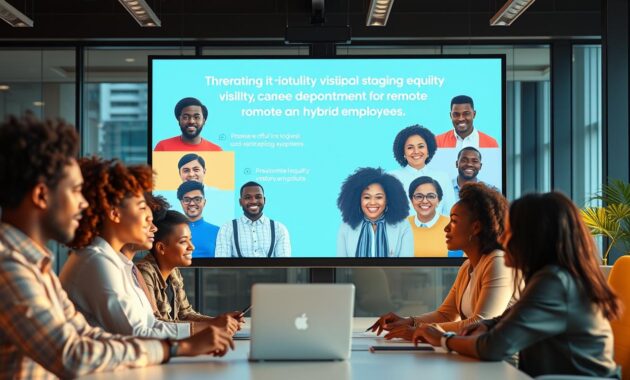
Mitigating proximity bias with transparent criteria and outcomes
Publish promotion criteria. When the bar is visible and tied to outcomes, location matters less than results.
Use objective evidence: dashboards, OKRs, and artifacts make evaluation fairer. Train management to watch who gets airtime and stretch assignments, then correct patterns.
Rituals for recognition: demos, changelogs, and kudos channels
Make recognition public. Demo days, shared changelogs, and a kudos channel turn invisible wins into shared knowledge.
Honestly, public rituals also improve communication and lift morale. Team members who lead demos gain presence and credit that stays in the record ChatGPT Marketing.
Career pathways: remote leadership roles and cross-functional projects
Create explicit leadership tracks that do not require office hours. Give cross-functional projects to distributed talent to grow scope and showcase potential.
Teach narrative skills so workers can link tasks to business impact. That makes promotion decisions easier and more equitable.
| Practice | Why it helps | Who benefits |
|---|---|---|
| Published promotion rubric | Reduces bias; ties to measurable outcomes | All employees |
| Visible artifacts (dashboards, changelogs) | Provides objective evidence during reviews | Remote workers & on-site workers |
| Public recognition rituals | Builds reputation and social capital | Team members and managers |
| Remote leadership tracks | Creates access to strategic roles without geography | Skilled workers across locations |
Bottom line: Equity is a design choice. When companies tie promotion to outcomes and make wins visible, professional development becomes fairer and more predictable.
Health, satisfaction, and sustainable remote work practices
Small rituals at the start and end of the day protect focus and personal time. I’ve seen people blur work hours and then burn out. Simple design choices reverse that trend.
Designing dedicated zones and start/stop rituals
Your space shapes how you work. A dedicated home corner or a clear home office signals the brain to focus, EDU site for answer hacks.
Start rituals matter: a checklist, a short walk, or closing the laptop with intent helps set boundaries. Guarding work hours keeps energy for deep tasks and life outside the office.
Social connection: virtual coffee, communities, and periodic meetups
Isolation is common—61% reported feelings isolation—so connection must be intentional. Schedule short virtual coffees, join community channels, and plan occasional meetups.
- Turn off noncritical notifications after hours to reduce digital creep.
- Managers: protect lunch and avoid stacking late meetings across time zones.
- Share resources: mental health links, movement prompts, and ERG groups help employees feel supported.
| Practice | Benefit | Who gains |
|---|---|---|
| Dedicated workspace | Faster focus, clearer boundaries | All workers |
| Start/stop rituals | Protected evenings and better recovery | Employees & team leads |
| Planned social rituals | Less isolation, stronger culture | Distributed teams |
Conclusion
What matters now is not where you sit but what you deliver and how you make it visible.
I’ve seen data and practice align: 68% preferred flexible roles in 2023, while 61% felt isolated and 56% worried about productivity. That mix makes design and equity nonnegotiable.
Make the invisible visible: publish clear goals, keep a changelog, and build a tight stack that supports async flow. Teams and managers who do this turn pressure into growth.
Companies that act will gain talent, cut footprints (PNAS notes up to 58% reduction), and compete better—especially when applicants outnumber listings nearly five to one. Invest in simple rituals, measurable outcomes, and steady training. Do that, and flexible models become a durable advantage, not a compromise.
FAQ
How has the shift to hybrid and remote models changed hiring and talent access?
What are the biggest barriers to equitable career progression for distributed employees?
How can teams prevent isolation and preserve social connection?
Which communication practices reduce misunderstandings and wasted time?
What tools and setups improve project visibility across distributed teams?
How should companies approach security and home-office risks?
What design choices distinguish remote-first from hybrid-by-default models?
How can individual contributors demonstrate impact when they’re not physically visible?
What management skills matter most for leading distributed teams?
How do companies support continuous learning and upskilling remotely?
What policies help address taxation, payroll, and interstate hiring in the U.S.?
How can organizations reduce tool fatigue and technology fragmentation?
What practices help prevent burnout in flexible schedules?
Are there measurable sustainability benefits from less commuting?
How do you create fair recognition systems for distributed teams?
Related Articles
- Remote Jobs: The Secret to Financial Freedom?
- Top 10 Remote Jobs You Can Start Today
- Remote Jobs Near Me: 9 Proven Tips to Kickstart Your Work-from-Home Career
- Remote Jobs Indeed: 4 Expert Tips to Land Your Dream Role Online
- Best Places to Work Remotely in 2025 – Top Companies Hiring Now!
- Work from Home Easy Jobs: 12 Best Remote Gigs for Quick Cash!
- Best Work From Home Jobs With No Experience – Top 11 Remote Careers Hiring Now!
- Amazon Work From Home Jobs

I’m Rodrigo Durães, founder of CareersForge — the world’s leading career platform — and recognized as one of the most comprehensive and experienced career and life coaches globally. With multiple academic degrees from the world’s top universities and over two decades of experience as a CEO, my mission is clear: to help people unlock their full professional potential through honest, strategic, and proven content.
656433 262264It can be tough to write about this topic. I think you did an excellent job though! Thanks for this! 587754